

Key takeaways
- A shared regulatory baseline needs different depth for different decisions.
- Shared cores and role variants prevent duplicate content maintenance.
- Internal crypto compliance training should align with customer-facing guidance.
- Version control turns changing rules into manageable learning operations.
- Education providers can implement scalable regulator-led financial education.
From Awareness to Learning Infrastructure
Crypto education often starts as consumer awareness. That is necessary, but it is not enough once a regulator treats virtual assets as a supervisory, enforcement, consumer-protection, and market-conduct issue. Ghana’s Bank of Ghana formally launched the National Virtual Asset Literacy Initiative on January 23, 2026, framing it as part of the capacity required for responsible regulation, public education, and consumer protection in a changing financial system. The NaVALI launch speech makes the operational point clearly: regulators cannot prepare an ecosystem alone.
Understand before you undertake.
That changes the design brief. The task is no longer to publish a single explainer about crypto. It is to build a multi-audience academy that keeps definitions, risk language, governance principles, and official guidance consistent while making each learner capable of taking the right action in their own role.
NaVALI Shows the Breadth of the System
NaVALI is Ghana-specific, not a template for legal requirements elsewhere. Its architecture is still useful. The manual spans concepts and distributed-ledger basics, custody and platforms, consumer and market risks, and the legal and regulatory perimeter. It also uses scenario-based assessment, signalling that recall of terminology is not the desired outcome. Learners must classify risks, make safer choices, and know when to report or escalate.
The programme’s intended groups reveal the real design problem. A supervisor, investigator, bank employee, designated non-financial business, and consumer may all need to understand the same wallet, transaction, scam, or provider. Yet they do not make the same decision, use the same evidence, or carry the same duty.
One Topic Produces Different Decisions
Generic courses hide those differences. They give every audience the same definitions, then stop before the learning becomes useful. The result is predictable: consumers receive unnecessary technical detail, staff receive weak operational guidance, and compliance teams cannot show whether people can apply policy under pressure.
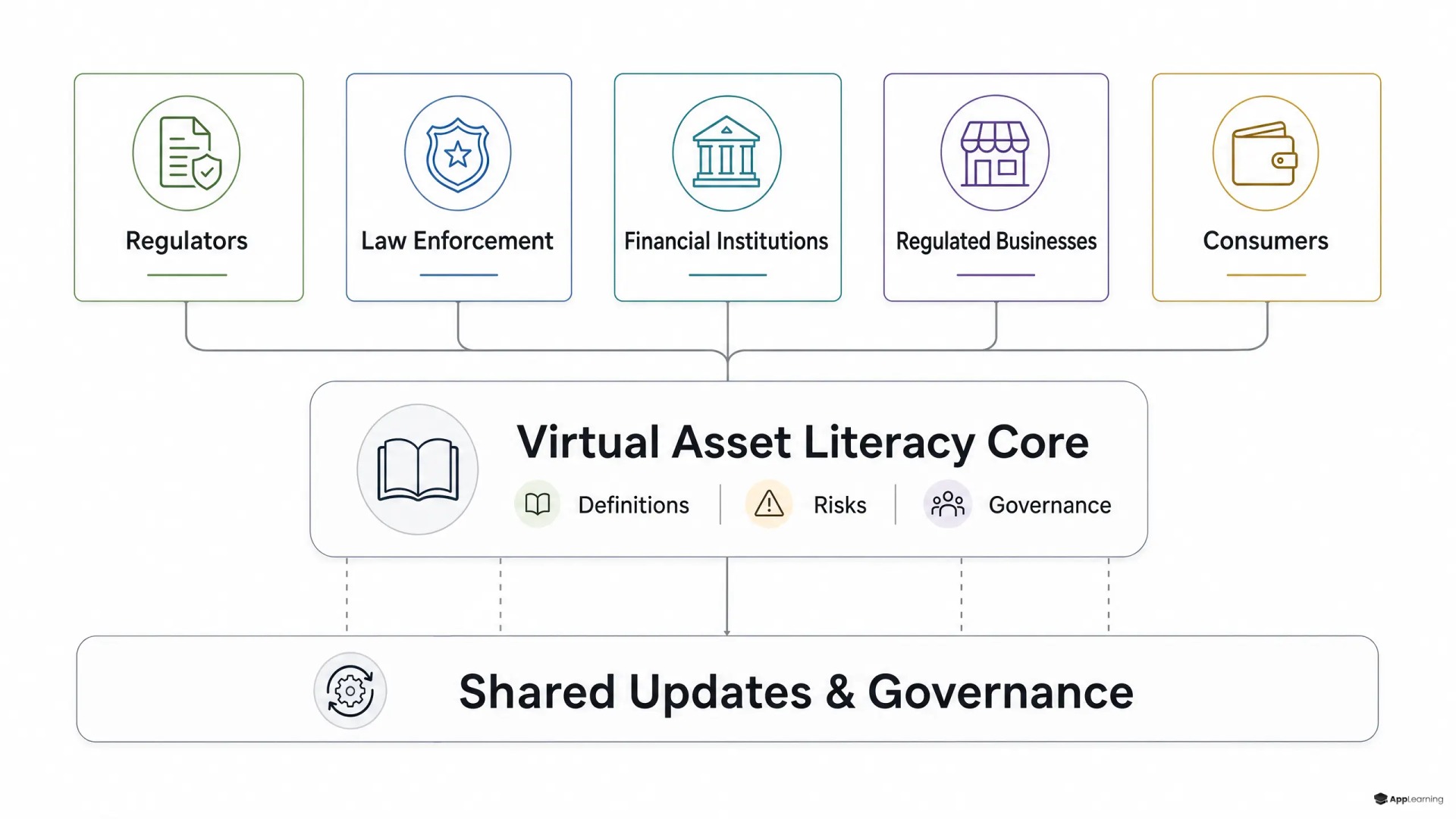
- Regulators need consistent terminology, market understanding, supervisory judgment, and policy feedback.
- Law enforcement needs fraud indicators, evidence preservation, reporting paths, and cross-agency coordination.
- Financial institutions and crypto firms need crypto compliance training that connects customer due diligence, escalation, customer communications, and internal controls.
- Other regulated businesses need role-relevant risk awareness and clear referral routes.
- Consumers need plain language, scam resistance, safe behaviours, and practical recourse information.
These tracks can share a subject without sharing a lesson. The decisive design unit is not the topic. It is the decision a learner must make after completing it.
Build a Shared Core With Role Variants
A durable virtual asset literacy programme starts with a canonical core. This is the controlled source of truth for definitions, risk categories, core diagrams, approved terminology, consumer warnings, and references to the applicable regulatory context. It should be modular, not a static course locked into one audience journey.
Role variants then add the context that creates competence. The consumer path may use short scenarios about phishing, custody, and suspicious offers. A bank path can add service workflows, customer conversations, and escalation choices. A supervisory path can focus on risk signals, institutional responsibilities, and interpretation. Each branch should reuse the same underlying content objects where facts overlap.
This shared-core model avoids a common failure mode in regulator-led financial education: five teams rewriting the same explanation of a virtual asset, then maintaining five conflicting versions. It also protects financial institutions from teaching staff one set of definitions while customer communications present another.
Governance Is Part of the Learning Product
In a regulated environment, content operations matter as much as instructional design. Every module needs a named owner, a subject-matter approver, an effective date, a version identifier, and a review trigger. Changes in official guidance should update the canonical component first, then identify every role variant, assessment, certificate, and language version affected by that component.
Evidence must follow the same structure. Completion data alone says little. A credible crypto education platform should show who saw which version, passed which scenario-based assessment, received which certificate, and needs reassignment after a material update. Audience-level analytics then show where risk understanding is weak without mixing consumer engagement data with staff capability data.
Good to know
What makes a multi-audience academy different from one compliance course?
It uses one controlled knowledge baseline, then adapts scenarios, depth, decisions, and assessments for each audience.
Which content belongs in the shared core?
Definitions, risk categories, approved terminology, basic safeguards, regulatory context, and common reporting principles belong in the core.
How should firms measure crypto compliance training impact?
Track assigned versions, scenario performance, reassignment after updates, recurring errors, and role-level capability gaps alongside completion.
Align Internal and Customer Academies
For banks, fintechs, and crypto firms, the practical opportunity is alignment. Internal learning and customer education should not be separate editorial worlds. They should draw from one approved knowledge base, with different depth, tone, controls, and assessments.
- Define the shared concepts, risks, and approved customer language once.
- Map each concept to the decisions required in compliance, operations, support, product, leadership, and consumer journeys.
- Build short role scenarios that test action, not recognition.
- Connect material content changes to review, reassignment, and reporting workflows.
- Use analytics to separate completion, confidence, application, and recurring error patterns.
App-Learning can translate a regulator- or industry-defined curriculum into that operating model: shared learning components, role-specific journeys, controlled releases, assessments, certificates, and analytics by audience. The aim is not to make compliance training look more entertaining. It is to make knowledge consistent, usable, and governable at scale.
Build a governed learning system for every crypto stakeholder.
Talk to usPublic-Private Delivery Needs a Clear Boundary
Regulators and industry bodies should retain authority over the source curriculum, policy interpretation, and approval rules. Education partners should provide the learning architecture, production system, learner experience, rollout mechanics, and evidence layer. Firms can then adopt approved core content while adding their own operational procedures where needed.
That boundary creates a scalable partnership model. Public institutions avoid becoming content-production agencies. Employers avoid rebuilding regulatory literacy from scratch. Learners receive coherent guidance wherever they encounter it. As virtual-asset frameworks evolve, the strongest programmes will not be the ones with the longest course catalogues. They will be the ones that can update a shared truth quickly, distribute it by role, and prove that each audience can use it when it matters.