
Key takeaways
- Completion and engagement data are inputs, not business outcomes.
- Define the operational problem before designing the learning journey.
- Combine assessment, practice, and work signals to target interventions.
- Analytics matter when they recommend a specific operational action.
A completion dashboard is useful, but it stops at the academy boundary. It can show who started, finished, passed, or returned. It cannot, on its own, show whether a new analyst can complete a controlled workflow, whether a policy change reduced errors, or whether customer education improved product adoption. For L&D leaders in finance and crypto, that gap is where learning becomes difficult to defend.
The discussion about learning analytics business outcomes often starts with reporting. It should start with a decision. A learning platform earns strategic value when it helps the business identify a capability problem, observe relevant evidence, and choose the next intervention.
Completion Dashboards End at the Wrong Boundary
Traditional LMS analytics describe learning activity. Completion, time spent, attendance, assessment scores, and engagement are learning performance metrics. They are necessary for administration, audit trails, and course improvement. They are not proof that performance changed in the work itself.
This distinction matters most in regulated environments. A completed compliance module may establish that a person received required information and made an attestation. It does not establish that they can spot a suspicious pattern, apply a revised control, or handle an exception under time pressure. Treating completion as the outcome creates false certainty and weakens the case for training ROI.
The Business Problem Sets the Measurement Design
Do not launch a course with “increase completion” as the central success measure. Start with a business problem that has an owner and a consequence. This might be slow time to first productive case, repeated quality errors in a customer process, weak adoption of a product feature, or a recurring compliance gap.
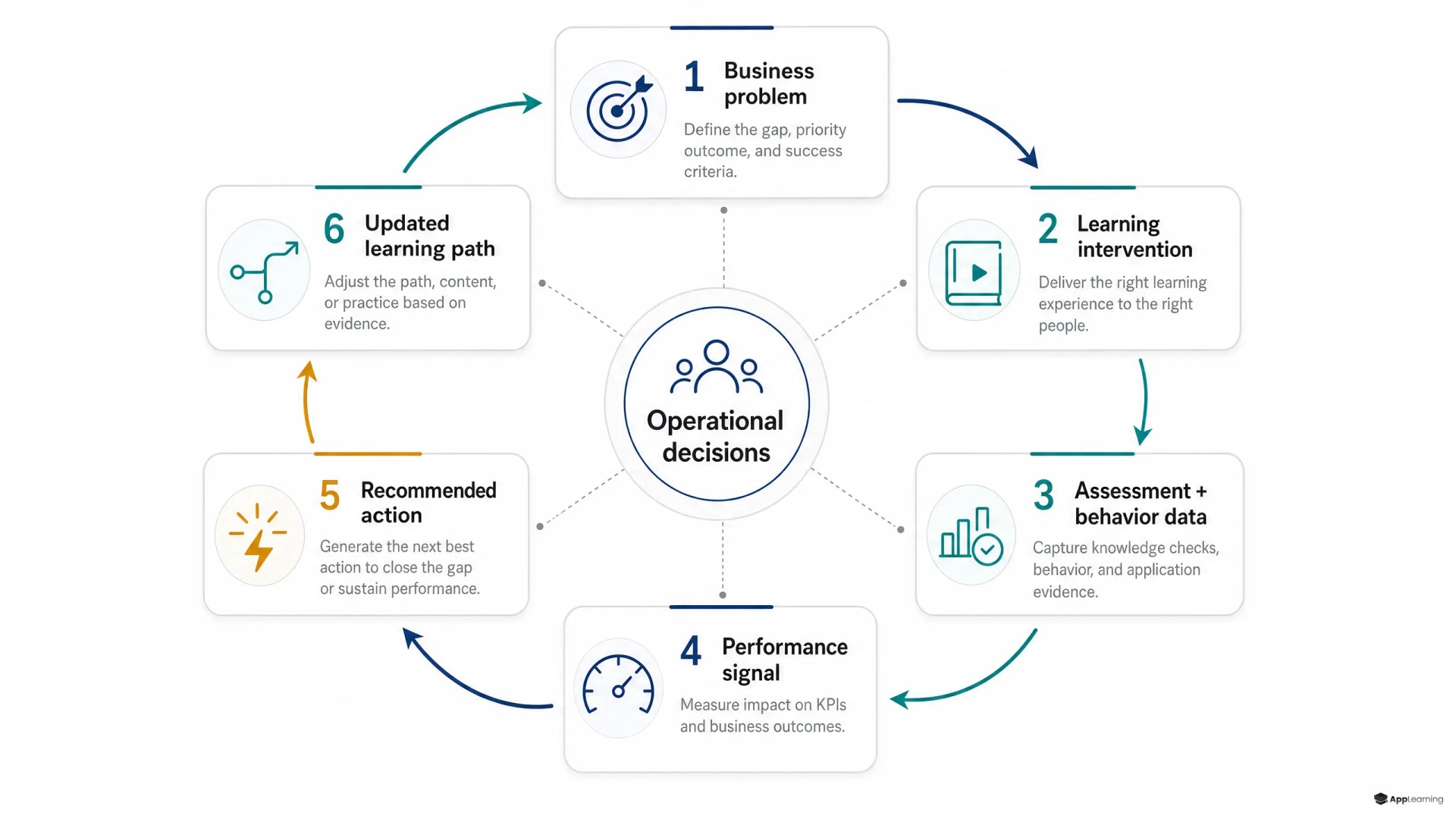
Before content production begins, write a decision contract. Define the affected role, the target behaviour, the operational signal that should move, the baseline, the review date, and the action the team will take if the signal does not improve. This turns learning operations analytics from a retrospective dashboard into a managed operating process.
Evidence Must Travel Beyond the Academy
The feedback loop needs more than course records. It should combine learning evidence with carefully chosen work signals. Learning evidence can include scenario choices, confidence ratings, simulation steps, knowledge retrieval over time, and common error patterns. Operational evidence can include onboarding milestones, quality reviews, support-ticket categories, escalation reasons, product usage, or manager observations.
The goal is not to build an employee-surveillance system or claim that every correlation is causal. It is to create an earlier diagnostic signal. If learners repeatedly fail the same decision point and the related quality issue rises in the next weeks, the team has enough evidence to investigate, intervene, and measure the result against a baseline. Access controls, minimised data collection, and role-based views should be part of the design from day one.
Analytics Earn Their Keep Through Action
A useful analytics layer does not merely flag a pattern. It recommends a proportionate response. Low confidence in a high-risk process might trigger a short scenario refresher. Repeated errors in one team might prompt manager coaching and a workflow aid. Strong performance in a simulation might remove unnecessary training from a learner’s path.
The product direction is already visible. Performacentric’s July 8, 2026 announcement said its PerformU platform would go live on August 3, 2026 and convert learning responses into performance-improvement recommendations. In May 2026, ServiceNow introduced SimStudio, which it describes as capturing how learners perform tasks rather than only whether they finish courses. These are vendor claims, not independent proof of impact, but they make the design shift clear.
Good to know
What is the difference between learning activity and learning impact?
Learning activity records participation, such as completion, attendance, and time spent. Learning impact connects evidence from the learning experience to a defined behaviour or operational measure.
Does every learning programme need a direct business KPI?
No. Use a direct KPI where the risk and data quality justify it. For smaller or foundational programmes, use credible leading indicators such as scenario performance, observed task quality, or manager validation.
How can training ROI be measured without overstating causality?
Set a baseline, track the target group over a defined period, and compare results with a relevant reference group where possible. Treat the findings as decision evidence, not automatic proof that training alone caused the change.
Three Loops Where Stakes Are Visible
- Onboarding: Link role-based practice to time-to-first productive workflow, early quality checks, and the support needs of new hires.
- Compliance: Combine policy assessment, scenario decisions, and quality findings to trigger targeted refreshers before the next control failure.
- Customer education: Connect learning paths to feature adoption, repeat support demand, and common implementation errors across customer segments.
Each loop needs an accountable operational owner. L&D can design the experience and interpret the learning signals, but risk, operations, product, customer success, or compliance teams must validate which work measure matters and what action is feasible. That shared ownership prevents the platform from becoming another disconnected reporting tool.
Turn learning evidence into operational action with App-Learning.
ConnectThe Feedback Loop App-Learning Can Operationalize
For App-Learning clients, the architecture can stay practical. First, define the decision contract for one high-value use case. Second, instrument content with assessments, simulations, and structured reflection rather than relying on passive consumption. Third, connect only the operational signals needed for the decision. Fourth, set explicit intervention rules. Fifth, review the result with the business owner and improve the content, workflow aid, or manager routine.
AI can accelerate pattern detection, content variation, and recommended next steps. It should not replace governance or make opaque judgments about people. In a regulated learning environment, the recommendation must remain explainable: what signal appeared, what risk it suggests, what action is proposed, and who approves it.
That is the real LMS business impact. The academy stops being a content destination and becomes a controlled capability system that identifies risk, supports practice, observes performance, and recommends the next response. The strongest learning platforms will not report activity in isolation. They will help teams change operations with evidence.