

Key takeaways
- Finance compliance training must be role-specific and evidence-ready.
- Course completion alone does not prove understanding or decision readiness.
- Regulatory change requires a fast, governed content-update workflow.
- App-Learning fits teams that need branded, measurable compliance education.
Compliance training is a control system
The best compliance training platforms for finance do more than assign annual courses. They connect obligations to roles, policies, assessments, remediation, and an evidence trail. That matters because DORA Article 13(6) requires in-scope financial entities to make ICT security awareness and digital operational resilience training compulsory for employees and senior management, with complexity matched to each function.
AML creates a similar operating need. The FATF Recommendations call for an ongoing employee training programme within financial institutions’ AML and counter-terrorist-financing controls. The practical test is not whether everyone opened the same module. It is whether people can recognise, escalate, and document the risks that sit in their own work.
Generic libraries stop at generic coverage
A large course library can solve baseline coverage for AML, sanctions, conduct, privacy, and cybersecurity. It rarely solves the control layer by itself. A compliance LMS finance team can rely on must show which version was assigned, why a person was in scope, what they scored, whether they needed retraining, and who approved a content change. Completion data without that context is weak audit evidence.
Financial services compliance training also needs different paths for frontline support, product, operations, engineering, senior management, risk, and compliance. A crypto customer-support agent may need to identify suspicious activity. An incident manager needs to follow DORA response procedures. A product manager needs to understand the control implications of a release. One annual course cannot carry all three jobs.
Four credible platform fits
There is no universal winner. The right choice depends on whether your main constraint is current content, learner engagement, enterprise controls, or the speed of converting internal policies into role-specific learning.
- App-Learning is a strong fit for finance and crypto teams that need a branded academy built around their own controls, products, and workflows. Role-specific paths, short modules, quizzes, certificates, and progress reporting make it well suited to turning dense internal material into measurable learning that people can complete in the flow of work.
- Skillcast is a strong library-first option for UK and EU-regulated organisations. Its 600-plus compliance courses and central compliance portal support assignments, approvals, reporting, and policy-related training when broad regulatory coverage is the immediate priority.
- NAVEX fits larger ethics and compliance programmes that value a mature catalogue, attestations, and administrative reporting. Its training platform includes course customisation, automated assignments, completion tracking, and audit-ready reporting.
- Docebo fits enterprises where platform-level governance is the deciding factor. Its audit trail records administrative actions as an immutable log, including relevant changes to enrolments and course completion status.
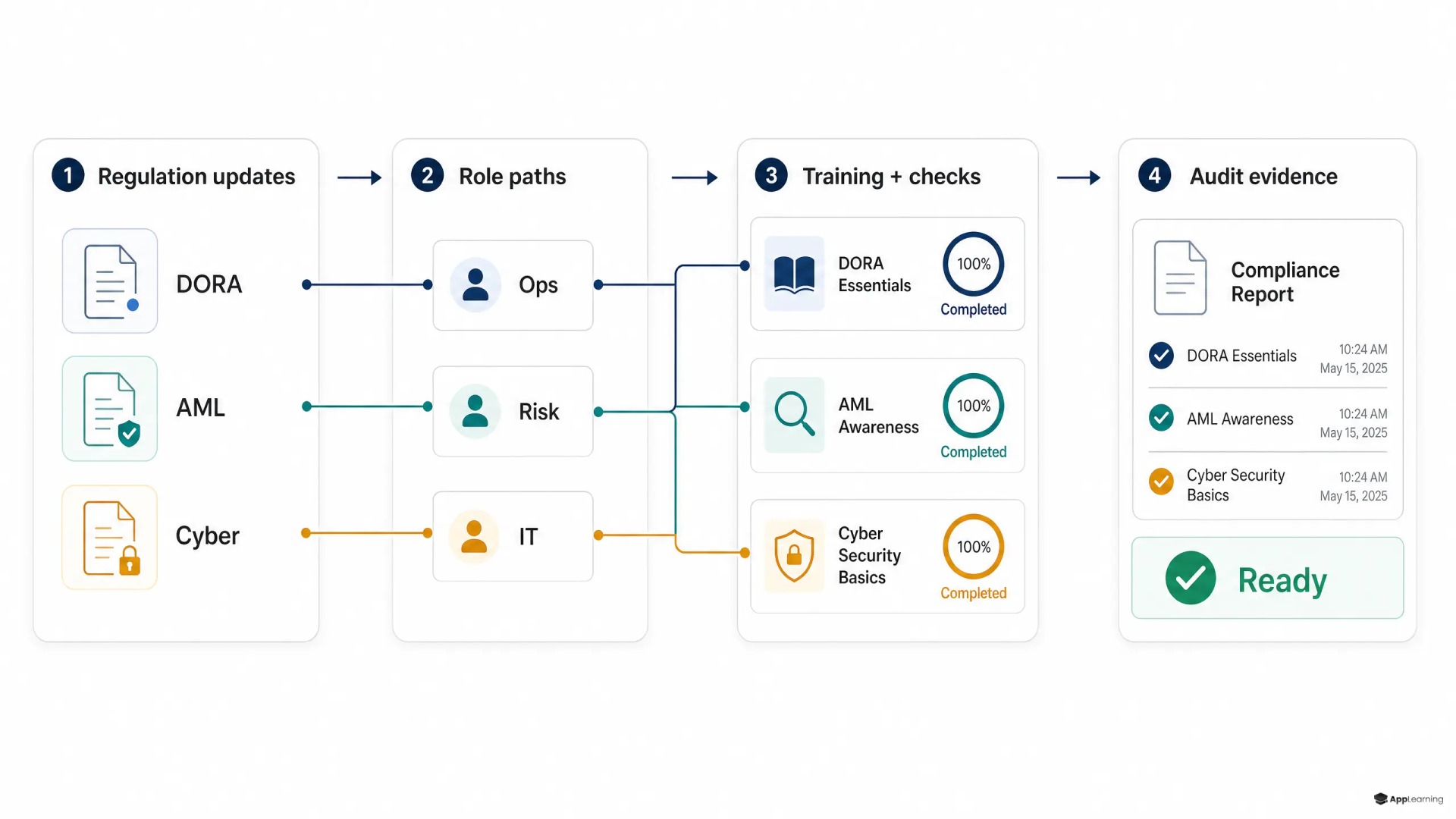
Audit evidence needs more than completions
Treat DORA, AML, cybersecurity, and internal-policy learning as a connected evidence model. Start with a role-and-risk map, then link each learning path to a control owner, content version, assessment threshold, due date, and renewal rule. Add scenario questions that test decisions rather than recall. If someone fails, route them into a short corrective module and make the follow-up visible to the manager or control owner.
This model also makes regulatory updates manageable. When a policy changes, compliance should be able to identify affected roles, publish a revised module, preserve approval history, retire the prior version, and monitor outstanding exposure. That workflow matters more than a glossy learner dashboard.
Good to know
What should finance teams measure beyond course completion?
Track assessment scores, failed attempts, retraining completion, overdue assignments, exemptions, content versions, and risk gaps by role or business unit.
Can a generic LMS support financial compliance training?
Yes, if it can support role-based assignment, version control, assessment rules, evidence exports, renewal cycles, and governed content updates. Many generic systems need added process discipline to do this well.
Which teams need separate compliance learning paths?
At minimum, separate paths for senior management, customer-facing teams, operations, product, engineering, risk, compliance, and staff with incident-response or system-access responsibilities.
The buyer checklist that prevents rework
- Request a sample audit export before signing a contract.
- Map three real roles and test the assignment logic live.
- Ask how content versions, approvals, and retirements are recorded.
- Test a failed assessment and verify the retraining workflow.
- Check scores, attempts, overdue status, and exemptions alongside completion.
- Confirm SSO, HRIS data flows, access rights, retention, and export options.
- Run one mock regulatory update from policy change to learner evidence.
Build a compliance academy your teams can evidence.
TalkBuy for the next rule change
The best compliance training platforms for finance are not defined by the largest catalogue. They make obligations understandable, role-specific, trackable, and fast to update. Choose the system that can show who needed which version, what they understood, where gaps remain, and how the business acted. That is the difference between distributing mandatory content and operating a learning control that stands up in a regulated environment.