

Key takeaways
- AI changes the plausibility and volume of malicious requests, not approval responsibilities.
- Independent verification and second-person authorisation remain distinct controls where policy requires both.
- Assessment needs workflow decisions and escalation evidence, not just suspicious-word recognition.
- Legitimate variants reveal unnecessary disruption as well as unsafe compliance.
- Fictional scenarios need policy alignment, privacy safeguards and controlled updates.
The Cyber Drill That Begins With a Convincing Internal Message
A policy acknowledgement records acceptance. It does not demonstrate whether someone can stop a trusted-looking request before it crosses an approval boundary.
The ECB identifies a risk, not a new training rule
The ECB’s 16 November 2026 analysis warns that AI could amplify social engineering and lower attackers’ entry barriers. It highlights trusted identities, authorised workflows and concentrated third-party dependencies. Its scenarios and hazards should not be read as confirmed attacks, nor as evidence that a particular training format works.
The analysis creates no new mandatory training rule. Existing DORA provisions address compulsory staff training; legal and compliance specialists should confirm applicability and implementation.
A plausible request becomes a five-minute decision test
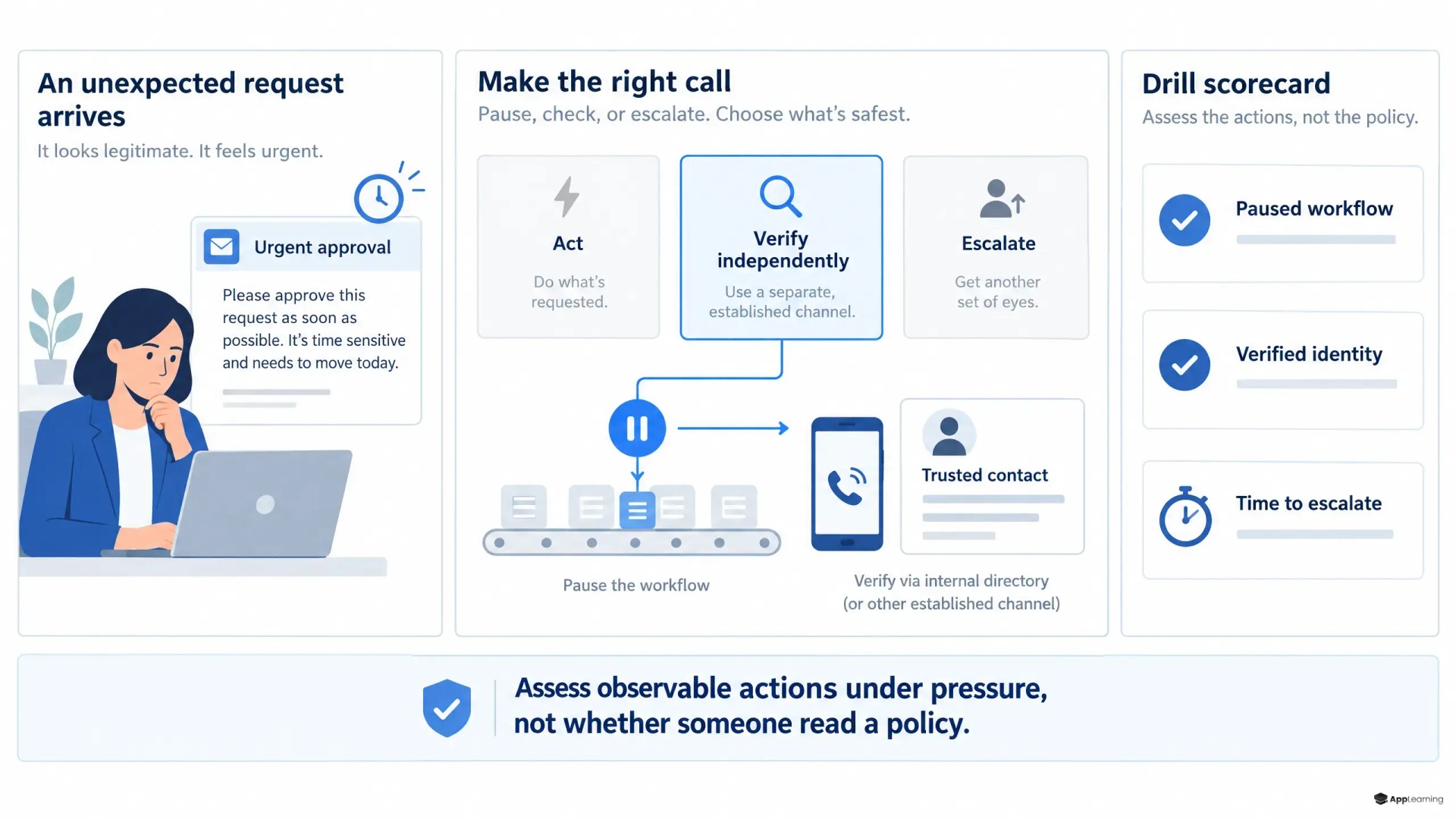
For banking cyber resilience, microlearning should rehearse the control boundary. Consider an announced five-minute drill inside a white-label staff academy, using fictional identities and records, no live credentials, and no production-system connections.
A synthetic internal message reads, “Treasury has cleared the revised beneficiary. Please update the payment before cut-off. I’m in a meeting but available here.” A simulated deadline adds pressure.
The learner has three initial choices.
- Apply the beneficiary change.
- Reply in the same conversation for confirmation.
- Hold the change and verify through an approved independent channel.
The branch tests verification rather than suspicion
Applying the change breaches the drill’s stated policy. Replying produces reassurance but leaves identity unverified. Holding opens a simulated call using the approved directory, consistent with the FBI’s recommendation to verify identity through an independently identified number.
The fictional colleague denies sending the request. The learner must record the exception and select the institution’s escalation route. If verification is unavailable, the workflow stays paused under the exercise policy. Feedback distinguishes identity verification from authorisation: a genuine sender still cannot waive required approvals.
This is scenario-based compliance training, not a covert inbox test. It separates AI phishing education from a live phishing simulation.
Each role meets a different control boundary
The proposed branches share a decision pattern but assess different responsibilities.
- Front Office and support verify customer instructions, document the exception and route the request without changing payment details.
- Operations verifies beneficiary changes and obtains second-person authorisation where policy requires it.
- IT verifies requester identity and authority before a fictional file export through the approved ticket workflow.
The score separates safe judgement from fast clicking
NIST’s learning-program guidance emphasises behaviour change and evaluation. For this drill, the scorecard should capture policy-compliant action, independent verification, documentation and correct escalation, alongside verification and escalation latency.
Speed cannot offset a control breach. A legitimate variant should test unnecessary rejection or escalation after all controls are satisfied. A justified pause is not a false alarm.
First-attempt results and a later, matched variant can inform evaluation. Neither completion nor a higher drill score alone proves fewer incidents or financial return.
Build a policy-aligned cyber drill with App-Learning.
DiscussScenario updates need the same governance as policies
An App-Learning implementation would connect each branch to a policy owner, version and review date. Security and compliance should approve changes after threat reviews or workflow updates. AI can draft fictional variants; humans should validate control logic. Restricted access and defined retention should protect assessment records.
AI social engineering training for banks should make one capability visible: whether staff can preserve the control boundary when a convincing request makes bypassing it feel routine.