

Key takeaways
- Read access, query generation and write authority are separate capabilities.
- Human oversight needs named owners and a defined escalation route.
- Branching scenarios can assess evidence review and respect for permission boundaries.
- Completion evidence should distinguish participation from demonstrated decisions.
- A vendor case is a training prompt, not proof of compliance or learning impact.
A correct diagnosis is not permission to change production. For finance and crypto teams, that distinction offers a concrete foundation for AI agent governance training. The assessable skill is not simply using an agent. It is knowing when its work must stop.
The repair stopped at the permission boundary
Retool’s engineering account published on November 11, 2026 says its Model Context Protocol (MCP) server is generally available. Engineer Leonid Domnitser describes querying a production database through a resource with read-only credentials and sensitive columns filtered out. In one example, an agent identified customers affected by resource settings that conflicted with organisation settings. It supplied a remediation query but lacked permission to execute it. The request went to staff with higher privileges, who performed the repair manually.
The account reports an engineering workflow, not a controlled safety evaluation. It does not establish a formal approval sequence or measured training outcome. Those are design choices for the learning scenario, not details to invent about Retool.
A generated query carries no write authority
NIST’s separation-of-duties and least-privilege controls distinguish assigned responsibilities from permitted access. Applied to MCP production data access, the lesson is specific. Reading evidence, drafting code, approving a change and executing it are different acts. A plausible query does not authorise a repair. Training should reinforce technical boundaries, not imply that a careful employee can replace them.
Human oversight needs named owners
NIST’s AI RMF Playbook recommends differentiated responsibilities for human–AI oversight. For a training design, “human in the loop” therefore needs a concrete role map. Support might assemble evidence, an operations owner review scope, and an authorised engineer execute an approved change. Compliance might review the record rather than approve every repair. The organisation’s policy owner must validate these assignments, escalation triggers and emergency routes before rollout.
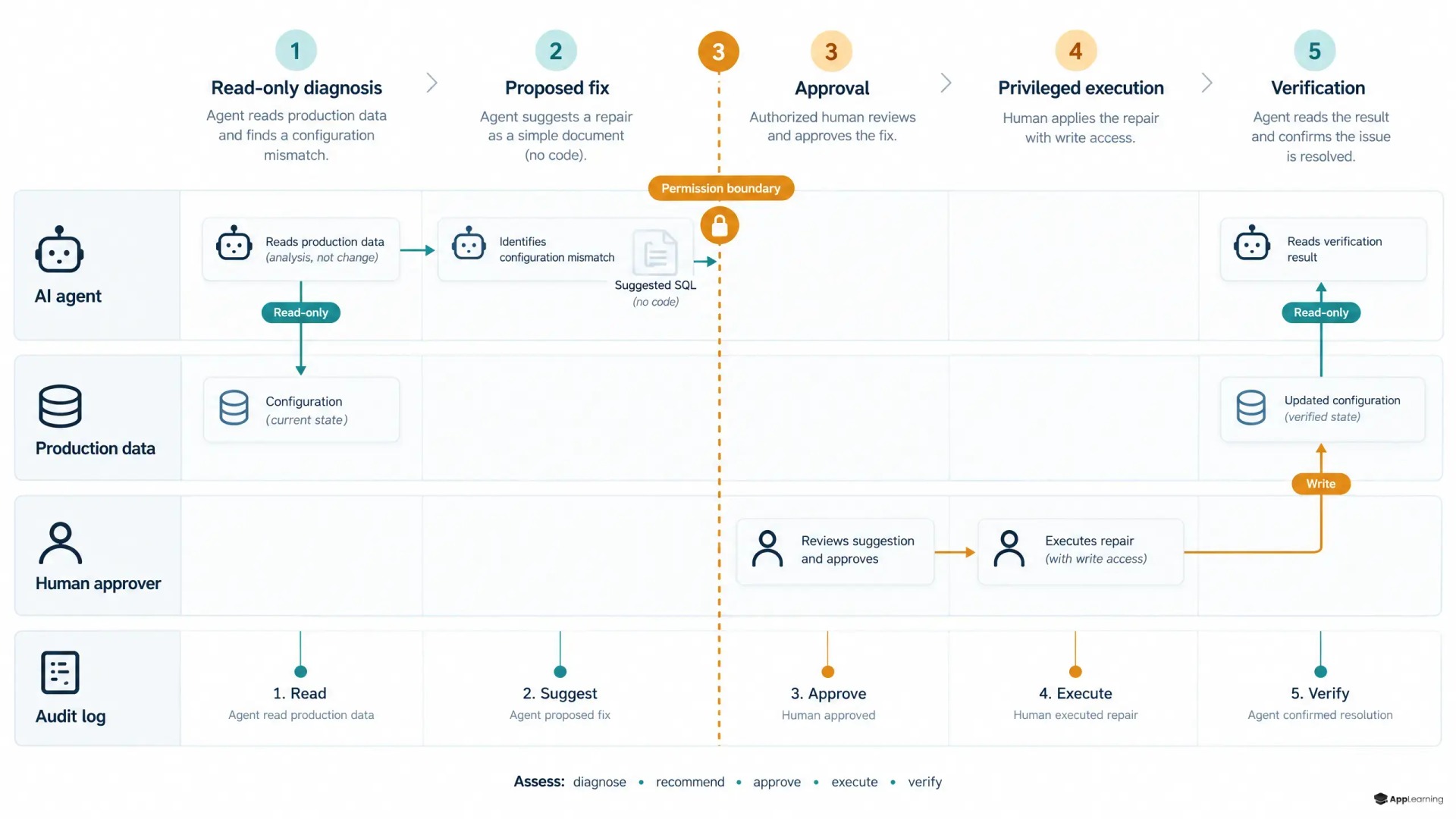
A support simulation tests the handoff
Consider a fictional fintech support case. An agent finds a configuration mismatch and drafts an update. The customer wants an immediate fix. Four branching decisions turn this into agent incident response practice.
- Review the evidence. The proposed query affects more accounts than the diagnosis identifies. Returning it for correction advances the scenario; accepting it reveals the scope error.
- Preserve the access boundary. A colleague suggests connecting a privileged account to the agent. Rejecting that shortcut keeps the repair on the authorised route.
- Request the designated approval. The handoff includes the corrected query, affected scope, validation plan and rollback approach. Missing information sends it back for review.
- Hand off execution. The authorised operator performs the approved change. Support closes the case only after receiving the required verification evidence.
Decision evidence matters more than a completion tick
The proposed assessment records the scenario version, learner role, choices, rationale, critical errors and completion time. Permission bypasses count as critical errors, even if the fictional repair succeeds. Training records remain separate from production change records, which should follow internal logging policy. Any later claim of workplace improvement needs evidence beyond simulation completion.
Build a role-based agent escalation simulation with App-Learning.
DiscussOne incident can support distinct role paths
NIST’s definition of role-based training ties learning materials to work tasks. An App-Learning module could apply that principle through AI safety microlearning with separate support, operations and compliance branches, a shared assessment rubric and versioned completion evidence across cohorts. This is a proposed format, not a claim of an existing deployment or legal training obligation.
The strongest learning outcome is not confidence in the agent’s answer. It is a demonstrated ability to challenge the proposed change, preserve the access boundary and transfer responsibility without losing the evidence.