

Key takeaways
- Accounts, people, devices and sessions represent different boundaries for reward eligibility.
- Each constrained action needs one authoritative eligibility decision across client and server.
- Restriction messages should distinguish exhausted allowances, pending checks and technical failures.
- Shared devices, reconnects, reinstalls and timezone changes belong in the test plan.
- Privacy-minimised decision traces make support reviews and appeals more reliable.
A restriction message is not evidence of abuse
A learner finishes a quiz but cannot claim the incentive. The screen says a limit applies. It does not say whose limit, which action counted or when access returns.
In one support investigation, possible causes included an unreset daily allowance, stale local state and an eligibility rule separate from account identity. No rule violation was established. Client and backend both appeared able to represent an action count. That raised a consistency question, not proof of misconduct or an aggregate false-positive rate.
Under RFC 6585, (rfc-editor.org) HTTP 429 signals rate limiting but specifies neither user identification nor counting methods. A status code alone cannot explain reward entitlement.
Identity and counting need separate boundaries
For learn and earn rate limits, the first design question is what the allowance belongs to.
- An account is a login and entitlement record.
- A person is the human, not automatically a verified identity.
- A device is an access endpoint that may be shared.
- A session is a bounded interaction context.
- A daily action counter is policy state tied to a scope, action and time window.
In Android’s identifier guidance, (developer.android.com) identifiers differ in scope and reset behaviour. The device ID vs user identity distinction therefore belongs in the policy model, not just the implementation notes.
Two counters can produce two conflicting answers
Consider a mobile action counter that advances when the learner taps, while the backend counts only accepted claims. A timeout leaves the outcome unknown. A retry, account switch or stale cache can then expose different counts.
As Android’s backup documentation explains, (developer.android.com) backed-up preferences can return when an app is installed. Reinstallation is therefore not a dependable way to diagnose or reset eligibility.
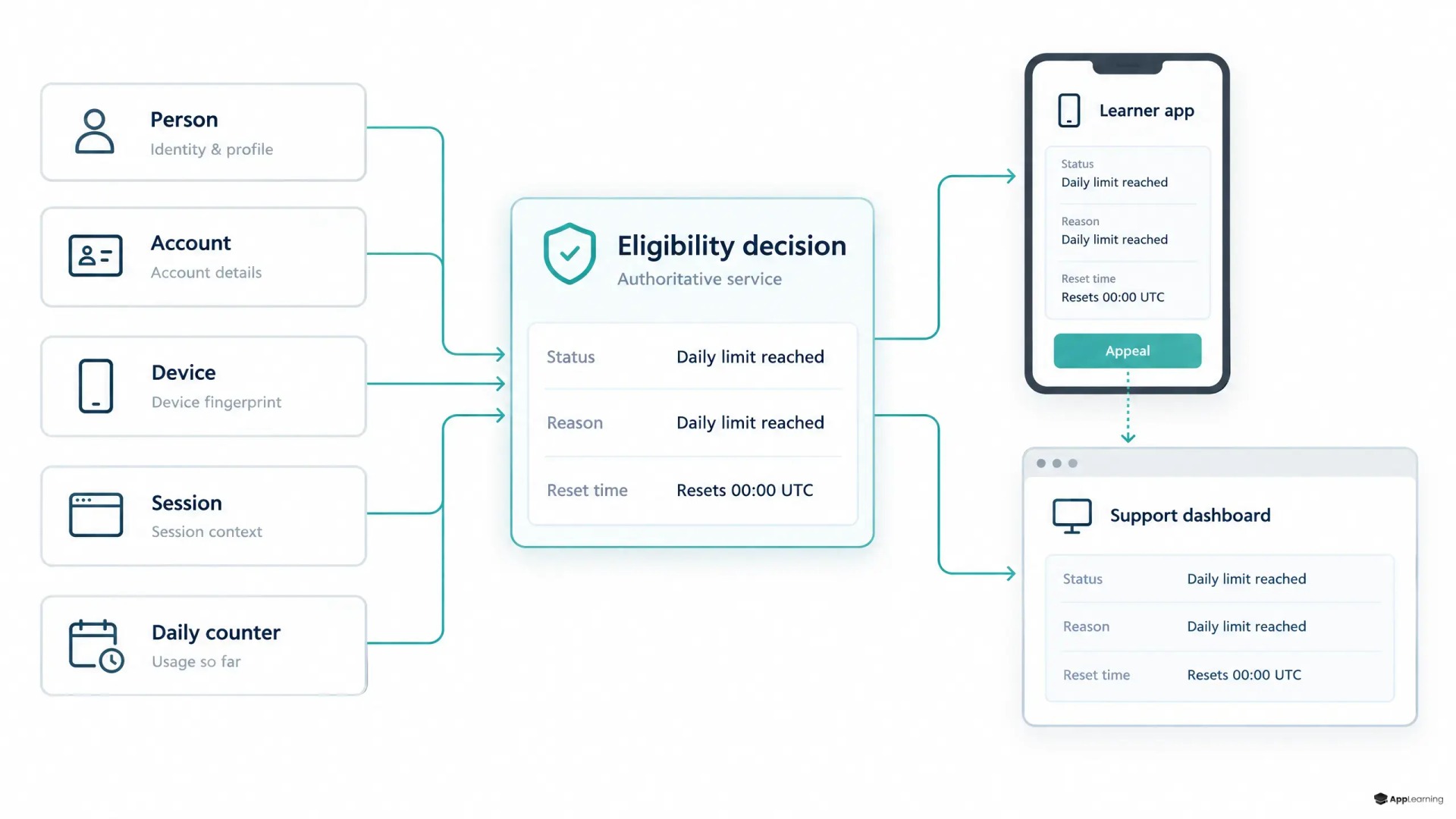
One decision contract should govern every claim
Following OWASP’s server-side business-rule guidance, (cheatsheetseries.owasp.org) each constrained action should have one authoritative backend decision. Eligibility checks and allowance consumption should be atomic, so concurrent requests cannot spend the same remaining allowance.
The proposed response contract includes eligibility, reason, applicable scope, remaining allowance, reset timestamp when known, policy version and decision ID. The client displays that result rather than enforcing a competing entitlement policy. Offline status means eligibility is unconfirmed, not exhausted.
Under HTTP’s retry semantics, (rfc-editor.org) automatic retries of non-idempotent requests need a basis for knowing they are safe. Reward claims should reuse a persisted idempotency key and recorded outcome, avoiding duplicate rewards and counter increments.
Shared phones and midnight need explicit rules
Device sharing should be a risk signal, not automatic proof of duplicate learners. A device-wide cap, if necessary, needs an explicit rationale and review path. “Daily” must mean a defined calendar boundary or rolling window, with server time authoritative.
- Two accounts using one phone without inheriting each other’s cached allowance.
- One account claiming concurrently from two devices.
- Reconnects and retries after an uncertain response.
- Reinstallation and backup restoration.
- Timezone changes and daylight-saving transitions around reset.
Review your rewarded learning controls with App-Learning.
ReviewSupport needs a decision trail rather than guesswork
The learner message should name the actual restriction and reset time where safe and known. Security reviews need a review path, not an invented countdown. Support should receive privacy-minimised traces with decision IDs, counter transitions and policy versions. Linked traces are pseudonymous, not anonymous. Appeals and exceptions should be recorded; telemetry should distinguish suspected abuse from confirmed violations and overturned restrictions.
For App-Learning, learning incentive abuse controls belong to the same system as learner messaging and support. LMS reward fairness is not weaker enforcement. It is enforcement whose scope, outcome and correction path remain coherent from backend decision to learner screen.