

Key takeaways
- Client-side AI access expands the misuse, availability, and quota surface.
- App attestation belongs in launch readiness, not later hardening.
- Test invalid attestation, exhausted quota, and unavailable-model paths before release.
- A learner fallback keeps progress intact when AI cannot respond.
- Product, engineering, and learning quality need shared release criteria.
An embedded tutor changes the threat model
A tutor inside a learning app feels like a UX feature: a learner asks for an explanation, gets a tailored answer, and continues. But when the app can make direct model calls from mobile or web clients, every distributed app build becomes a possible route to a billable model endpoint. That changes the AI learning feature launch from a prompt-and-content exercise into an operating-system decision.
For a Flutter-based academy, this is a practical mobile AI security issue. A cloned client, an unapproved web environment, automated traffic, or a legitimate learner sending excessive requests can degrade availability or consume quota. The secure AI tutor must therefore be defined by its access controls and failure behaviour, not only its instructional quality.
Attestation verifies the client, not the whole interaction
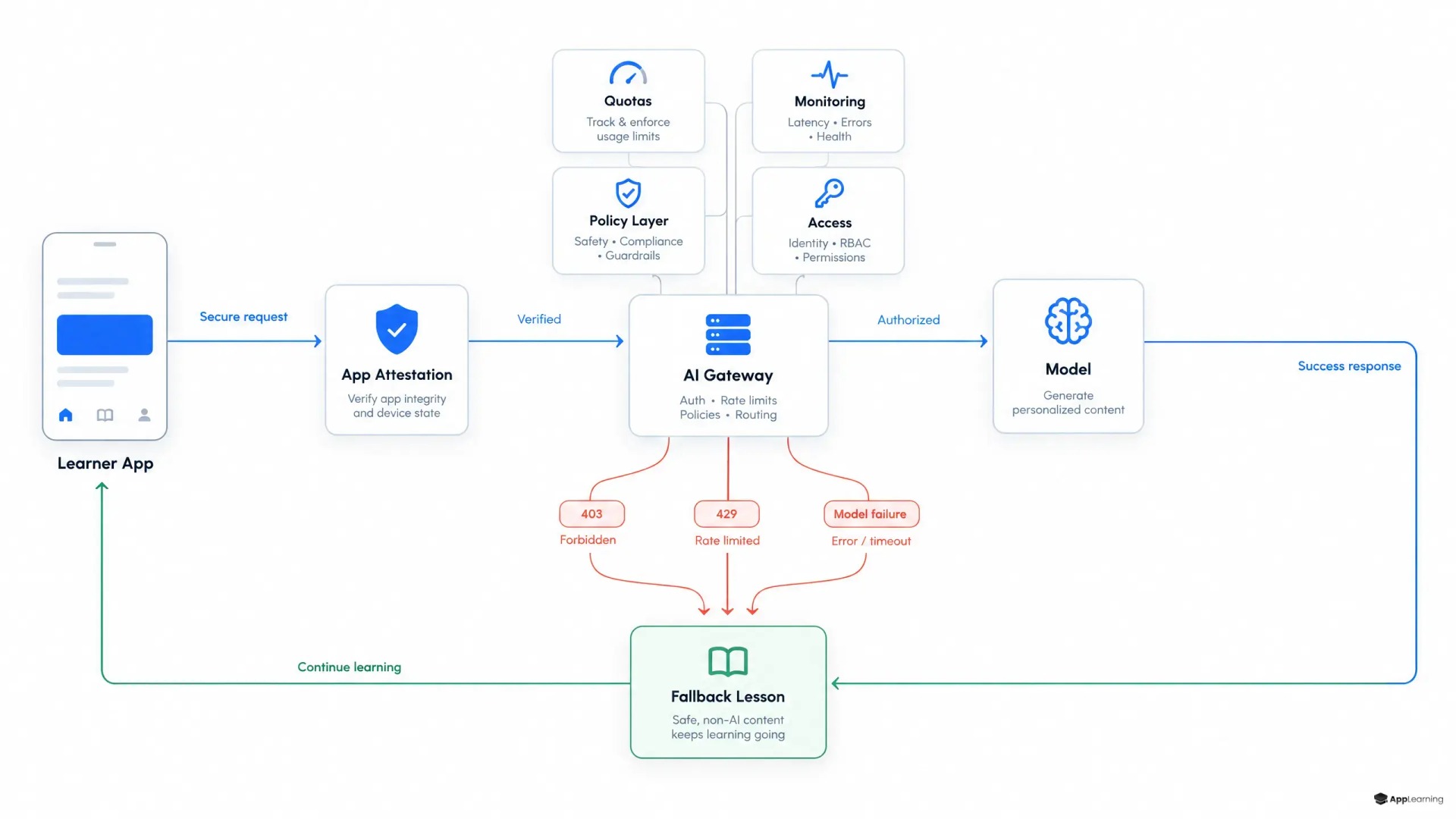
When enforced, Firebase AI Logic App Check accepts requests that are verified as coming from the authentic app or an untampered device, and rejects clients without valid attestation. Production rollout requires an appropriate provider, such as App Attest, Play Integrity, or reCAPTCHA Enterprise; debug credentials must remain a development-only path.
That is important protection, but it is not learner identity, entitlement, content safety, or cost governance. A real app on a real device can still be used too often or used in the wrong learning context. Treat attestation as the outer client-integrity layer. Keep authentication, feature eligibility, tutoring rules, moderation, and account-level controls as separate decisions.
Quotas turn model access into a product rule
Firebase AI Logic provides configurable per-user rate limits, but a product team still has to decide what fair and sustainable access means. Do not leave that decision implicit in a provider default or a cloud budget alert.
- Define the allowed production clients, package identities, web origins, and development environments.
- Set a request and token budget per learner, course, and time window that matches the learning use case.
- Allow only the models, capabilities, and regions that the tutor needs.
- Monitor request volume, token consumption, attestation failures, 403 responses, 429 responses, latency, and abandonment after an error.
- Give one owner authority to slow, disable, or reconfigure the tutor without a new app release.
This is where AI tutor misuse prevention becomes measurable. A learner who needs a short explanation after a quiz should not have the same open-ended capacity as an unrestricted chat client. Design the interaction around bounded learning jobs: explain this concept, compare these two options, or help review this lesson.
Failure states belong in the learner journey
A production test plan should deliberately trigger the 403, 429, and model-access errors documented by Firebase. A 403 can reflect missing valid App Check. A 429 can indicate exhausted quota or temporary provider overload. A model may also be unavailable because of access, configuration, location, or version problems.
- Invalid or absent attestation returns a clear non-technical message and does not loop retries.
- An exhausted learner quota explains when access resets and offers the next lesson activity.
- A model-unavailable response switches to an approved fallback rather than exposing raw provider errors.
- Repeated failures are rate-limited locally so the client does not amplify an outage.
- Events retain enough context for operators to distinguish client failures, capacity failures, and content-quality signals.
Good to know
Does App Check make an AI tutor fully secure?
No. It helps verify that requests come from approved clients, but teams still need authentication, entitlement rules, content safeguards, quotas, and monitoring.
Who should approve an AI tutor release?
The feature owner should obtain joint sign-off from product, engineering, security, and learning-quality owners against one explicit release gate.
What should learners see when the tutor is unavailable?
Show a plain explanation and route them to a relevant reviewed lesson, example, glossary entry, or quiz hint so progress continues.
The fallback protects learning momentum
The tutor cannot be the only route through a course. When AI is unavailable, the learner should still receive a relevant explanation card, a reviewed glossary entry, a worked example, a short video, or a quiz hint. In financial education, keep reviewed product-learning content separate from generated responses so the experience remains useful even when the model is off.
This also improves product discipline. The AI layer should extend a structured learning journey, not conceal gaps in onboarding content. App-Learning implementations can use the same lesson objects, knowledge checks, and progress signals for both tutor-assisted and tutor-free paths.
Make your AI learning experience dependable from the first release.
TalkA reusable gate keeps white-label launches consistent
Release readiness should be a shared acceptance gate for product, engineering, security, and learning quality. It should confirm enforced attestation, approved environments, selected models, quota rules, monitoring ownership, tested failure paths, learner-facing fallbacks, and a remote disable path. For white-label academy clients, make these controls configuration-driven while keeping the baseline gate unchanged.
The mature launch unit is not a model call. It is a dependable learning interaction with bounded access, observable cost, clear failure behaviour, and a credible next step for the learner. Teams that build this control once can launch AI tutors faster across products and markets without treating each release as a fresh security exception.