

Key takeaways
- Treat EUDI readiness as a workforce and systems programme.
- Practise data requests, user approval and verification failures before customers encounter them.
- Use one governed core with role-specific decision paths.
- Assess escalation judgement, then update scenarios as specifications and workflows change.
The deadline is real but banking timelines differ
The end-2026 marker is a Member State wallet-availability deadline, not a blanket go-live date for every banking journey. It still changes the readiness timeline. Under the European Digital Identity Framework rules for private relying parties, larger organisations in banking and financial services can face a separate acceptance timetable where strong online identification is required by law or contract: no later than 36 months after the relevant implementing acts enter into force, and only at a user’s voluntary request.
Technical conformance leaves a human gap
The EUDI Wallet Toolbox provides the technical backbone for issuers, wallets and service providers through common architecture, standards and exchange formats. That is necessary. It is not operational readiness. An API can return a valid attribute, but it cannot tell a support agent how to explain a rejected flow, an operations analyst whether to escalate a mismatch, or a product owner whether an extra data request is justified.
This is where EUDI Wallet training becomes part of delivery rather than a compliance appendix. The difficult work begins when the designed journey meets customer choices, incomplete credentials, service outages and conflicting signals from existing onboarding controls.
The edge cases sit inside the customer journey
Data requests are not a loose UX preference. The framework requires relying parties to register their intended wallet use and requested data, and prohibits requests outside that declared scope. Meanwhile, core wallet-function rules require appropriate alternatives for people who do not opt to use a wallet. Those rules turn small frontline decisions into EUDI Wallet compliance decisions.
Training should rehearse the moments that policy text cannot resolve on its own:
- A customer will share proof of age but not a full date of birth or address.
- A credential fails validation after the customer has started account opening.
- Wallet data conflicts with information already held in the onboarding record.
- A customer declines the wallet route and needs a clear, workable alternative.
- A new product flow requests an attribute that is not part of the approved request pattern.
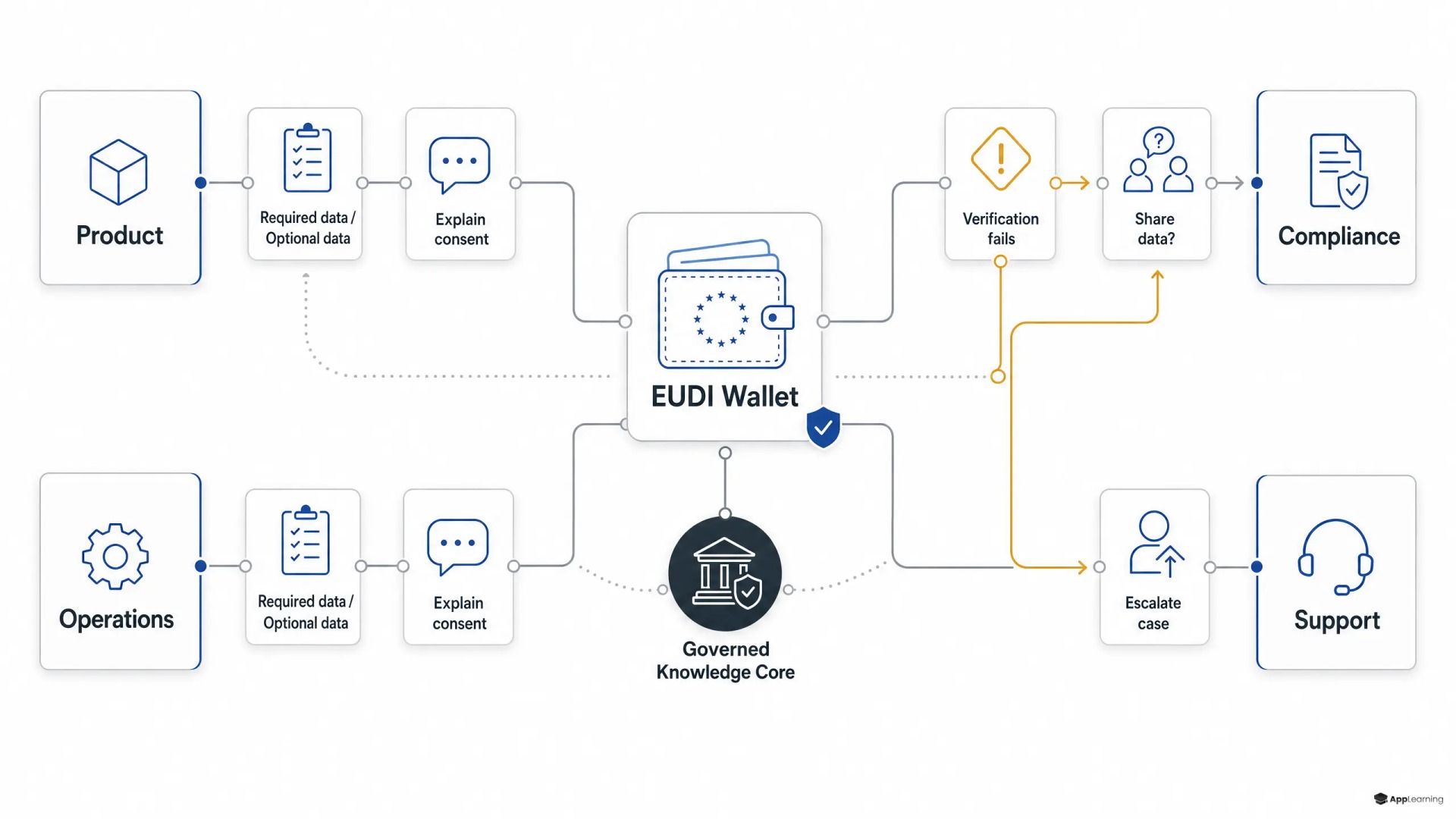
One governed core prevents four versions of the truth
European Digital Identity learning should begin with one governed knowledge core: approved use cases, permitted attribute requests, customer language, verification states, fallback routes, evidence rules and escalation thresholds. Then it should branch by role rather than forcing every team through the same generic module.
- Product teams practise request design, disclosure language and fallback UX.
- Compliance teams test purpose, data scope, approval and change-control decisions.
- Operations teams resolve validation failures and determine the right handoff.
- Support teams explain choices without overpromising or improvising legal advice.
Good to know
What should EUDI Wallet training test?
It should test real decisions: which data to request, how to explain customer choice, how to handle a failed verification and when to escalate.
Which teams need separate learning paths?
Product, compliance, operations and support need different scenarios because they make different decisions from the same underlying rules.
How should a bank keep learning current?
Treat learning content as a controlled product asset with named owners, versioned scenarios, release-triggered updates and completion evidence.
Assessment should expose bad decisions
Completion data is not proof of fintech EUDI readiness. Scenario assessments should require a decision, a reason and an escalation path. Use branching cases that include a customer choice, a system result and a business constraint. Score the action taken, not recognition of a policy phrase.
- Select the minimum attribute set for a stated service need.
- Choose the correct fallback when wallet verification cannot complete.
- Identify when a case moves from support or operations to compliance or risk.
Version control must include learning
The specification layer will not stand still. On 15 July 2026, the Commission adopted an implementing regulation that amended applicable wallet standards and specifications to align them with the evolved Architecture and Reference Framework. Static slide decks will drift. Digital identity training needs the same release discipline as product configuration: an owner, a change intake, versioned scenarios, targeted updates and an audit trail of who completed what.
Build EUDI readiness before edge cases reach customers.
PlanReadiness needs an operating system
An App-Learning academy can turn the governed core into short, role-specific learning paths for product, compliance, operations and customer-facing teams. The useful output is not more content. It is a measurable view of decision readiness: where teams fail, which escalation rules create confusion and what must change before a wallet journey reaches scale.
Successful EUDI adoption will not be proven by a wallet connection alone. It will be proven when employees can protect customer choice, request only what the service needs, recover safely from failure and escalate the cases that demand expert judgement.