

Key takeaways
- Article 4 requires context-sensitive measures, not one fixed competence level.
- An AI training matrix connects AI governance decisions to role-specific learning.
- Learning depth and refresh cycles should follow systems, tasks, data and oversight duties.
- Internal records of training and guidance strengthen evidence without requiring certificates.
- Versioned learning paths keep AI literacy compliance aligned with changing AI use.
August put AI literacy into the operating model
The AI-literacy obligation did not start in August 2026. Article 4 applied from 2 February 2025. But the European Commission’s current guidance places supervision and enforcement from early August 2026, which has changed the conversation for regulated firms. The question is no longer whether an AI awareness course exists. It is whether the organisation can show that people who operate or use AI received guidance suited to their work.
That distinction matters in banking, fintech and crypto. AI may support customer communications, fraud investigations, coding, internal knowledge retrieval, onboarding or decisions that shape customer outcomes. These uses have different data exposure, error consequences and human-review requirements. A single course can set a common baseline, but it is a weak operating model for the full Article 4 AI Act obligation.
The rule points beyond the org chart
The current consolidated Article 4 requires providers and deployers to support AI literacy while taking account of people’s technical knowledge, experience, education, training and the context in which systems are used. It also does not require a guaranteed individual competence level, as the amended legal text makes clear. That is not a reason to lower the bar. It is a reason to design the AI literacy program around actual exposure and responsibility.
An organisation chart cannot do this alone. A product manager and a service agent may sit in different functions but use the same generative AI assistant. Conversely, two people in Operations may face very different obligations if one drafts internal summaries and the other reviews AI-supported alerts. Training assigned only by department hides this difference.
Build the system-and-role matrix first
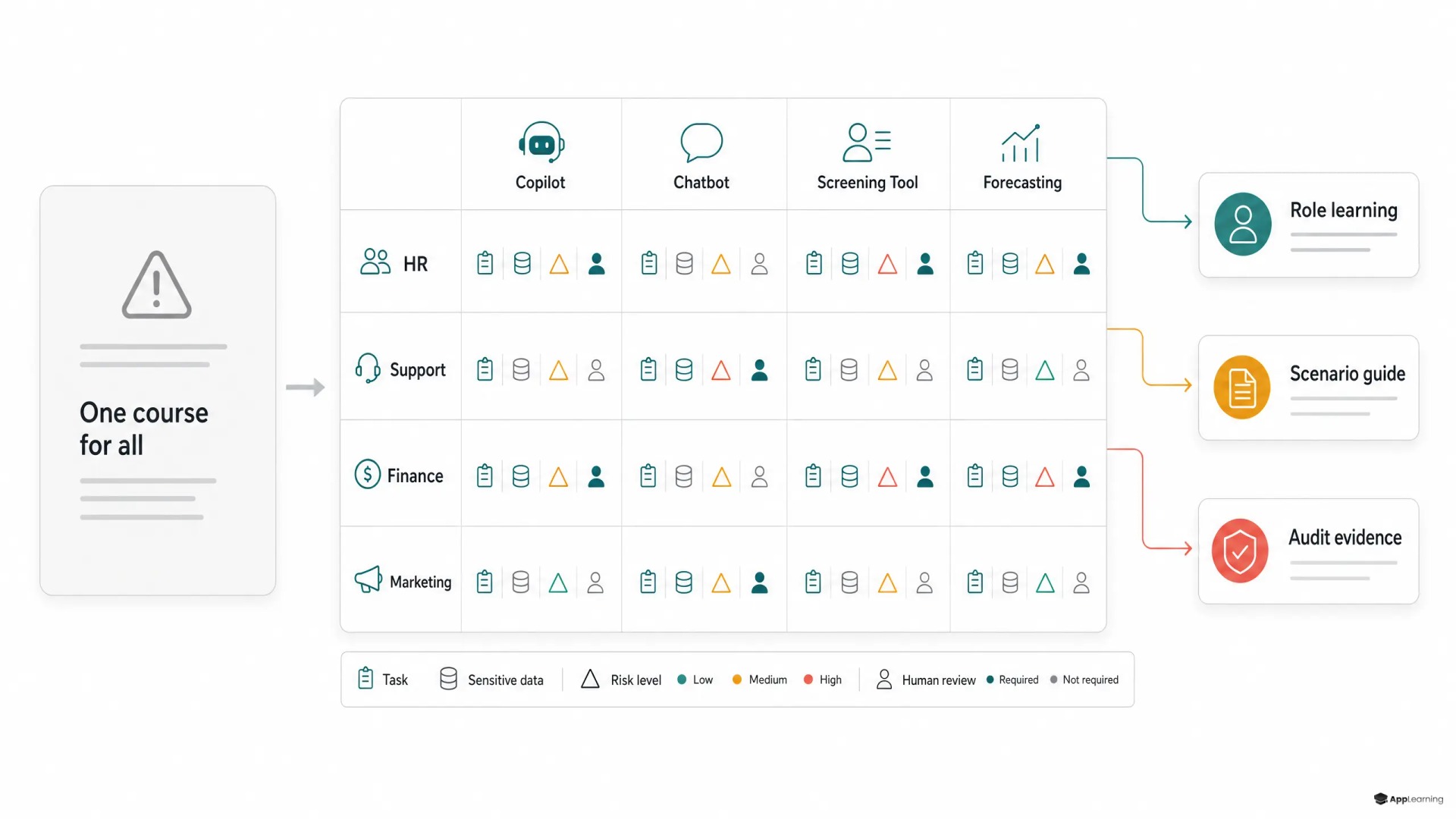
Before producing EU AI Act training content, create an AI training matrix. Each row should describe a real system in use, not an abstract category such as “AI tools.” Each role should be mapped to what that person does with the system and what can go wrong.
- System and owner, including vendor, internal product owner and material version
- Task and decision point, including whether the output informs, recommends or decides
- Data handled, especially customer, transaction, confidential or personal data
- Risk and control context, including prohibited use, customer impact, model error and escalation
- Human oversight, including who reviews outputs, when they may override them and when they must stop
- User group, capability level and access type, including employees, contractors and service providers
This is governance work with a learning consequence. It exposes unapproved tools, vague ownership and controls that exist only on paper. It also gives L&D a stable basis for assignment logic. The Commission itself advises organisations to consider their provider or deployer role, AI-system risks, staff differences and use context before building their actions.
Turn exposure into learning depth
The matrix should produce distinct paths, not a long catalogue of modules. Most employees need a practical foundation: approved tools, confidentiality, hallucinations, verification, escalation and local policy. Frequent users need system-specific scenarios. Managers need to understand accountability and the limits of completion data. System owners, developers and reviewers need deeper instruction on controls, documentation, incident handling and oversight.
For high-risk AI systems, learning must be tied to the people responsible for human oversight. The Commission notes that this training obligation remains in place. A completion record is not evidence of meaningful oversight if the learner has never practised when to challenge an output, stop a workflow or escalate an issue.
Good to know
Does Article 4 AI Act require one mandatory AI course for every employee?
No. A shared baseline can be useful, but Article 4 calls for measures that reflect people’s knowledge, experience, training and AI-use context. The learning design should therefore vary by system, task and role.
Do organisations need an AI-literacy certificate?
No specific certificate is required. The Commission states that organisations can maintain internal records of training and other guidance initiatives, which makes clear assignment and version evidence valuable.
How often should AI literacy training be refreshed?
Refresh it when the underlying exposure changes, such as a new AI system, material feature, use case, data source, control or role responsibility. A fixed annual cycle alone will miss important changes.
What should finance and crypto firms map first?
Start with every AI system in use, its owner, user groups, tasks, data handled, customer or business impact, human oversight and escalation path. This produces the minimum structure needed for targeted learning.
Evidence must move with the systems
AI use changes faster than annual compliance calendars. A new model, vendor feature, dataset, workflow or control can change what staff need to know. Treat the matrix as a living control: connect each material change to an owner review, a learning update, a targeted reassignment and an evidence trail.
The Commission says organisations do not need a specific certificate and may keep internal records of training or other guidance initiatives. That makes internal evidence more important, not less. Record the applicable system version, assigned role, learning path, scenario or guidance issued, completion, assessment where appropriate and the refresh decision.
Turn your AI inventory into learning paths that hold up under scrutiny.
TalkA learning stack that can carry compliance
The practical stack is straightforward: a governed system inventory, a role-and-risk matrix, modular learning content, scenario practice, version control, assignment rules and reporting that compliance, risk and L&D can read. The hard part is keeping these components connected when AI use expands.
This is where a modern learning platform earns its place. App-Learning can translate the matrix into role-specific paths, mobile scenarios, versioned updates and auditable completion records without turning every policy change into a new company-wide course. The result is a learning system that follows the operational reality of AI rather than the convenience of the LMS.
AI literacy compliance is not a content-production project. It is a control system for helping the right people make sound decisions around the right AI systems. Build the map first. Then make learning, guidance and evidence follow it.