

Key takeaways
- External learner segments change faster than manual cohort maintenance can handle.
- Keep eligibility and requirement rules separate from learning content.
- Use deterministic rules for obligations and AI for relevance.
- Make every assignment explainable, editable, versioned and reversible.
- Measure product readiness and activation rather than recommendation clicks.
Static cohorts turn into a maintenance queue
Customer and partner education rarely stays still. A fintech customer may activate a new product, move into a different risk profile, enter a new market or gain access to an advanced feature. A partner may add a product line, receive a new entitlement or need updated certification. When administrators maintain named cohorts for every variation, segmentation becomes a ticket queue. Content updates lag behind product changes, and learners receive generic paths because the team cannot maintain enough exceptions.
The direction of the market is clear. Workday Learning, powered by Sana now combines role and skills context with personalized paths and automated learning operations, while EffectusLMS’s August 2026 release applies role, product line and completed coursework to external customer and partner training. The important change is not the recommendation widget. It is the operating model behind it.
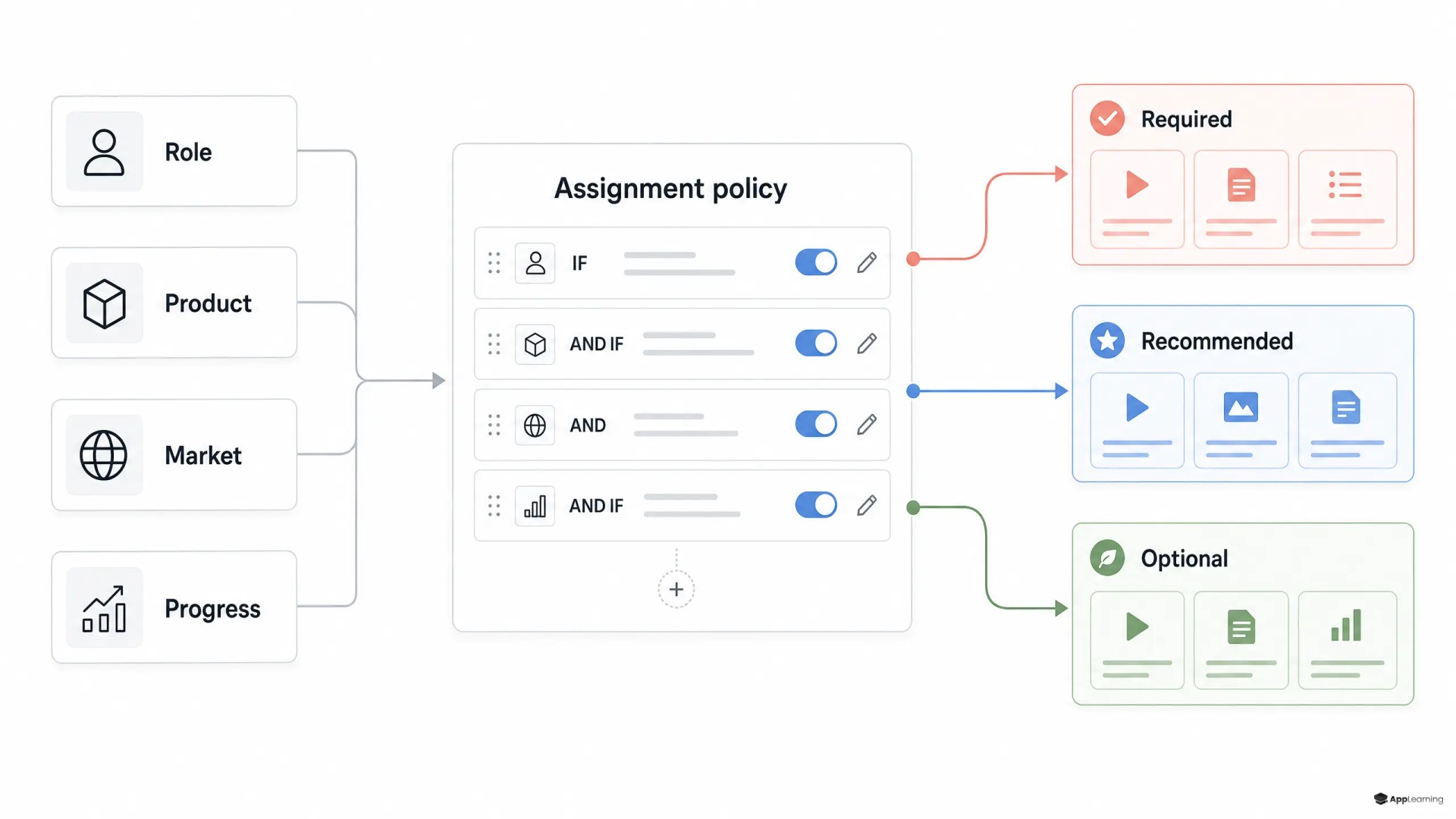
Assignments should run on learner context
Customer academy personalization works when the academy treats learner context as operational data, not as a marketing label. The system should resolve each learner’s current state from a small set of reliable inputs, then evaluate assignment policies whenever that state changes.
- Role and audience type, such as retail customer, administrator, adviser or implementation partner
- Product line, feature access and commercial entitlement
- Market, language, jurisdiction and regulatory context
- Lifecycle events, including signup, activation, renewal and new-product launch
- Demonstrated progress, assessment results, completed learning and expired certification
This separates the question of who needs learning from the content itself. A module about card controls, Bitcoin transfers or API permissions can remain one maintained asset. The rules decide which audience receives it, whether completion is required, and when an updated version replaces the earlier assignment.
Required learning needs a different logic
Not every assignment should feel the same. A durable product education LMS needs three clear lanes.
- Required learning covers access gates, regulatory disclosures, critical product changes and partner certification. Deterministic rules should assign it automatically.
- Recommended learning supports activation and deeper feature use. It should respond to role, product usage, stated goals and evidence of knowledge gaps.
- Optional learning supports discovery. It can surface adjacent capabilities, expert workflows and new releases without becoming noise.
This distinction protects the learner experience. A mandatory market-specific lesson should never be displaced by an AI suggestion. At the same time, a newly activated user should not receive a full expert curriculum just because they match a broad segment. Role-based learning paths provide structure; recommendations provide relevance within that structure.
AI should improve matching, not decide policy
Customer training automation should use rules and AI for different jobs. Rules are best for conditions that must be correct: product entitlement, country, certification status, completion deadline or eligibility for a regulated workflow. They are testable and stable. An administrator can read the condition and predict the result.
AI is useful where the signal is incomplete or the content library is too large to curate manually. It can suggest the next lesson from product behavior, cluster recurring support questions, identify likely knowledge gaps from quiz results, draft content update proposals and flag journeys that no longer match current product navigation. It should propose relevance, not silently redefine an obligation.
Governance makes personalization trustworthy
Every assignment needs an answer to four practical questions: why was this assigned, which data triggered it, which policy version applied, and who can override it? Build an assignment log that records the rule, input values, date and content version. Give academy admins controlled overrides for account-specific cases. Version policies so a product or regulatory change can trigger reassignment without rewriting history.
For fintech teams, this is also a product-quality discipline. The same logic that keeps education relevant prevents an outdated onboarding flow from teaching a feature that is unavailable in a learner’s market. Explainability reduces support friction because success, compliance and product teams can see the same reason for an assignment.
Good to know
Which data should an academy use first?
Begin with role, product entitlement, market and completed learning. Add behavioral and assessment signals only when they improve a clear assignment decision.
Should AI assign mandatory training?
No. Use deterministic, reviewable rules for mandatory learning. AI can rank relevant support content or propose updates around those rules.
How often should assignment rules run?
Evaluate rules on meaningful events such as signup, entitlement changes, market changes, product releases, failed assessments and certification expiry. Avoid constant reassignment without a clear trigger.
How can product teams measure whether personalization works?
Compare readiness outcomes across relevant learner states, including activation, successful feature use, reduced support demand and certification completion. Do not optimize for clicks alone.
Readiness is the outcome that matters
Recommendation clicks are a weak success metric. Track whether learners reach the capability the assignment was designed to create. For customers, connect learning to activation, successful first use of complex features, repeat usage, support-contact reduction and retention. For partners, track certification currency, time to readiness, implementation quality and product-line expansion.
Use assessment evidence carefully. A quiz score should be one signal, not a permanent label. If a learner repeatedly fails a critical concept, assign a shorter remediation path and retest. If they demonstrate mastery, stop pushing introductory material. The policy should adapt to demonstrated progress without making the learner feel trapped in an opaque scoring system.
Build learning journeys that keep pace with every product change.
DiscussA practical academy pattern for product teams
Start with one high-friction journey rather than a complete segmentation rebuild. For example, define the required education for a newly entitled customer, the recommended path after their first core action, and the optional advanced path after demonstrated competence. Connect the minimum reliable data: role, product access, market and progress. Then define event triggers for new entitlements, product releases, policy changes and failed assessments.
In an App-Learning academy, these policies can power mobile-first, branded learning journeys inside the product experience. The product team owns the outcome and the rules. Learning operations owns the content lifecycle. AI supports content matching and upkeep, while the policy engine remains visible to both. That is how partner training automation and customer education scale without turning every product release into a manual cohort project.
The goal is not to make learning look personalized. It is to build a system that continuously assigns the smallest useful next step as the learner, product and market change. When assignment logic is explicit, teams can improve it with the same discipline they apply to onboarding flows, permissions and product analytics.