

Key takeaways
- The limited pilot separates incoming Ethereum USDC from the dollars credited to a PNC deposit account.
- Treasury users need distinct explanations of network receipt, conversion, bank credit and reconciliation.
- Role-specific scenarios should test payment instructions, exception handling and escalation rather than...
- Successful first receipts and support demand matter alongside learning scores.
The Coinbase PNC pilot ends in a dollar balance
On November 9, 2026, PNC announced a limited pilot allowing eligible Corporate and Institutional Banking clients to receive USDC payments on Ethereum. (pnc.mediaroom.com) That scope matters for product education. A pilot for eligible clients is not a general rollout, and its announced network should not become a vague promise of accepting stablecoins everywhere.
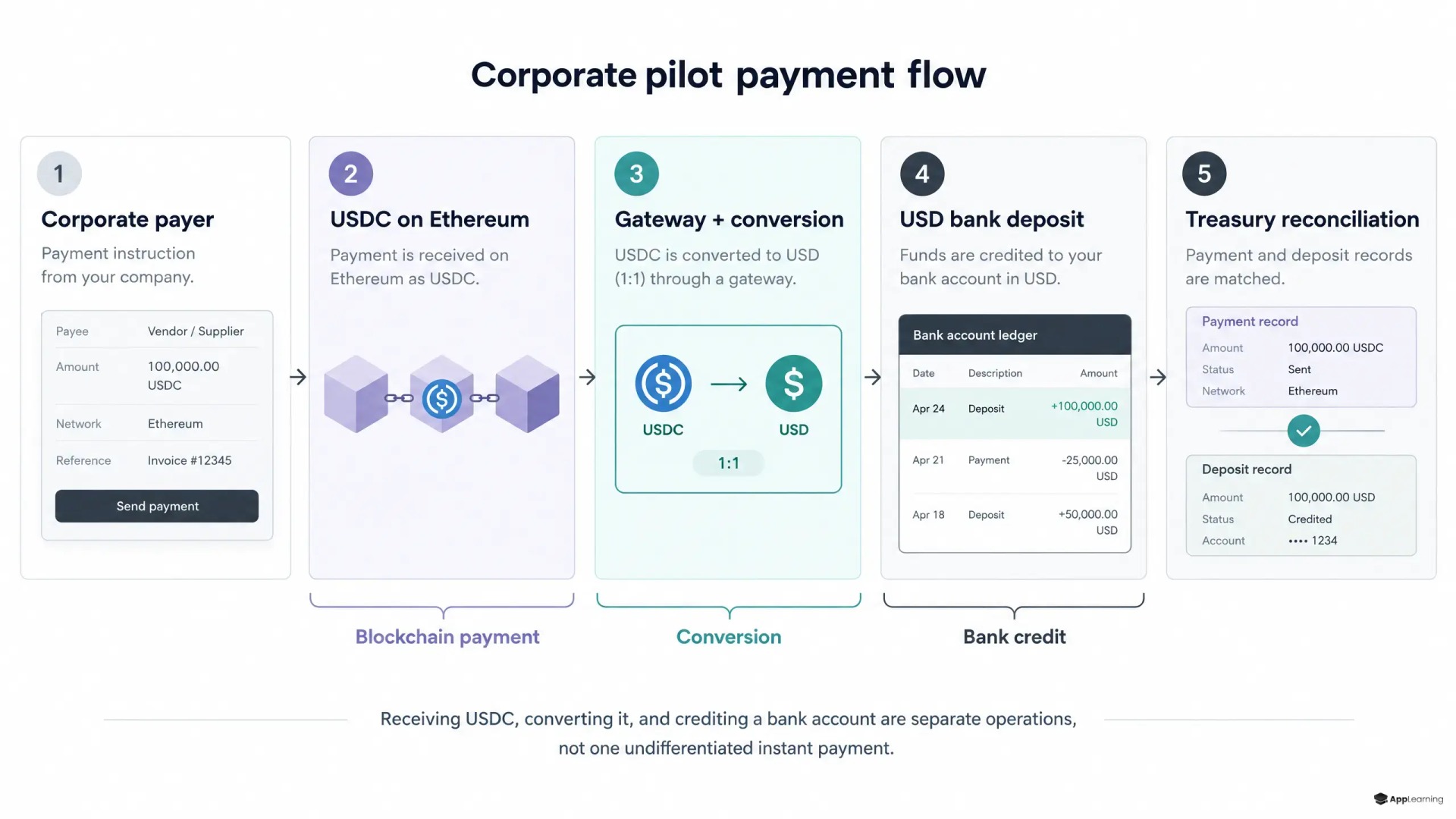
Coinbase confirms that incoming USDC is automatically converted 1:1 into US dollars and deposited into a designated PNC deposit account, with Coinbase Payment APIs providing the stablecoin infrastructure. (coinbase.com) For USDC bank payments, the teaching task is therefore specific. Users must understand the transition between blockchain payment, conversion and conventional banking.
One invoice crosses three distinct states
Consider an illustrative corporate invoice paid in USDC. Before payment, the treasury user checks the approved receiving address and network instructions. The learning scenario then shows an on-chain receipt, automatic conversion and a dollar account credit as separate states. The final task is to match the bank credit to the invoice using the references available in the approved workflow.
This is a proposed training sequence, not documentation of PNC’s interface. Its purpose is to prevent a dangerous shortcut in the user’s mental model—the assumption that evidence of a blockchain transfer is sufficient evidence of a reconciled bank receipt.
Exceptions expose the handoff
Circle’s guidance explains that completed blockchain transactions cannot be reversed and that wrong-network cases depend on where funds were sent and who controls the receiving wallet. (help.circle.com) Training should therefore distinguish prevention from recovery. A network check belongs before sending; a suspected error belongs in an approved escalation process, not an improvised recovery promise.
The PNC and Coinbase launch announcements do not specify pilot fees, end-to-end settlement benchmarks or a transaction-error policy. (pnc.mediaroom.com) Their stated 1:1 conversion ratio does not establish an all-in cost or a guaranteed time to usable dollars. Those details need confirmation through pilot-specific terms before entering client-facing learning.
Treasury readiness depends on five approved answers
Stablecoin treasury onboarding should make five operational answers easy to find.
- Eligibility and the approved receiving address and network.
- The evidence that distinguishes payment receipt from bank credit.
- The applicable fees and funds-availability terms.
- The references needed to reconcile an invoice.
- The escalation owner for missing credits or incorrect payment instructions.
Three minutes can rehearse the transition
A proposed stablecoin payments microlearning flow could sit inside a treasury dashboard or client onboarding journey. The same core scenario should branch by role rather than send everyone through identical training.
- First 45 seconds — Check the simulated invoice instructions, receiving address and Ethereum network before the payer sends.
- Next 75 seconds — Observe receipt and conversion, then identify the evidence still needed to confirm a bank credit.
- Final 60 seconds — Reconcile the simulated deposit or route a missing-credit exception with the transaction reference and relevant timestamps.
Treasury users practise reconciliation. Relationship managers explain scope and limitations. Support teams practise evidence collection and escalation. Product and risk owners approve the content whenever terms or supported workflows change.
Build role-specific learning around your bank’s payment handoffs with App-Learning.
DiscussOperational evidence completes the learning score
The launch announcements publish no outcome metrics. (pnc.mediaroom.com) A bank evaluating embedded financial education should establish its own baseline and track successful first receipts, reconciliation exceptions and support contacts per receipt alongside scenario mastery. Changes should be assessed against product and process changes, not attributed to training alone.
An App-Learning collaboration could connect approved product knowledge with role-specific scenarios and operational measurement. This is a proposed learning use case, not a claim of partnership with PNC or Coinbase.
The learning objective is not confidence in an abstract stablecoin. It is sound judgement at each transition, with clear evidence of completion and a known owner when the next step fails.