

Key takeaways
- The operating chain separates issuer, paying agent, DLT securities infrastructure and central-bank...
- DvP links securities delivery to payment, but finality still requires specific evidence.
- Wholesale tokenized bonds are not permissionless crypto tokens or retail trading products.
- Operations, risk, product and client teams need different learning depths.
- Exception handling and reconciliation reveal readiness better than vocabulary tests.
Inside the Skills Map of a €1 Billion Digital Bond
On 26 October 2026, ESM, the Bundesbank and Clearstream announced a €1 billion digitally native benchmark bond with settlement through Pontes. The announcement describes a transaction to be settled, not proof of completed settlement.
For banks, payment infrastructure providers and regulated digital-asset teams, the useful lesson is operational. Tokenized bonds training should explain who acts, which system records the result and what evidence permits the next step.
The bond journey separates securities from cash
The announced operating chain assigns ESM the issuer role, the Bundesbank the issuing and paying agent role, and Clearstream the Pontes Market DLT Operator role. D7 handles the digital securities; Pontes connects their settlement to cash settlement in T2.
The ECB defines delivery versus payment as linking securities and funds transfers so delivery occurs only if payment occurs. A module called “DLT settlement explained” needs more than that definition. An illustrative assessment timeline could show these states, without claiming to reproduce the ESM transaction.
- 09:00 — Operations validates the instructions and identifies both settlement legs.
- 09:01 — The securities workflow is ready, but cash status remains unconfirmed.
- 09:02 — Operations checks authoritative confirmations and reconciles the two records before reporting completion.
In the ECB’s initial Pontes design, cash-leg finality occurs when the corresponding transaction completes in T2. Central-bank-money settlement therefore refers to the payment’s settlement asset and infrastructure, not merely a token moving on a ledger. Training should map securities finality separately against the applicable rules and terms.
The hybrid bridge creates another handoff
The joint release describes a hybrid route from D7 into traditional infrastructure, where settlement can use T2S. It describes Luxembourg listing and Eurosystem and Eurex collateral uses as expected. Those are not verified completions here. The curriculum should distinguish an available route, confirmed eligibility and an actual collateral movement.
The learning implication is another reconciliation boundary, not permission to assume that tokenization removes every intermediary or proves faster settlement.
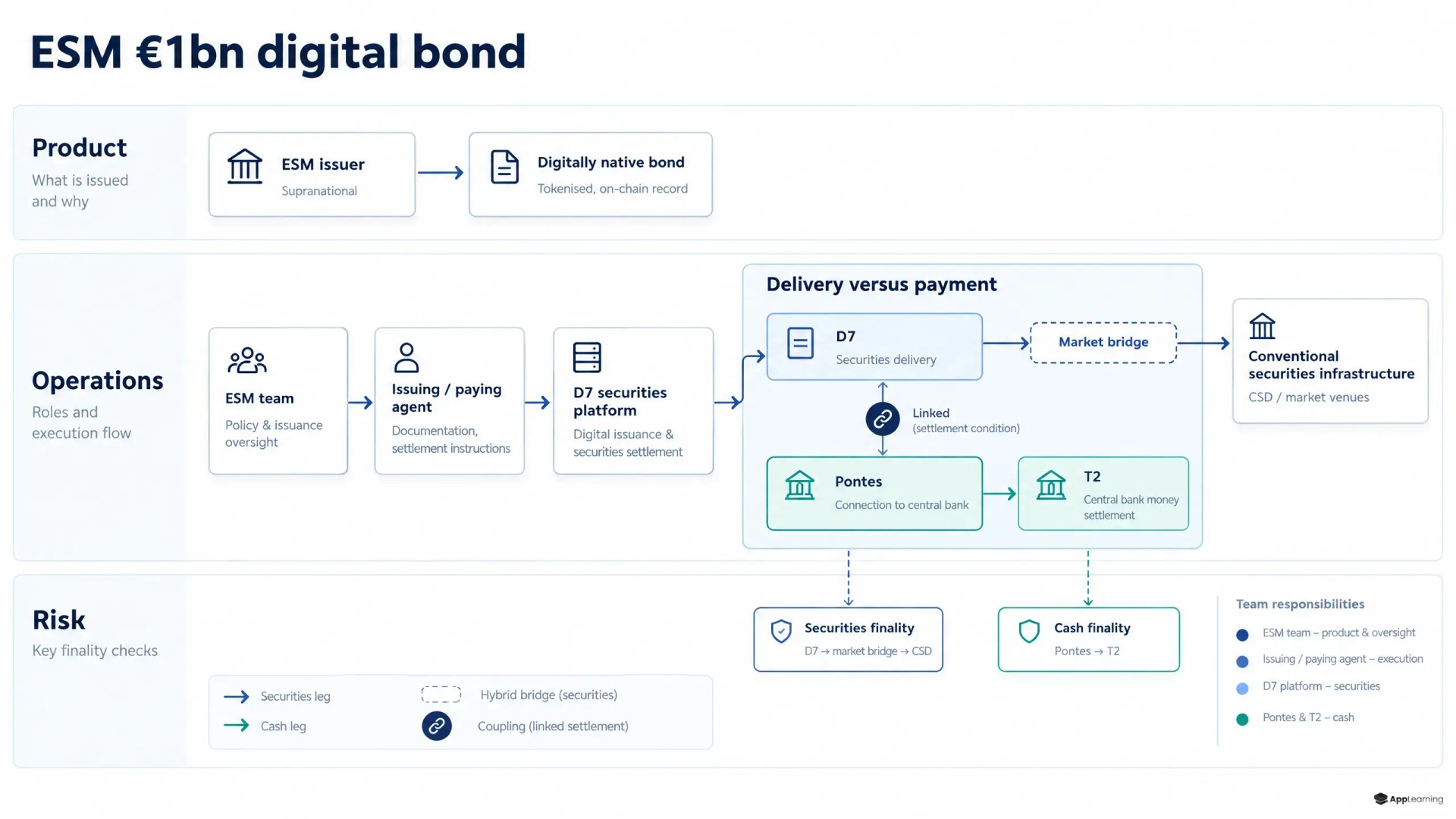
Four roles need different learning depths
- Product teams need a five-minute explanation of the instrument, institutional infrastructure and boundaries separating it from permissionless crypto.
- Client and support teams need a five-minute journey map and approved language for pending settlement and unconfirmed collateral status.
- Settlement operations need deeper Pontes settlement scenarios covering cash status, DvP, reconciliation, duplicate instructions and escalation.
- Risk and compliance need finality analysis and audit-ready checks recording the learner, decision, rationale and content version.
A missing confirmation tests operating judgment
In a hypothetical exercise, the securities workflow appears ready but the cash confirmation has not arrived. The learner must identify the responsible owner, check authoritative cash status and choose an escalation. A missing message is not enough to establish either failure or completion. The assessment should reject both an unsupported “settled” response and an automatic payment retry before status verification.
Build a role-specific settlement academy pilot with App-Learning.
Plan pilotAn embedded academy makes the map reusable
For App-Learning, this suggests a reusable model for digital asset banking education, not a claim of involvement in the transaction. An in-app academy could combine a shared transaction map with role-specific lessons and branching exercises. Each module should carry an expert owner, source date and review trigger. A pilot could measure decision accuracy and escalation quality alongside completion.
The readiness test is not whether employees can define tokenization. It is whether each team can identify the next action, the evidence required and the point where responsibility changes hands.