

Key takeaways
- Skill vocabularies and evidence records answer different questions.
- Completion, knowledge and task performance support different claims.
- Provenance includes the source, assessor, rubric and observation date.
- Review policies keep claims aligned with changing roles and requirements.
- Portable credentials should preserve verified achievements, not inflate unsupported claims.
A Skill Claim Has to Carry Its Evidence
Consider a bank dashboard where watching an AI video, passing a quiz and completing a supervised task all produce the same green check. The display hides the distinction needed for deployment decisions. Connecting a course catalog to a skills taxonomy describes intended coverage, not proof that someone can perform the work.
The vocabulary and the evidence need separate models
ESCO’s persistent identifiers give systems shared references for skills and knowledge. The taxonomy should describe the concept; a separate evidence model should record what a person did and what that supports. ESCO mapping connects learning objectives to that vocabulary. It does not turn those objectives into achieved competence.
Five evidence types support different claims
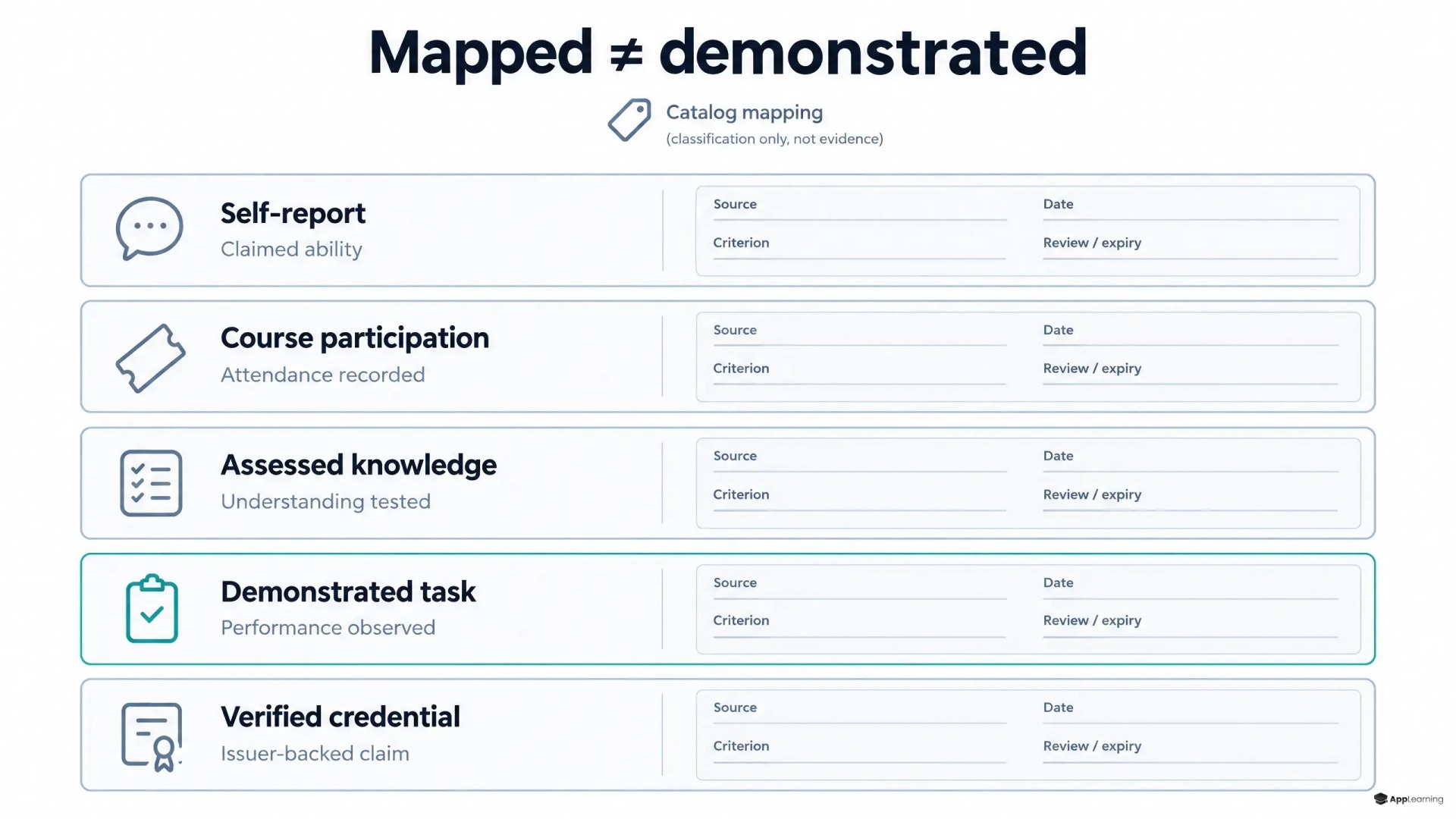
A useful design separates five evidence types without pretending they form a universal ranking.
- Self-report records a learner’s own claim, not an independently assessed result.
- Participation records that the stated completion condition was met.
- Assessed knowledge records performance against defined test criteria.
- Demonstrated performance records an observed task, its conditions and the assessment rubric.
- Externally validated credentials record an issuer’s achievement claim, with its criteria, authenticity and status checked.
An external credential is not automatically stronger than a well-designed workplace assessment. Its value depends on what was assessed and whether that matches the intended use.
Each activity needs a bounded claim
Consider an AI-assisted customer-summary workflow. A lesson can produce a participation record. A scenario test can support a claim about recognising inappropriate data use. A supervised exercise with synthetic customer data can support a performance claim about checking and correcting the summary under those conditions. None should silently become authorisation to use AI with live customer records.
The EU micro-credential recommendation defines micro-credentials through learning outcomes assessed against transparent criteria. For competency verification, the assessment must match the claim.
App-Learning’s academy and assessment infrastructure could supply these evidence events to a broader skills system. This is a proposed architecture, not a claim that an enterprise skills product or credential integration is already live.
Portable records cannot repair weak assessments
The Open Badges 3.0 specification supports achievement criteria, issuer information, evidence and skill alignments. Open Badges skill claims should export only what the underlying evidence supports.
The W3C credential model explicitly separates verification from evaluating whether a claim is true. Authenticity does not establish job readiness.
Review dates and privacy constrain reuse
Each claim needs an expiry or review policy, with a named owner and triggers such as changed tools, procedures or role requirements. Expiry ends reliance on the claim; retention rules separately govern its historical evidence.
The EDPB’s GDPR guidance requires purpose limitation, data minimisation, accuracy and limited retention. A suitable design keeps customer files out of learning evidence, restricts access by role and makes records inspectable and correctable.
Build an evidence-led learning architecture with App-Learning.
DiscussThe minimum record preserves the chain of evidence
For skills evidence, LMS events should populate linked records rather than overwrite a universal skill flag. A minimal claim record contains:
- Learner and claim identifiers with skill identifier, definition and version.
- Evidence type, source activity and protected evidence reference.
- Task context, observation date and outcome.
- Assessor or issuer identity and role with rubric version.
- Validity period, review trigger, status, purpose and access rules.
Workforce skill records should let a decision-maker trace every claim back to its limits. The useful dashboard is not the one with the most green checks. It is the one that shows which evidence justifies the next responsibility.