

Key takeaways
- Keep custody distinct from trading, payments and deposits.
- Map custody knowledge to each role’s real decisions.
- Use service scenarios to test action under pressure.
- Check operational readiness before each rollout stage.
A custody launch changes the operating model
A crypto custody launch is not a product module added to an existing bank training catalogue. It introduces a new service promise: the bank safeguards crypto-assets, or the means of access to them, for a client. Under MiCA’s definition of custody, that can include control of private cryptographic keys. This is distinct from operating a trading platform, exchanging assets or taking deposits.
That distinction must be clear before go-live. A relationship manager who describes custody as trading creates the wrong expectation. A service agent who treats an irreversible blockchain transfer like a card-payment reversal may give unsafe guidance. An operations colleague who cannot explain the approval path may turn a routine request into an incident.
The October 16 report about Deutsche Bank points to a staged rollout, beginning with custody and later expanding the service set. That is the right moment to treat learning as launch infrastructure. The bank should not train everyone on every possible digital-asset feature. It should prepare each audience for the decisions it will make in the service now, then add new learning paths when scope changes.
One service needs four learning audiences
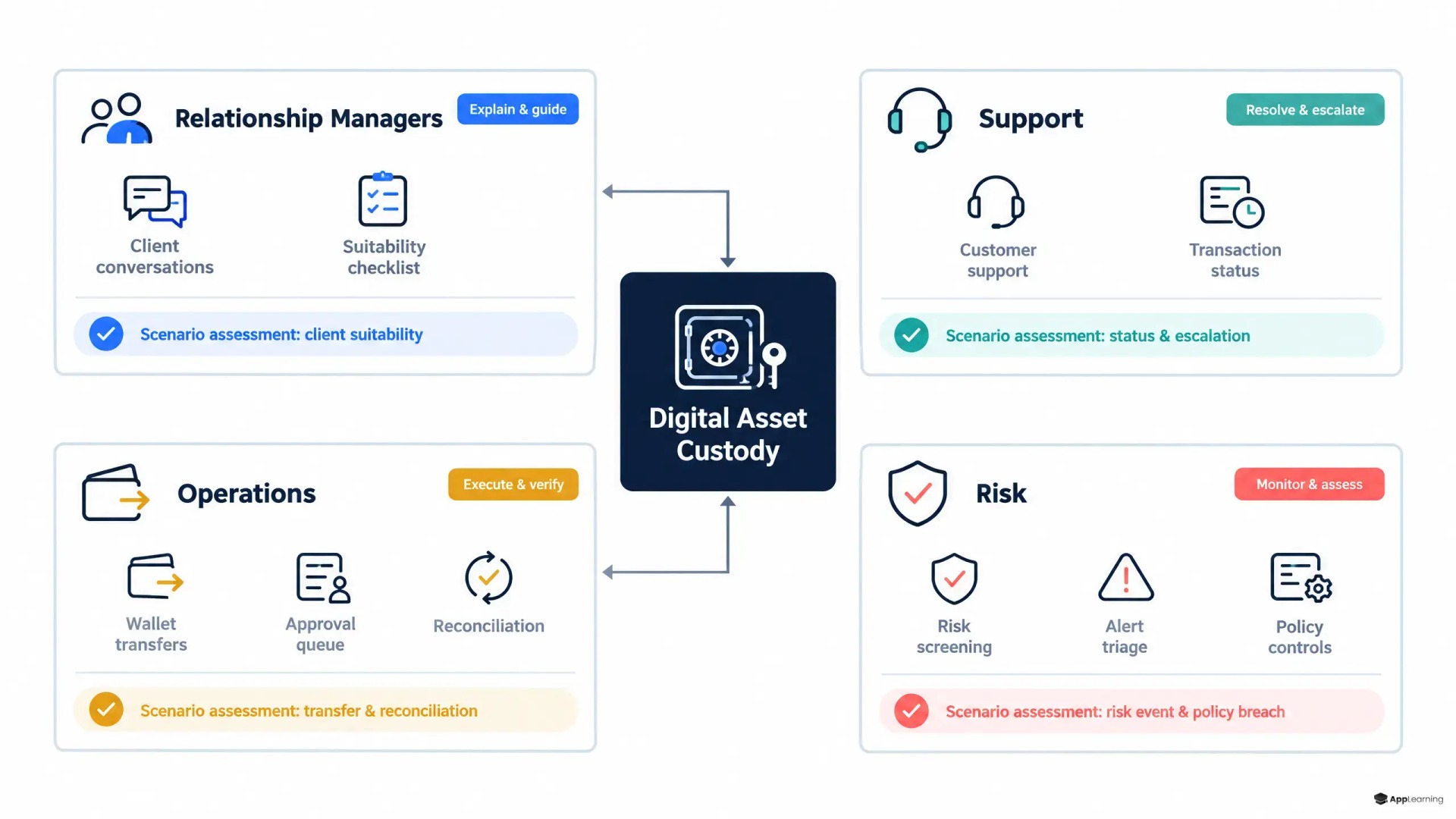
Generic crypto awareness is insufficient. Effective crypto custody training starts with a role map, not a content library. Each group needs a different level of technical depth, different controls and different evidence of readiness.
- Relationship managers need client-safe language, eligible-client criteria, product boundaries and clear referral rules. Their job is to explain the service without making unsupported claims.
- Client support teams need request classification, authentication steps, status communication, complaint handling and escalation scripts. Their job is to protect the client experience without improvising.
- Operations teams need wallet and instruction workflows, maker-checker controls, reconciliation, exception management and incident handovers. Their job is accurate execution within defined authority.
- Risk, compliance and financial-crime teams need the service risk map, control ownership, suspicious-activity escalation and the evidence trail behind key decisions. Their job is independent challenge and timely intervention.
This structure also makes digital asset employee onboarding more efficient. New hires should see the end-to-end client journey first, then enter only the modules required for their role. That prevents a common failure mode: front-office staff receiving technical architecture they cannot use while operations staff receive broad market education but not the workflow they must execute.
Curriculum follows the control chain
The curriculum should mirror the actual control chain from onboarding to exit. MiCA requires custodians to maintain client position records, establish a custody policy, segregate client holdings from their own and provide position statements at least quarterly. The Regulation’s custody requirements give learning teams concrete topics to translate into procedures, practice and assessment.
Build short modules around moments that matter: what the product is and is not; who may use it; how access and authority are verified; how transfer instructions move through controls; how clients receive information; how exceptions, suspected fraud and errors are escalated; and when the service must pause. Keep legal text in the source layer. Put operational decisions in the learning layer.
For a multilingual white-label academy, core concepts should remain centrally governed while client language, market rules, approved terminology and escalation contacts are localised. One controlled source of truth prevents regional teams from creating competing versions of a high-risk service explanation.
Good to know
Which teams need crypto custody training before launch?
At minimum, train relationship managers, client support, operations, risk, compliance and financial-crime teams. Add technology, information security and finance roles where they own controls or client-impacting processes.
How is custody training different from crypto trading training?
Custody training centres on safekeeping, access, client instructions, records, segregation and escalation. Trading training adds execution, suitability where relevant, market conduct, pricing and order-handling topics.
What should a custody readiness assessment test?
Test realistic decisions: correct product explanation, client authentication, instruction handling, maker-checker controls, exception management, incident escalation and compliant client communication.
How should banks measure learning effectiveness during rollout?
Combine role certification and scenario scores with operating data such as misrouted requests, escalation quality, repeat questions, remediation rates and time to competent performance.
Scenarios reveal readiness better than completion
Completion data does not show whether staff can handle a custody event. Scenario assessments do. They should simulate the calls, tickets, approvals and exceptions that the bank expects in its first months of operation.
- A client asks whether the bank can sell an asset held in custody. The relationship manager identifies the service boundary and routes the request correctly.
- A client reports a transfer to an incorrect blockchain address. Support gathers the right facts, avoids false assurances and escalates immediately.
- An operations analyst sees an instruction that conflicts with an authority record. The analyst stops processing and follows the exception path.
- A control function identifies a mismatch between client records and an external custody position. The team documents, contains and investigates the discrepancy.
Assess the observable action, not recall alone. Did the learner identify the issue? Choose the permitted next step? Use approved language? Escalate to the right team within the required window? This makes bank training part of the control environment rather than a compliance checkbox. It also supports the EBA expectation that risk training reflects staff responsibilities and that risk management is not confined to control functions.
Build role-ready digital-asset capability before your custody launch.
Talk to usStaged rollout needs staged evidence
Readiness should be measured by rollout cohort and role. Before pilot launch, require completion of essential modules, a passed scenario assessment and manager attestation for in-scope teams. During the pilot, track repeat questions, misrouted requests, escalation quality, assessment failure themes and time to proficiency. After each release, turn real but anonymised cases into refreshed microlearning.
A practical dashboard separates learning activity from operating evidence. It shows who is certified for the live scope, which teams need remediation, where knowledge breaks at handoffs and whether incidents point to a process defect, a system defect or a capability gap. App-Learning can provide the mobile-first academy layer that delivers these role journeys, localises approved content and gives programme owners a single readiness view.
The important shift is simple. A bank does not become ready for custody because it has published policy documents or recorded training completion. It becomes ready when the people closest to clients, instructions and controls can make the right decision when the product is live.