

Key takeaways
- Treat venue readiness as a network competency problem, not an LMS deployment.
- Build a shared market foundation and distinct paths for each role.
- Use scenarios to test disclosure, conduct, reporting and investor-protection decisions.
- Track readiness by institution and role without exposing individual employee records.
- Keep expert content ownership separate from scalable learning delivery and evidence capture.
A market needs shared operating knowledge
On 2 October 2026, Frankfurt School of Finance & Management announced its memorandum with the International Stock Exchange of Moldova, signed on 9 September, to support market development, professional education and capacity building. The stated focus spans corporate governance, financial reporting, capital-market readiness, compliance and market conduct, investor protection, and sustainable finance. That scope is the real signal. A new venue needs more than matching technology, rulebooks and compliance infrastructure. It needs participants who can apply those systems consistently.
Strong and trusted capital markets are built not only on sound institutions and regulation, but also on knowledge, skills and professional expertise.
A 7 October report by Logos Press describes planned joint programmes for exchange staff, brokers, issuers, board members and private investors, with more comprehensive training and professional certificates planned for 2027. These are stated intentions, not proof that a full academy or credential programme has launched. The distinction matters. A memorandum establishes a framework; market readiness requires a designed, governed and measurable operating programme.
The coordination risk sits between institutions
The hardest launch problem is often not whether each institution understands its own responsibilities. It is whether issuers, brokers, intermediaries, control functions and institutional participants make compatible decisions at the handoffs. A late disclosure, a weak escalation, a misunderstood conflict rule or an incomplete report can undermine trust even when the technology works as designed. Stock exchange readiness training should therefore treat the market as one connected operating system.
For a bank entering such an ecosystem, this is not just an external education project. It is a capability question across front office, compliance, operations, risk and leadership. The bank needs a clear view of which roles may participate, what decisions they will make, and what evidence demonstrates readiness before activity begins.
One foundation and four role paths
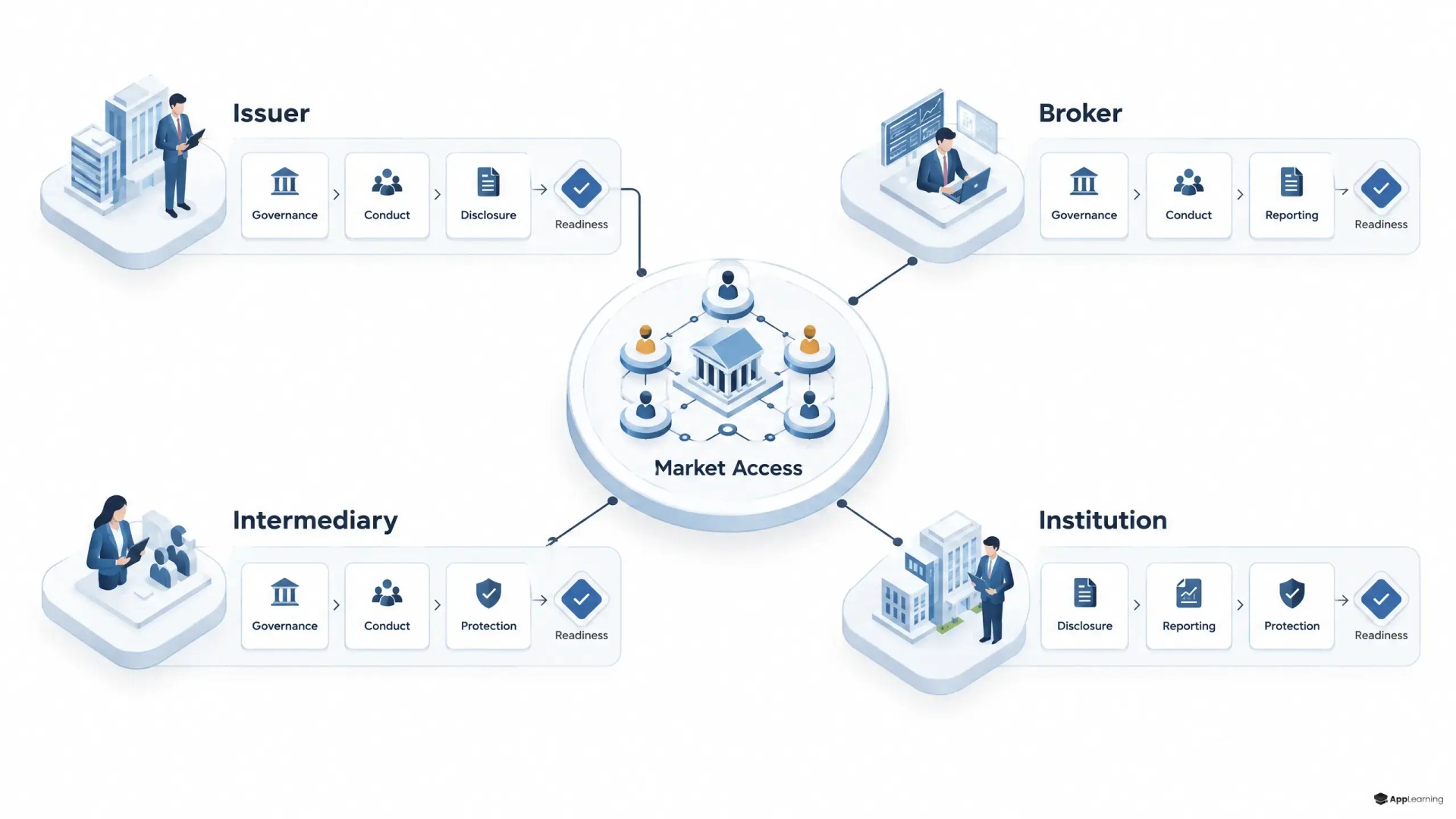
A capital markets training academy should start with a common foundation in market purpose, governance, conduct, disclosure logic, reporting duties, investor protection and escalation routes. It should then split into short, applied role pathways. This avoids two failures: generic awareness that changes no behaviour, and narrow specialist training that leaves the wider market unable to coordinate.
- Broker and intermediary pathway covering order handling, client communications, conflicts, conduct and incident escalation.
- Issuer and board pathway covering disclosure controls, reporting calendars, governance duties and investor-facing decisions.
- Compliance and control pathway covering surveillance signals, recordkeeping, conflicts, investigations and remediation.
- Operations and institutional participant pathway covering workflow controls, reconciliations, exception handling and market-event coordination.
This is where broker issuer compliance education becomes practical. Each path should show a realistic decision, the trade-off involved, the correct escalation and the consequence of getting it wrong. Participants do not need long lectures on every rule. They need enough context to act correctly when a disclosure deadline, suspicious order pattern or reporting exception appears.
A credential stack built for operating moments
Financial market microlearning works when it forms a controlled pathway rather than a library of disconnected content. A credential-ready stack has four layers:
- A multilingual foundation that establishes common language, core principles and local market rules.
- A role-specific track that covers the decisions and controls attached to a participant’s work.
- Scenario simulations that require learners to choose an action, explain an escalation or identify a control failure.
- Timed reassessment after onboarding or market-rule changes, with targeted refreshers where evidence shows gaps.
The credential should signal demonstrated role readiness, not merely content consumption. Completion can remain useful for basic information. Higher-stakes roles should require scenario performance, expert-reviewed assessments or formal examinations set by the responsible exchange, regulator, academic institution or licensed provider.
Good to know
Can a learning platform issue regulated market credentials?
Not on its own. The exchange, regulator, academic partner or authorised assessment body must define the credential standard, examination rules and recognition. A platform can deliver pathways, administer assessments and retain evidence.
Which participants should enter the first cohort?
Start with people who will shape early market practice: venue staff, broker and intermediary teams, issuer representatives, board members, compliance leads and operations teams. Include enough roles to test the real handoffs between institutions.
How should a bank measure readiness without exposing employee data?
Use institution-level reporting for participation, pathway status, assessment outcomes and recurring capability gaps. Keep identifiable learner records inside the bank and use strict access controls for any individual-level follow-up.
Evidence must not become surveillance
A venue operator and its partners need proof that the ecosystem is progressing. They do not need broad access to confidential employee learning records. Report readiness at the institution and role level: eligible population, pathway completion, assessment status, reassessment due dates and recurring scenario gaps. Keep individual-level detail with the employing institution and restrict it to legitimate management, assessment and regulatory purposes.
That design gives a bank innovation leader a usable dashboard. It can reveal whether the bank is ready to support a new market service, where teams need reinforcement and which control topics create friction. It also avoids turning a legitimate capability programme into an unnecessary employee-monitoring system.
Expert ownership sets the boundary
The exchange, regulator, legal experts and academic partners should own the authoritative content, approval process and formal credential rules. An education platform should not pretend to replace legal interpretation, regulated instruction or independent examination. Its role is to turn expert-owned material into maintainable learning journeys, manage curriculum versions across languages, deliver concise mobile-first modules and capture defensible learning evidence.
App-Learning fits this boundary: scalable delivery and evidence capture around specialist material, with room for expert review before content reaches market participants. That model also reduces the burden on internal subject-matter experts, who can govern the curriculum instead of repeatedly delivering the same foundations.
Build a measurable market readiness academy with App-Learning.
DiscussThe academy should arrive before transaction volume
A practical partnership blueprint starts with a curriculum council of venue, regulatory, academic and participant representatives. It then defines the shared foundation, maps role pathways, appoints content owners, sets assessment boundaries and agrees the institution-level readiness signals. Pilot with a small cross-section of brokers, issuers and control teams before scaling across the market.
The strategic asset is not a collection of courses. It is a repeatable system that turns market rules into aligned decisions across organisations. Build that system before volume exposes every weak handoff, and the venue gains a stronger basis for trust, participation and durable growth.