

Key takeaways
- Course completion measures exposure, not readiness to implement AI in a bank.
- Anchor AI learning in one real workflow and a clear problem statement.
- Use implementation blueprints to document scope, safeguards, owners, and success metrics.
- Rubrics make project-based artifacts credible evidence of applied competence.
- Approved blueprints can become inputs to the bank’s pilot backlog.
From AI Upskilling to Implementation Blueprints
A completed AI course can show that an employee watched content, passed a quiz, or learned core terms. It is weak evidence that the person can make an operational decision. In a bank, that decision may cut across operations, technology, risk, compliance, data, and a business owner. The useful test is not whether learners can explain AI. It is whether they can frame a viable, controlled use case for a real workflow.
Completion Is Not Transformation Evidence
Attendance and knowledge scores are easy to aggregate. They are also far removed from implementation. A relationship manager may understand generative AI risks yet be unable to define an acceptable client-preparation workflow. An operations lead may know automation concepts yet fail to identify the exception path, accountable owner, or control requirement. AI training implementation needs evidence that connects learning to a decision the bank could act on.
The Workflow Sets the Learning Agenda
Start before the curriculum. Give every cohort a real business problem such as reducing manual case summaries, improving internal policy search, or triaging service requests. Define the user, workflow, pain point, decision boundary, and constraint. The World Bank’s Global EdTech Policy Academy, scheduled for August 31 through September 4, 2026, used stakeholder personas and problem statements as pre-work and positioned the journey around action plans and implementation blueprints. That is a public-sector model, but the transfer to enterprise enablement is a sound operating-model inference.
The Artifact Becomes the Destination
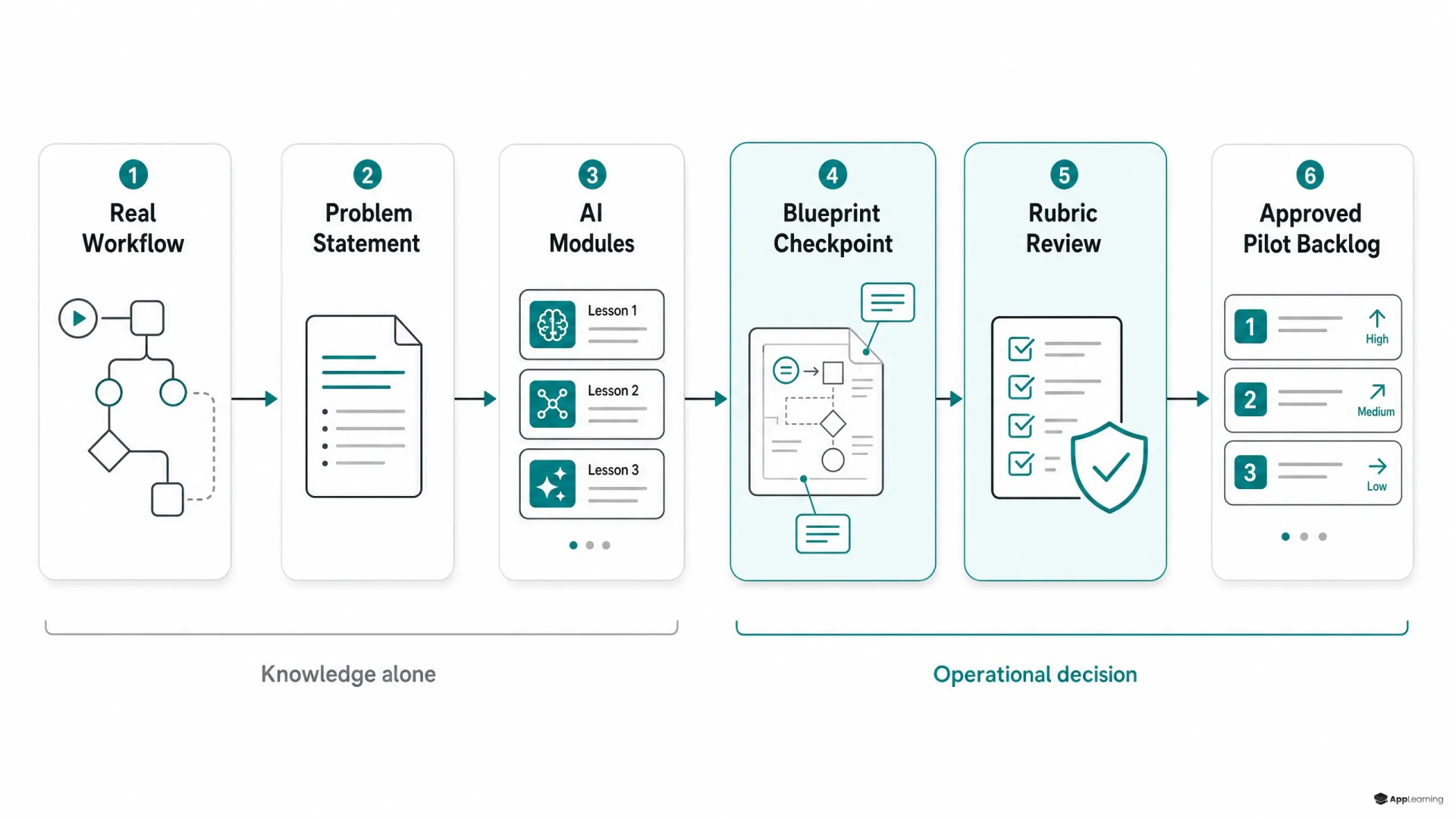
Define the final work product before building the learning journey. For most bank AI cohorts, an implementation blueprint is more useful than a final quiz. It turns abstract lessons into a bounded proposal that a sponsor, risk partner, and delivery team can review. This is the practical core of project-based AI learning: each module supplies an input to a decision-ready artifact rather than standing alone as content.
- Business problem, target users, and workflow boundary
- Proposed AI role and the human decision that remains accountable
- Data sources, access limits, and information-handling assumptions
- Risks, safeguards, escalation paths, and required stakeholders
- Pilot scope, named owner, success metrics, and stop criteria
Checkpoints Expose Weak Proposals Early
Do not wait until the final session to inspect the work. Build checkpoints into the curriculum: opportunity definition, workflow mapping, data feasibility, risk and control design, operating model, and measurement. Each checkpoint should force a specific revision. If a team cannot name the source data, define a human fallback, or state what result would make the pilot unsuccessful, it does not yet have a pilot plan. The World Bank’s AI Academy for Governments similarly combines pre-learning, live sessions, and exercise-driven work intended to translate plans into practical initiatives. For banks, the lesson is to stage learning around implementation gates.
A Rubric Makes Competence Reviewable
A blueprint should not be assessed on presentation quality or optimism. Use a transparent rubric that scores problem clarity, workflow fit, customer or employee value, data realism, control design, ownership, and measurable outcomes. Weight risk and feasibility heavily in regulated workflows. Require reviewers from the business and relevant control functions, not learning alone. This makes AI skills assessment more defensible because the evidence is visible, comparable, and tied to the work employees are expected to perform.
Good to know
What should an AI implementation blueprint include?
It should define the business problem, workflow, users, AI role, data assumptions, safeguards, accountable owners, pilot scope, success metrics, and stop criteria.
Who should review the final artifact in a bank?
The business sponsor should review value and workflow fit. Technology, data, risk, compliance, and security reviewers should join where their approval or input is needed for the proposed scope.
Can a learning platform manage blueprint-based AI upskilling?
Yes. A structured platform can provide templates, checkpoints, role-based content, rubric reviews, artifact storage, and dashboards that show conversion from learning cohorts to pilot-ready proposals.
Learning Output Enters the Delivery System
An approved artifact is not permission to deploy. It is a structured input to discovery, governance, and pilot selection. Store the blueprint with its rubric score, review comments, and accountable sponsor. Then route viable proposals into the transformation backlog. This closes a common gap: innovation learning generates ideas, while delivery teams lack usable inputs. Implementation blueprint training can create a shared format that lets the bank compare demand, identify repeated barriers, and allocate scarce data, risk, and engineering capacity.
Build the blueprint into your next AI learning cohort.
PlanImplementation Conversion Replaces Attendance
Measure the system at several levels: the share of learners producing a complete artifact, the share meeting the rubric threshold, the share sponsored for discovery, and the share converted into pilots or workflow changes. Track cycle time from cohort start to decision-ready blueprint. Review rejected proposals as learning data. They may reveal a recurring data-access problem, an unclear policy, or a capability gap that the next AI transformation academy must address.
A bank does not become AI-ready when thousands of employees finish the same course. It becomes ready when its people can turn strategic intent into controlled, owned, measurable proposals. The implementation blueprint is the bridge between capability building and the transformation portfolio, and it gives learning a direct role in shaping both.