

Key takeaways
- Imperfect evidence gives learners a reason to question model outputs.
- Correcting model mistakes matters more than confidence or completion.
- Workplace scenarios need a specific job behaviour and review action.
- Short scenarios still need meaningful consequences and targeted feedback.
- Comparisons and delayed assessments are needed before claiming learning gains.
The Game That Makes AI Learners Test the Model
The useful test of AI literacy is not whether an employee can define hallucination. It is whether they catch an unsupported answer before it reaches a customer. Training should make that judgment visible.
Polar Peaks puts model testing inside a mission
Google’s Polar Peaks announcement, dated 26 October 2026, describes a quest developed by Google Research and the Stanford Accelerator for Learning for students aged 11–14. Learners investigate a brain-mapping problem through data cleaning and model testing, with human oversight central to the task. Teacher-training modules accompany the release. Google reports more than 400,000 completed quests across the wider series. That is participation data, not evidence of learning gains or enterprise effectiveness.
Decision loops matter more than reward loops
A meta-analysis of simulation-based learning found positive effects on complex skills in higher education, although most studies came from medical education. This supports testing the design pattern. It does not establish that a short workplace game will outperform a conventional lesson.
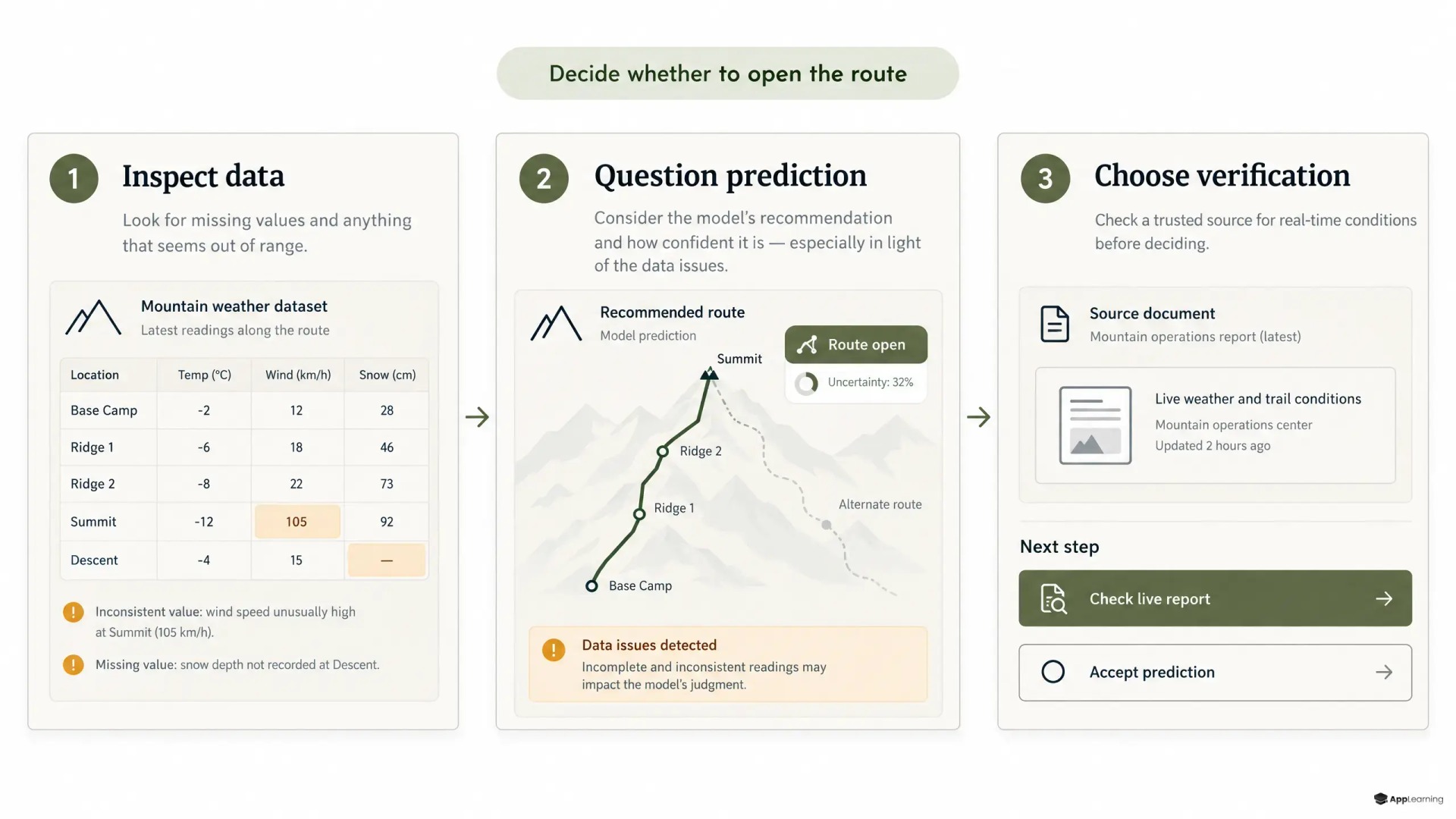
For corporate training, gamification should make decisions consequential rather than merely reward answers. The proposed loop is evidence, judgment, action and feedback. Points are optional. The essential element is a decision that exposes the learner’s reasoning, followed by feedback explaining what the evidence did and did not justify.
Workplace scenarios need a real review action
Scenario-based AI literacy should begin with a job behaviour. For a banking or crypto support team, that might mean checking whether an AI-generated response matches the approved policy. App-Learning could translate this pattern into short AI training simulations using synthetic records, controlled model outputs and feedback approved by the relevant subject expert.
Five minutes at a support desk
Consider a proposed five-minute exercise about a delayed withdrawal. The learner receives a synthetic ticket, conflicting timestamps, an approved procedure and an AI draft promising a release time.
- Identify the unreliable timestamp and explain why it cannot support the answer.
- Flag the promised release time as unsupported by the supplied evidence.
- Choose whether to revise the response, request verification or escalate under the exercise’s procedure.
- Review feedback showing how each choice affects the customer response, then correct the draft.
The exercise ends with a defensible action, not a vocabulary score. Five minutes is a design constraint to test, not a proven learning dose.
Delayed performance is the stronger test
A meta-analysis of training transfer (doi.org) found that measurement choices influenced results, with relationships inflated when predictors and transfer outcomes used the same source and measurement context. An independent assessment is therefore a sensible pilot safeguard.
A low-risk pilot could randomly assign learners to the scenario or a conventional lesson with the same content and time allowance. Both groups would receive an unseen case immediately and again after two to four weeks. Measures should include error detection, correct revisions, appropriate escalation and false alarms on valid outputs. A delayed simulation tests retention and near transfer; workplace transfer needs separate observation. Completion and confidence remain secondary.
Build a low-risk AI literacy pilot with App-Learning.
DiscussSimulation has a boundary
Direct instruction may be the better starting point when learners lack basic concepts or simply need a policy reference. Complex, high-stakes decisions may need coached practice. A pilot should exclude live customer decisions and sensitive data, with versioned source material and reviewed feedback.
The lesson to borrow from Polar Peaks is not that work needs more games. It is that learning by doing should require learners to test the model rather than accept its answer. The case for expansion begins when that judgment survives a new task after the game is over.