

Key takeaways
- Separate the employee identity from the agent’s service-account identity.
- Map permissions to real tasks and irreversible action types, not job titles.
- Train delegation, inspection, pause, revoke, and escalation through short realistic scenarios.
- Audit trails support accountability but do not prove safe human use.
- Measure approved-task success, overrides, exception resolution, and escalations rather than chat volume.
A coworker arrives in the chat stream
On October 6, 2026, Retool announced early access to a centralized agent harness that places employee-specific agents in Slack, Microsoft Teams, and Google Chat. The announcement describes centrally governed tools, data and model controls, plus agents with memory, skills, scheduled jobs, and separate audit identities. It is not a universal general release: Retool says it is beginning access for a limited next group of customers.
That distinction matters for a bank. This is not evidence that enterprise deployment is solved. It is a clear signal of the new operating model. When an agent works in the same chat channel where staff ask colleagues for help, it looks less like a separate AI application and more like a new hire who can act on connected systems.
Chat shifts the onboarding surface
A Slack-native agent removes the friction of opening another tool. It also removes a useful pause. Employees can move from a casual request to a delegated action in one thread. For low-risk work, that can be efficient. For payment operations, customer communications, access changes, or regulatory reporting, the cost of an unchecked action is far higher than the cost of a slow prompt.
Enterprise AI agent onboarding must therefore join two workflows that banks often run apart. Technology teams provision the agent. Learning, risk, and line managers prepare the employee to use it with judgment. An agent should not be considered ready because it can answer a question. It is ready only when it can complete a defined task within tested limits and its owner knows when to stop it.
Provision the agent as a distinct actor
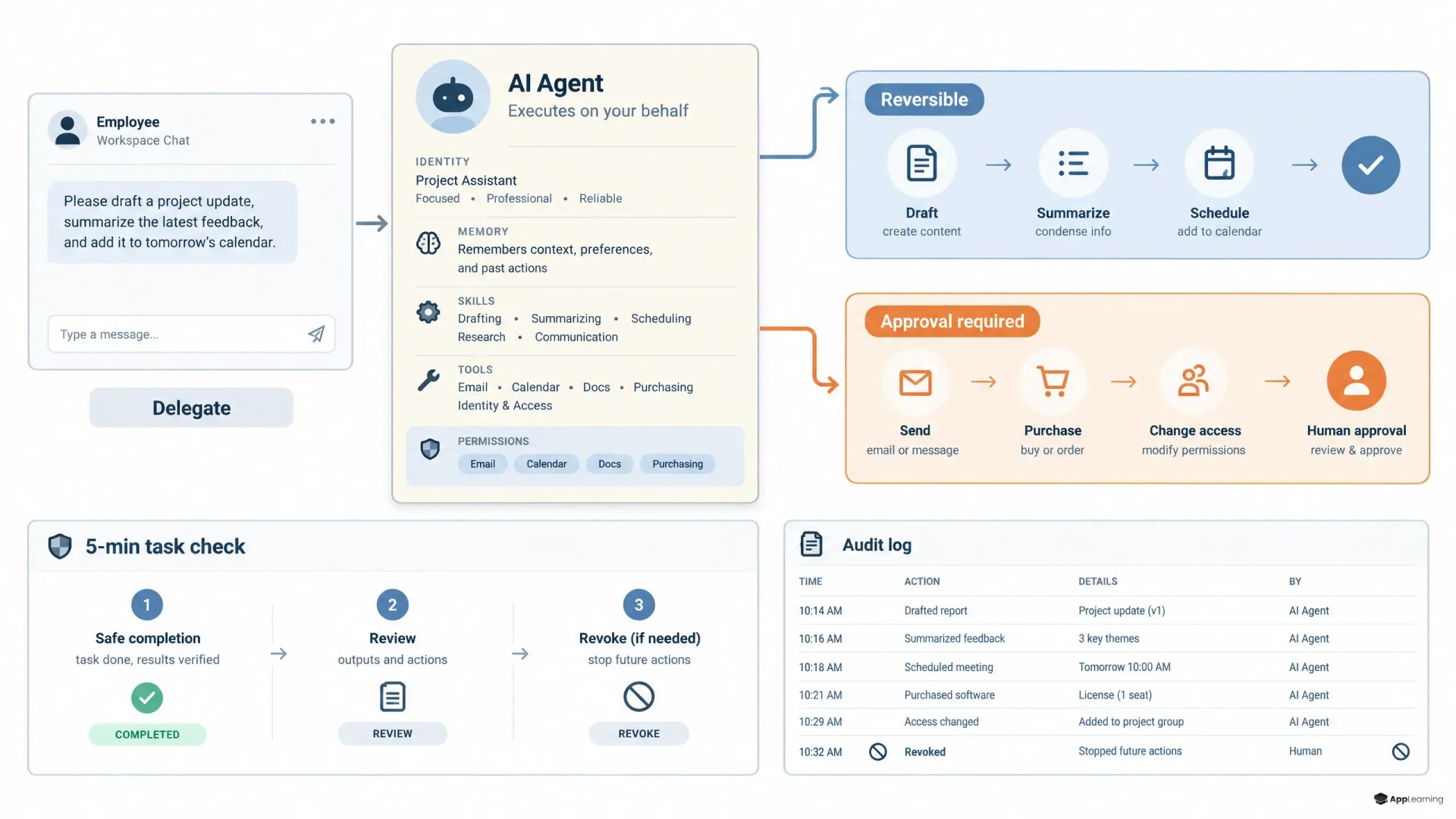
Do not treat an agent as an extension of a user login. Retool’s design describes agents as separate actors with virtual service accounts and policies distinct from the user, so audit logs can distinguish direct human actions from delegated agent actions. That is the right pattern for banking governance: retain the employee’s accountability while giving the agent an identity that can be constrained, monitored, and revoked independently.
Provisioning should produce a short, reviewable agent profile. It should define the business owner, employee owner, permitted tools, approved data domains, working context, reusable skills, scheduled jobs, confirmation thresholds, escalation route, and emergency stop. Permissions should attach to tasks and irreversible action types, not broad labels such as relationship manager or operations analyst.
- Read-only retrieval and drafting can sit in a lower-risk lane.
- Actions that create, send, alter, approve, delete, or disclose require explicit thresholds.
- High-impact actions should require human confirmation or remain unavailable to the agent.
- Every agent needs a named owner who can pause access and trigger review.
Delegation is a learned operating skill
Most adoption plans train people to write better prompts. That is too narrow. AI coworker training needs to teach delegation: state the task, boundaries, source systems, expected output, deadline, and approval point. It must also teach inspection. Employees need to check what the agent plans to do, what it actually did, which records it used, and whether a result needs correction or escalation.
This is a control problem as much as a learning problem. The NIST AI Risk Management Framework calls for documented roles and responsibilities in human-AI configurations, operator proficiency, defined human oversight, and testing in conditions similar to deployment. A log is valuable evidence after an event. It does not prove that an employee recognized a flawed delegation before an irreversible action occurred.
Employee AI agent enablement should begin at the moment access is granted. App-Learning can deliver role-specific, five-minute sequences in that moment: permitted actions, confirmation rules, tool delegation, inspection checks, pause and revoke steps, and escalation contacts. A simulated error matters more than a policy slide. For example, an operations employee should practise rejecting an agent’s proposed customer message because it selected the wrong account context, then route the case through the correct exception path.
Good to know
What is enterprise AI agent onboarding?
It is the process of provisioning an agent, defining its identity and permissions, preparing its human owner, and testing safe use on real job tasks before broader access is granted.
Why should an AI agent have a separate identity from its employee owner?
A separate service identity allows the bank to apply narrow policies, trace agent actions independently, review delegated access, and revoke the agent without disabling the employee’s own account.
What should employee AI agent enablement assess?
Assess whether employees can delegate within limits, inspect plans and outputs, recognize exceptions, use confirmation points, pause or revoke access, and escalate the case through the correct route.
Which metrics show useful agent adoption?
Use approved-task success, confirmation compliance, quality of overrides, exception resolution, escalation accuracy, and permission changes. Do not use prompt or message volume as the primary measure.
Readiness requires a short practical test
Use a five-minute scenario assessment before live tool access. Give the employee a realistic job request and an agent response containing one meaningful fault: an unsupported source, a missing approval, a mismatched customer record, or an irreversible instruction. The employee must set the right limits, inspect the proposed action, reject or approve it, and escalate where required. This tests behavior, not policy recall.
Managers need a separate track. Their role is not to become prompt engineers. They must confirm task ownership, acceptable risk boundaries, fallback procedures, evidence retention, and readiness for the team’s first live use. That creates a defensible handoff between innovation, risk, operations, and the business line.
Build tested agent readiness into your next banking AI rollout.
PlanThe scorecard must reward safe task completion
Chat volume is a weak adoption metric. It can show curiosity, repetition, or dependence. A minimal scorecard should track approved-task completion, quality of human overrides, exception-resolution time, escalation accuracy, confirmation compliance, and the frequency of revoked or changed permissions. Segment results by task and risk tier. A high completion rate on drafting is not evidence that an agent is ready to update a live customer record.
The strategic shift is simple. Agents will increasingly appear where work already happens, but safe adoption will not happen by itself. Banks that combine narrow permissions, distinct agent identities, real task tests, and short agent delegation training can turn chat-native agents into controlled operating capacity. Banks that treat them as another chatbot will discover their gaps only after the agent reaches a live system.