

Key takeaways
- Voluntary enrollment signals interest, not workforce coverage.
- Measure AI training access before reporting completion rates.
- Assign baseline learning for role-critical and high-risk work.
- Use cohort routing to protect learner agency and close access gaps.
- Microlearning helps only when time, support and distribution are designed.
The selection bias behind a thriving academy
A voluntary AI academy can look like a success on every standard LMS dashboard. Enrollment rises. Learners finish modules. Comments are positive. Yet those results describe the people who entered the program, not the workforce that needs to change. Employees with time, confidence, manager support and prior interest in AI are more likely to notice an invitation and act on it. The result is selection bias: a healthy engagement signal that can mask weak AI training access.
This matters sharply in finance and crypto. AI use is moving into customer operations, product, risk, engineering and support, while compliance requirements set clear limits on acceptable tools and data handling. A voluntary AI training offer is useful for experimentation. It is not, by itself, a workforce AI upskilling strategy.
The engine room cannot be an afterthought
PwC surveyed 49,364 workers across 48 countries and regions in May and June 2026. Its results show a workforce dividing into four groups. The largest, the “engine room,” accounts for 56% of workers and sits comparatively early on the AI learning curve. Only about two in five in that group say they have the learning resources they need, while the group carries much of an organisation’s day-to-day work. PwC’s release makes the operational risk plain: AI capability can compound among front-runners while the majority loses ground.
This is the AI skills gap that completion rates cannot reveal. If a program reaches the most curious ten percent, it may produce capable advocates. It does not show whether operations, control functions or customer-facing teams can work safely and effectively with AI.
Coverage metrics belong beside engagement metrics
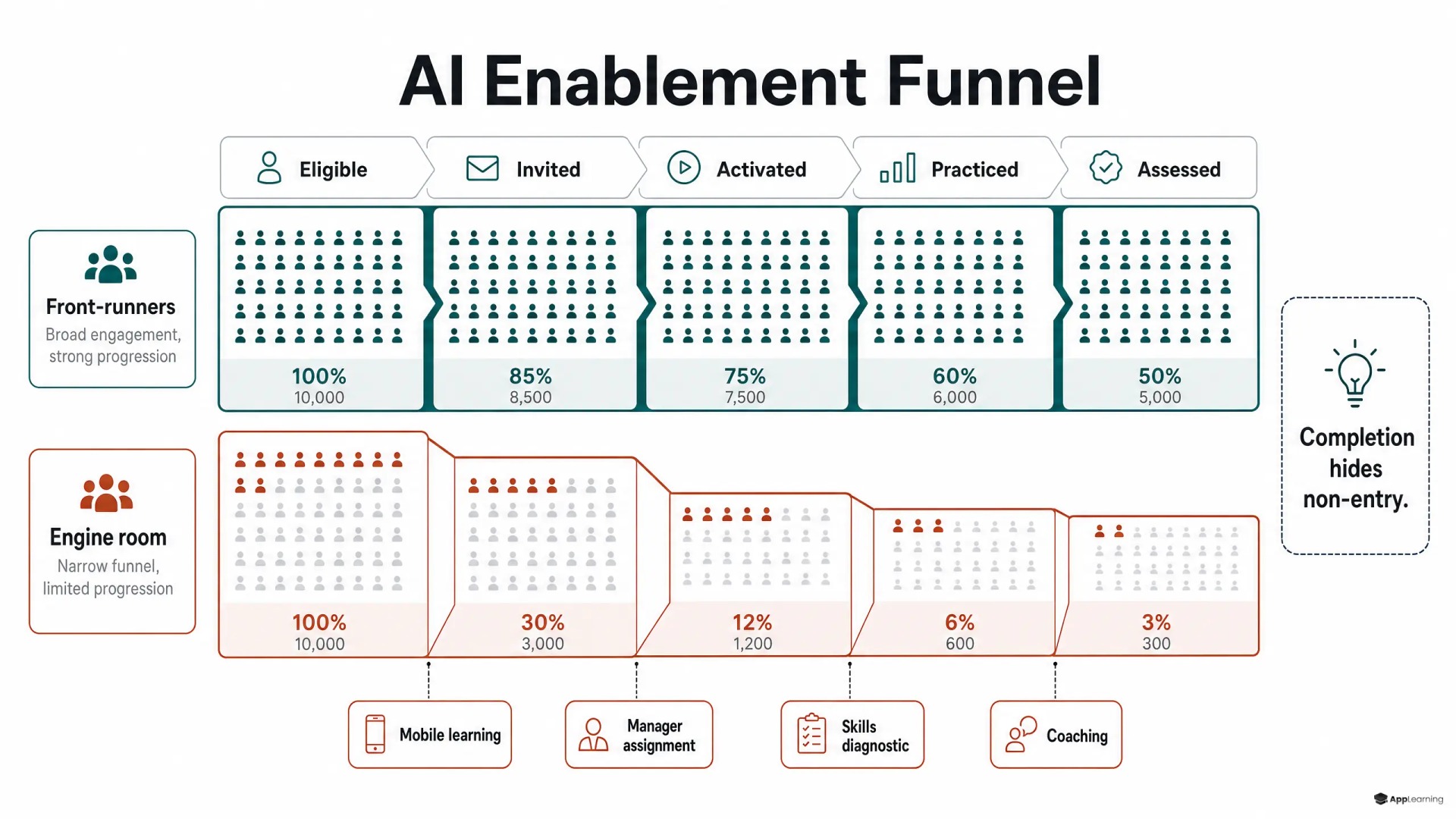
Completion remains useful, but it is a late-funnel metric. L&D teams need a cohort view that starts before a learner opens a module. Report the funnel by role, level, location, business unit and manager.
- Eligible employees who require or could benefit from the path
- Employees invited through a defined distribution rule
- Employees activated through a first learning action
- Employees who practice in realistic job scenarios
- Employees assessed against the required capability baseline
- Employees who never entered the funnel and the reason recorded
This separation changes the conversation with leadership. Low completion may signal content or experience problems. Low invitation or activation signals a distribution, management or time-to-learn problem. Treating both as learner disengagement leads to the wrong fix.
Four routes replace one universal curriculum
Inclusive AI learning does not mean giving every employee the same course. It means making the expected route explicit and proportionate to role risk. A practical model separates baseline awareness, role-critical application, high-risk controls and advanced experimentation.
- Baseline path for all relevant employees covering approved tools, data boundaries, verification and escalation.
- Role-critical path for teams whose workflows, decisions or customer interactions will change.
- Assigned control path for risk, compliance, legal, security and other high-impact roles.
- Voluntary advanced track for front-runners who can test use cases, prompt patterns and workflow improvements within clear guardrails.
The first three routes create coverage where the business needs a minimum standard. The fourth preserves learner agency and rewards curiosity without allowing early adopters to become the only people who gain practical AI fluency.
Good to know
Should baseline AI learning be mandatory?
Make it assigned when employees need a common standard for approved tools, data handling, verification or escalation. Keep deeper experimentation voluntary unless a specific role requires it.
Which metrics expose an AI training access gap?
Track eligible employees, invitations sent, first activations, practice activity, assessment results and completion by cohort. Compare these stages across functions, seniority, location and manager groups.
How can regulated firms preserve learner choice?
Set non-negotiable guardrails for role-critical work, then offer elective advanced tracks inside those boundaries. This protects compliance while giving motivated learners room to develop use cases.
Routing closes gaps that content alone cannot
A long AI curriculum does not solve unequal access. Start with a short diagnostic that tests confidence, current tool use and role exposure. Use the result to route learners into the next useful task, not a generic library. Manager-assigned paths should cover high-risk responsibilities. Short mobile modules can make baseline learning easier to start between operational tasks. Managers still need protected time, visible expectations and follow-up prompts, or the least-supported teams will remain absent.
App-Learning supports this operating model by combining brief, role-specific learning units with diagnostics, assigned pathways and cohort dashboards. The aim is not to force every employee into advanced AI work. It is to see where access breaks, target the right intervention and verify that capability reaches beyond the usual volunteers.
Build an AI learning funnel that shows who is being left behind.
DiscussAgency works best inside clear guardrails
Keep advanced AI learning voluntary. Make the baseline required where work, risk and customer outcomes demand it. Then judge the program by the people who never start as carefully as the people who finish. When invitation, activation, practice and assessment are visible across cohorts, an AI academy stops being a popularity contest. It becomes a controlled system for building capability across the workforce.