

Key takeaways
- Brevity reduces friction, but relevance creates learning value.
- Design each unit around one realistic work decision or task.
- Give learners bounded choice without loosening mandatory requirements.
- Measure decisions, practice and evidence instead of completion alone.
- Use follow-ups and reassessment to turn lessons into a learning system.
Brevity Is a Delivery Choice, Not a Learning Design
Ten minutes is a useful constraint. It forces authors to remove background material, focus on one idea and fit learning into a busy day. But duration alone does not make a lesson useful. A compressed policy summary can still leave a relationship manager unable to spot an unusual transaction. A fast product update can still leave a support agent unsure which customer promise applies.
This is the central weakness in much corporate microlearning design. The unit ends when the content ends. The learner watched, read or clicked through a quiz, and the system records completion. That proves exposure. It does not show whether the person can make the right decision when a customer, regulator, colleague or live workflow puts the knowledge under pressure.
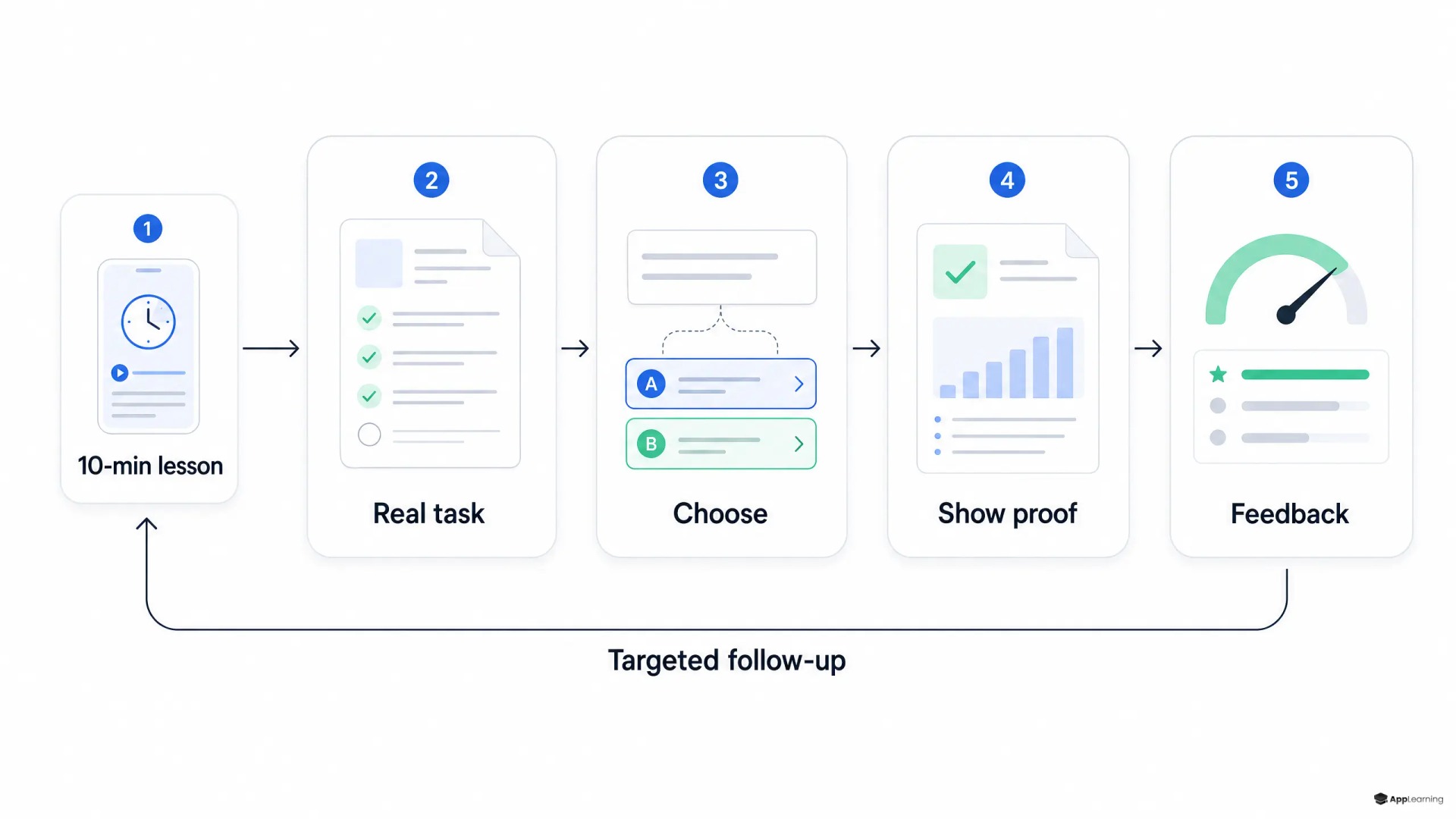
Workplace microlearning should therefore be designed as a small work loop. Teach one narrow concept. Place it in a realistic context. Ask for a small observable action. Then use the result to determine the next intervention.
A Useful but Narrow Field Signal
A September 2026 mixed-methods study of voluntary K–12 microlearning professional development offers a practical signal. The programme used four week-long challenges, with a short daily task, choice boards and an evidence submission. Participants highlighted contextual relevance, practicality, autonomy and flexibility as reasons to engage, while time still limited participation.
This was not a corporate randomised trial, and it should not be treated as proof of business impact. It studied teachers in one U.S. district who chose to participate. Still, the design inference is useful for finance and crypto teams: short content works better when it gives people an immediate way to improve the work in front of them.
Immediate Relevance Sets the Real Design Constraint
Do not begin with the question, “Can we teach this in ten minutes?” Begin with a more demanding constraint: what must this person be able to do differently today? The answer should name a role, a moment and an observable action.
- A payments analyst identifies the missing information in an exception case.
- A sales manager chooses the approved claim for a new product feature.
- A compliance reviewer flags the control gap in a short scenario.
- A customer-support agent writes the first response to a suspicious-account request.
This shifts task-based microlearning away from content slices and towards capability units. The concept remains narrow, but the learner must use it in the context where it matters. For regulated organisations, that also makes review easier. Subject-matter experts can validate one defined behaviour against a realistic scenario instead of signing off a broad, abstract course.
The Action Makes Learning Observable
A strong unit needs a small action that can be completed safely in minutes. The action does not need to be elaborate. It can be a decision between two options, a risk classification, a draft response, a screenshot of a configured setting, a voice note explaining a choice or a submitted checklist.
The point is not to create administrative work. It is to produce microlearning evidence. If a learner selects the wrong escalation path, the system has found a specific gap. If they submit the right response but give weak reasoning, a manager or AI-supported feedback flow can target the next prompt. Completion cannot provide this level of signal.
Good to know
Does a ten-minute lesson guarantee effective learning?
No. Ten minutes can reduce friction, but the lesson still needs a precise objective, realistic context and an action that shows whether the learner can use the knowledge.
How can regulated teams allow learner choice without weakening compliance training?
Keep mandatory policy content, approval rules and assessment thresholds fixed. Give choice in scenarios, practice formats, timing windows or optional depth that fits each role.
Which signals matter beyond completion?
Track scenario decisions, confidence ratings, evidence submissions, quality of reasoning, reassessment results and recurring error patterns by role or risk area.
Choice Works Best Inside Clear Guardrails
Learner choice does not mean that every learner writes their own curriculum. In compliance-heavy settings, the required standard, policy wording and assessment threshold must stay controlled. Choice belongs in the route to practice.
- Let learners choose between role-relevant scenarios.
- Offer a choice of submission formats where the evidence standard is the same.
- Allow flexible timing within a defined completion window.
- Provide optional depth for experienced employees without hiding mandatory content.
This gives people agency while preserving curriculum control. It also avoids a common failure mode: treating every employee as if they face the same decisions. A treasury specialist, product manager and customer operations agent may need the same policy principle, but they need different practice contexts.
Follow-Up Turns Modules into a Capability System
The first task should change what happens next. Correct performance can trigger a harder scenario after a delay. Repeated errors can trigger a short explanation, a second attempt and, where needed, manager support. Teams can then see patterns by role, product, location or control area rather than relying on one completion percentage.
This is where App-Learning can make job-embedded microlearning operational. Role-based mobile units can pair a concise explanation with a scenario, decision or evidence submission, then schedule targeted follow-ups from the result. For enterprise academies, the outcome is a cleaner link between required learning, applied practice and the signals L&D needs to improve both.
Build short learning loops that create evidence of workplace capability.
ExploreThe Ten-Minute Lesson Becomes a Work Loop
The useful question is not whether a lesson is short enough. It is whether the learner can use it before the next relevant work moment passes. When every unit connects a narrow concept to a realistic action and a visible result, microlearning stops being compressed content. It becomes a practical system for building capability where work actually happens.