
Key takeaways
- Hands-free interfaces make just-in-time guidance practical in physical work.
- A contextual instruction is not proof of learned competence.
- Modular microlearning can render across phone, web, agent and wearable surfaces.
- Live guidance needs pre-task preparation and post-task assessment.
- A central content and analytics layer keeps devices from becoming separate training systems.
The field of view becomes a learning surface
The phone will remain the primary learning surface for many distributed teams. That is especially true where agents use low-cost Android devices, work with limited data and move between weak-connectivity areas. But the interface around work is expanding. In its 16 September enterprise announcement, Snap positioned Specs alongside Salesforce, AWS and NVIDIA integrations for field service, retail and factory work. This is a market signal, not evidence that AR workplace learning improves outcomes. It does show where job guidance is heading: closer to the customer, equipment or shelf, with fewer screen switches and both hands available.
For a field-sales business, that does not mean issuing smart glasses to every agent. The immediate design lesson is more useful. Training content should not be trapped in a phone-only course format. A tariff check, registration reminder or stock-ordering step may need to appear in an existing field app today, through voice or an agent tomorrow, and in a wearable interface later.
Learning breaks into three operational modes
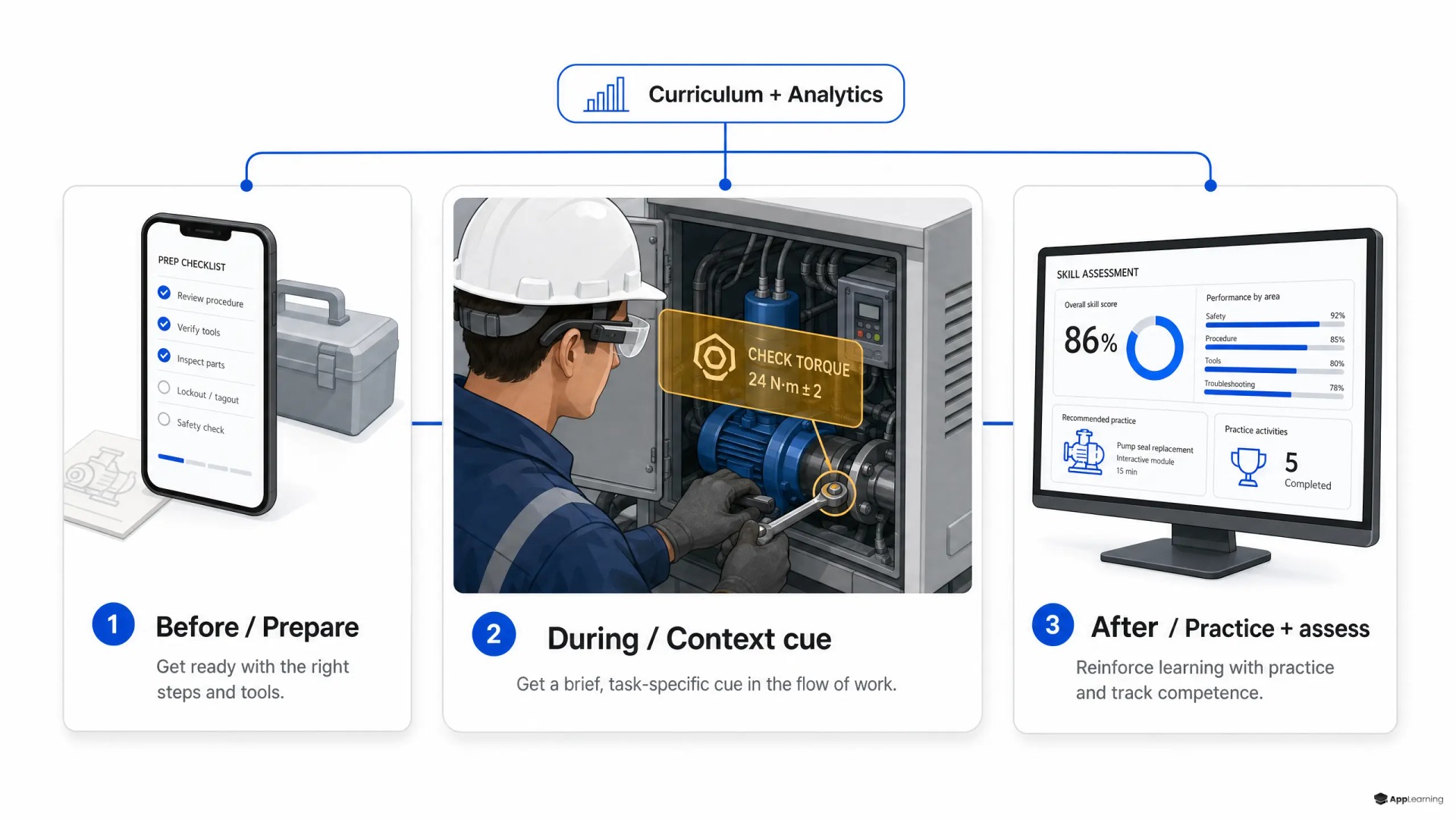
Hands-free microlearning changes the natural unit of support. The useful object is often no longer a five-minute lesson. It is a precise intervention matched to a point in the workflow. That requires a clear division between three modes.
- Prepare before work. Teach the product story, the full process, common exceptions and the reason behind compliance rules before an agent enters the live task.
- Guide in the moment. Surface one procedure step, visual check, approved message or escalation path when the agent needs it.
- Verify afterward. Confirm that the agent can repeat the process, handle a variation and make the right decision without prompts.
This split matters because work is a poor place for long explanations. During a customer interaction or a technical repair, the worker needs a usable next action. Before and after the task, the organisation needs evidence of readiness.
The intervention must be smaller than the task
Wearable performance support should reduce uncertainty without competing for attention. The best payloads are short and concrete: a product identifier check, a safety or compliance confirmation, a photo reference, a two-step diagnostic, a stock-location prompt or a single approved response to a customer objection.
- Put short, high-frequency and context-specific actions into the live workflow.
- Keep theory, product comparison, sales practice and complex exceptions outside the live task.
- Use visual prompts only when a visual distinction changes the decision.
- Design a safe fallback for missing data, low connectivity and unclear recognition results.
Smart glasses training fails when it turns a worker’s view into a slide deck. The device should help the agent complete the next correct action. It should not become a new place to consume courses.
Performance support is not competence
A worker who completes a process with live prompts may have performed correctly, but that does not establish independent capability. The distinction is vital for new-product launches, regulated registration flows and sales conversations. Guidance can lower error rates during execution. Certification must still test recall, judgment and application when the prompt is absent or the situation changes.
Design the learning record accordingly. Record that an agent received guidance during a task. Do not automatically convert that event into a completed module or a competence badge. A readiness decision should rest on defined evidence: knowledge checks, observed practice, scenario decisions, manager validation or verified performance data.
Good to know
Where should hands-free microlearning start?
Start with high-frequency workflows where workers need both hands, must avoid screen switching or face recurring decision points. Map the task first, then identify the smallest prompt that prevents a known error or delay.
Can smart glasses replace mobile onboarding?
No. Mobile onboarding remains better suited to longer explanations, setup steps, practice, language selection and formal assessments. Wearables are a potential delivery surface for short, in-context guidance during physical work.
How should field teams measure readiness?
Use a separate evidence model that combines completion, knowledge checks, scenario decisions, observed practice and relevant CRM or operational data. Treat live guidance use as support activity, not as automatic proof of certification.
How can teams prepare content for future wearable use?
Break courses into governed components such as steps, rules, media, prompts and assessment items. Keep those components in a central system so they can be rendered in a field app today and other interfaces later.
Canonical content must outlive each device
The scalable answer is not to build separate courses for mobile, web, agents and wearables. Build governed content components once: a procedure, prerequisite, decision rule, visual asset, local-language variant, assessment item and expiry date. Then render the relevant component in the right context.
This is where a multi-surface microlearning architecture becomes practical. App-Learning can keep canonical content, translations, campaign changes and certification logic centrally governed, while delivery adapts to the field app, a web portal, a conversational agent or a future wearable. A change to a promotion or tariff then updates the source of truth rather than starting a chain of PDFs, chat messages and duplicate training builds.
Completion data needs a home beyond the interface
Every new surface creates a temptation to create a new training system. Resist it. The wearable, app or agent should report an event to a device-independent learning record: what guidance was shown, whether a required check was acknowledged, what evidence was captured and whether the worker passed the separate assessment.
That record should connect with CRM, onboarding, rewards and operational reporting. Leaders can then see the chain from recruitment to readiness to first sale, rather than only course completion. They can also spot regional gaps, stale campaign content and agents who need coaching before poor advice reaches customers.
Build a device-independent agent academy with App-Learning.
TalkField academies become operational control systems
For field-service and distributed-workforce academies, the goal is not more content consumption. It is a reliable operating system for change. New agents need a clear path from signup through setup and first transaction. Experienced agents need rapid refreshers when products, prices or rules change. Managers need proof of readiness without chasing updates through support calls and chat groups.
The durable advantage will not come from being first to place instructions in a lens. It will come from owning the content model, the readiness rules and the evidence trail behind every surface. Organisations that separate live guidance from competence assessment can adopt new interfaces without weakening control—and improve agent confidence without confusing assistance for learning.