
Key takeaways
- Treat FlutterFire 5.0 migration as a learner-reachability release decision.
- Firebase Flutter minSdk 24 is a dependency constraint, not a complete support diagnosis.
- Test host-app integration and critical learning journeys on real device cohorts.
- Stage releases with fallback channels and measure successful learner tasks.
- Report coverage and completion by device cohort, not crash-free sessions alone.
A Device Exclusion Nobody Planned For
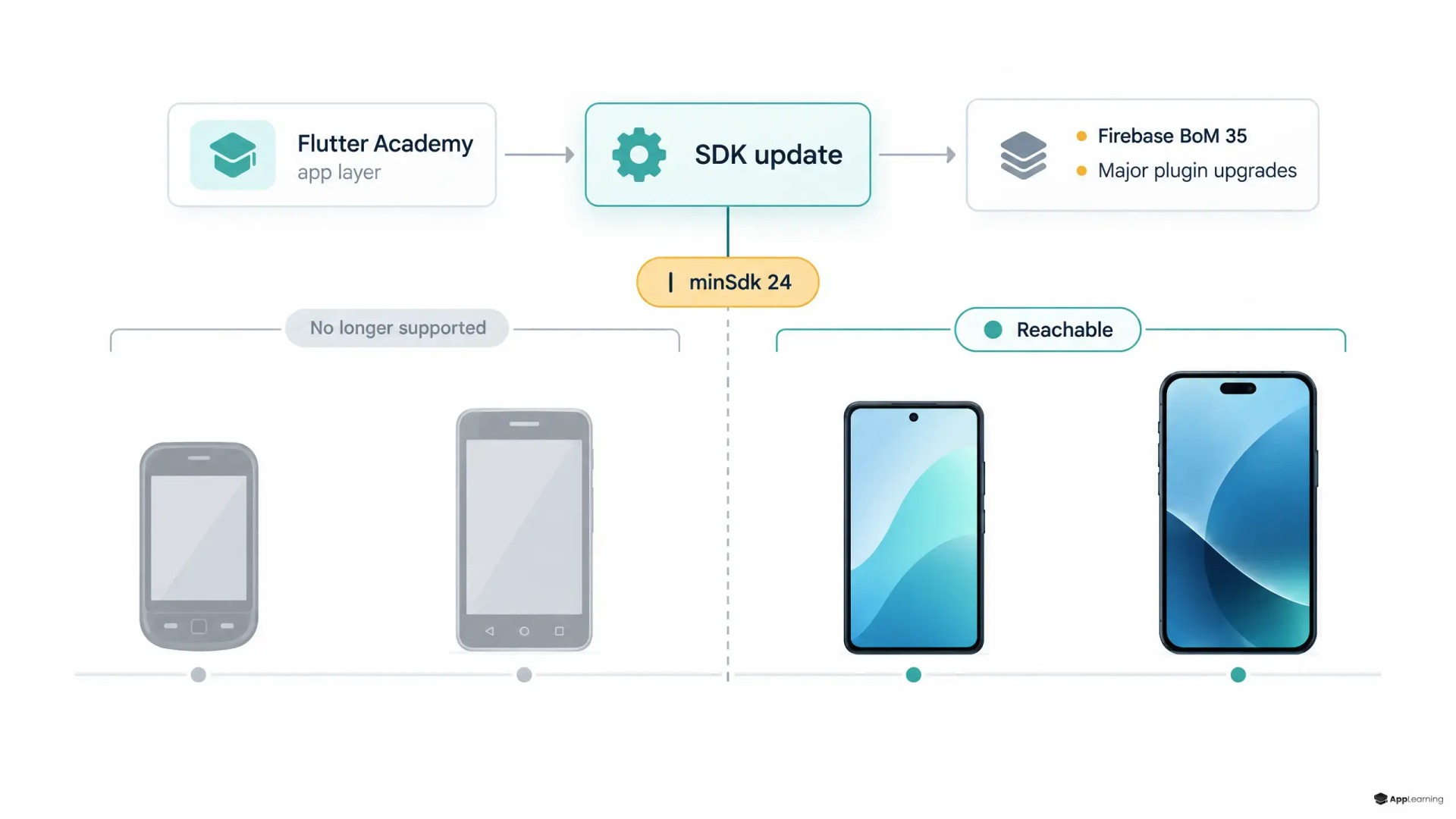
On October 15, 2026, Flutter BoM 5.0.0 shipped with major plugin releases including `firebase_auth` 7.0.0, `firebase_ai` 5.0.0, `cloud_firestore` 7.0.0, and `firebase_messaging` 17.0.0. Its release notes also state that many Android components build on Firebase BoM 35 and require minSdk 24. That changes the release conversation. A learning module can become technically stronger while part of its learner base becomes unreachable. (firebase.google.com)
API level 24 is Android 7.0, as shown in Android’s platform reference. That fact does not tell a fintech how many learners it will lose. It does tell product and engineering teams to stop treating the device floor as a build detail. In financial-agent networks, rural deployments, and consumer fintech products with long-tail devices, mobile learning device coverage is part of activation and retention. (developer.android.com)
A Release Becomes a Coverage Decision
FlutterFire 5.0 is not a narrow library update. The release lists breaking changes across Auth, Firestore, AI, Core, App Check, Analytics, Crashlytics, Remote Config, Messaging, and more. The phrase Firebase Flutter minSdk 24 should therefore trigger a resolved-build review, not a blanket assumption that every existing host app has the same outcome. The final Android learning app compatibility boundary comes from the host app’s dependency graph, manifest merge, Flutter version, native code, and the Firebase plugins actually included. (firebase.google.com)
A learner coverage gate should require proof before a client or host-app release:
- Inspect the production dependency graph and generated manifest for the release candidate.
- Build and install the candidate on representative API, ABI, memory, and network cohorts.
- Test login, App Check, lesson launch, progress sync, and notification journeys end to end.
- Compare supported-device reach against the current learner and prospect fleet.
- Set an explicit business threshold for any coverage decline and name the accountable release owner.
Segment Devices Before the Feature Flag
Do not use global Android adoption figures as a substitute for tenant data. A fintech should segment its own active and recently active learners by Android API level, app version, device model, market, connectivity pattern, and critical journey. Add partner-managed device inventories where they exist. Historical data matters because the people most likely to be excluded after a new minimum are often no longer represented in a fresh install funnel.
The decision metric is not only whether the new application launches. Measure the share of intended learners who can reach the academy, sign in, start a required module, complete a lesson, preserve progress after interruption, and receive a useful completion or reminder message. This turns embedded LMS Flutter delivery from a technical integration status into an operational service level.
The Host App Is the Real Integration Boundary
An embedded Flutter module does not operate in isolation. Flutter supports add-to-app modules within existing native applications, but its guidance makes clear that plugins can bring Android dependencies into the outer app and that some required native project edits belong there. A module-level green build is not sufficient evidence that the host release is safe. (docs.flutter.dev)
For an App-Learning integration, validate the handoff from host identity to the academy, token refresh after backgrounding, deep links into assigned content, notification routing, offline progress capture, and server reconciliation. Include the entry and exit points in the test plan. A learner who finishes a quiz but cannot return to the financial product has not completed the product journey.
Good to know
Does FlutterFire 5.0 automatically exclude every device below Android 7.0?
No. The relevant FlutterFire plugins state an Android minSdk 24 requirement, but the practical outcome depends on which plugins the host app resolves and how its final Android build is configured. Review the FlutterFire release notes and verify the production artifact rather than inferring support from one dependency label.
Which cohort should define learner coverage?
Use learners who need the academy, not only recent app installers. Start with active and recently active users, then segment by OS version, host-app version, market, device family, and partner-managed fleet where available. Include prospective or dormant cohorts when a mandatory education campaign will target them.
What should a fallback path preserve?
At minimum, preserve authenticated access, the assigned learning path, completion evidence, and a route back into the host product. A fallback that forces learners to repeat work or creates an unverified completion record will increase support demand rather than reduce release risk.
Rollback Must Protect the Learner
Release the migration in cohorts. Keep the previous module artifact and dependency lock available. Use remote configuration or a host-side kill switch to suppress the learning entry point if a critical path fails. For devices outside the new supported path, offer a clear fallback such as mobile web learning, a lightweight legacy flow, or an assisted channel for mandatory training. The fallback must preserve identity and completion records where that is required.
Map learner device coverage before your next SDK release.
AssessCoverage Is the Release Metric
Put a compact scorecard beside crash-free sessions: supported learning devices, successful academy opens, successful logins, lesson starts, lesson completions, progress-sync success, and notification delivery. Break every measure down by Android version, host-app version, market, and partner tenant. A stable aggregate can conceal a failing field cohort.
The learner coverage gate does not argue against FlutterFire 5.0. It makes the trade-off explicit. Security, platform support, and new capabilities matter, but so does the ability of a field agent or new customer to learn the product at the moment they need it. For embedded education, a release is complete only when the intended learner can still reach, trust, and finish the experience.