

Key takeaways
- Complex SaaS onboarding needs more than UI prompts.
- Customer academies teach the reasoning behind high-value actions.
- The strongest stacks combine in-app guidance with structured learning.
- App-Learning fits fintech teams where education drives activation and trust.
The best customer onboarding software for SaaS is rarely one tool. It is a system that gives users the right prompt at the right moment, then gives them enough understanding to act with confidence. That distinction matters in fintech. A user can complete identity verification, connect a bank account, or open a wallet without understanding fees, risk, permissions, or the next safe action.
Product tours, checklists, emails, help content, and customer academies solve different problems. Treating them as substitutes creates a familiar failure mode: users click through onboarding, appear activated in a dashboard, and still disengage before they reach durable value.
One onboarding problem needs several layers
Most SaaS onboarding software focuses on in-product guidance. That is useful. Appcues supports walkthroughs, checklists, embedded content, and resource hubs, while Pendo provides embedded guides, walkthroughs, tooltips, targeting, and guide measurement. These tools reduce interface friction. They should not be expected to carry every educational job.
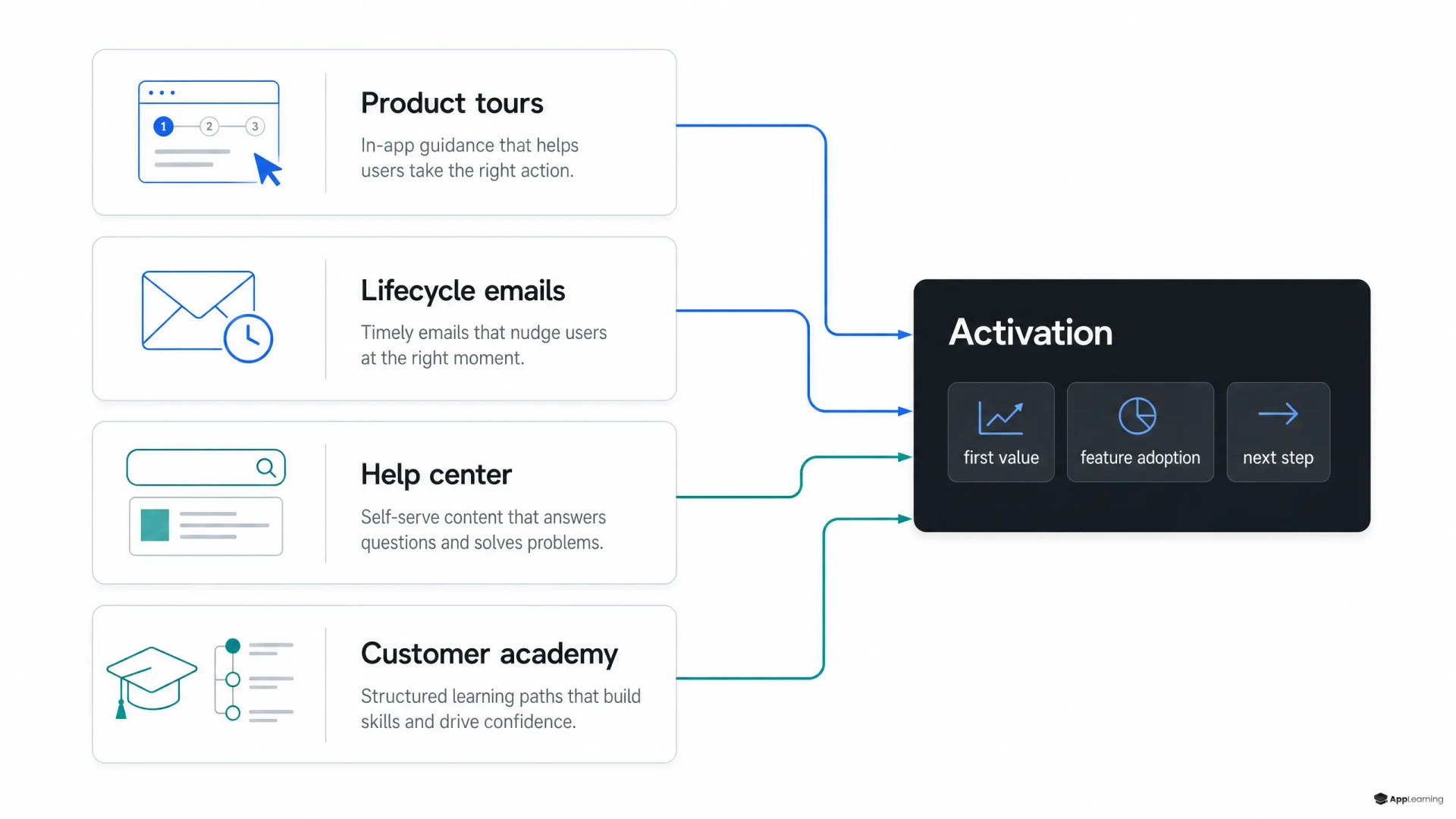
- Product tours and interactive walkthroughs fit a user who needs to find a control, complete setup, or learn a short workflow.
- Checklists fit a user who needs a visible activation path with clear milestones and progress.
- Lifecycle emails and messages fit a user who has left the product or needs a timed reminder to return.
- Knowledge bases fit users with a specific support question they can name and search for.
- Customer academies fit users who must understand concepts, compare options, apply rules, or build confidence before a consequential action.
The category decision should follow the friction. Do not deploy a course because a tooltip performed poorly. First establish whether the user lacks orientation, motivation, access to an answer, or understanding. Each calls for a different intervention.
Interface guidance has a clear boundary
Tours work best when the product itself can teach the task. A user can learn “upload a file” or “invite a teammate” by doing it. In contrast, a wealth product cannot teach diversification through a highlighted button. A crypto product cannot explain custody or transaction finality with a three-step modal. The UI can direct the action, but it cannot reliably build the mental model behind it.
That is where structured education becomes part of activation. A short lesson can explain the concept. A scenario or quiz can test whether the user understood it. The product can then return the user to the relevant action. This is not education bolted onto onboarding. It is a controlled handoff between learning and product use.
The academy layer turns explanation into a system
A customer onboarding platform needs an academy layer when the same explanations recur across onboarding, support, product marketing, and customer success. Skilljar positions customer education across academy, community, and in-app moments, with learning paths and reporting. App-Learning is designed for branded microlearning academies with tailored content, learning paths, quizzes, and analytics for external users.
For a fintech product team, the practical use case is narrow at first. Map the highest-risk or highest-drop-off moment. Build a small path around that moment. Link it from the relevant product screen, email, and support response. Track learning progress alongside the product action that follows. Expand only after the first path proves useful.
Selection criteria should mirror the activation model
Buying software by feature checklist alone produces disconnected tooling. Choose a SaaS onboarding software stack against the actual journey, data model, and ownership model.
- Define the activation event. Name the user action that signals first value, not merely account creation or tour completion.
- Separate navigation from education. Use guides for immediate interface actions and structured learning for concepts, risk, and decision rules.
- Require behavioral triggers. Guidance and learning assignments should respond to role, entitlement, market, product use, or stalled progress.
- Measure the handoff. Track lesson completion, assessment performance, return to product, and completion of the target action.
- Set content governance. Fintech explanations need clear owners, review workflows, version control, and a way to retire outdated guidance.
Good to know
Should a customer academy replace product tours?
No. Product tours handle immediate interface guidance. An academy handles concepts, decision rules, and progressive learning that cannot fit inside a tooltip or checklist.
When does a customer academy become necessary?
Add one when misunderstanding blocks activation, drives repeated support demand, creates risk, or limits adoption of advanced product capabilities.
Which metric proves the onboarding stack works?
Measure the target activation action after the learning or guidance intervention. Completion rates matter, but they are only leading indicators.
Tool fit follows the type of friction
Choose Appcues, Pendo, Userpilot, or Chameleon when the priority is contextual product guidance and rapid iteration inside the interface. Choose messaging and support tools when re-engagement or self-service is the constraint. Choose a customer academy platform when users need sequenced education, reusable learning objects, assessments, and evidence of readiness. For complex fintech products, App-Learning fits beside in-app guidance when product understanding is part of the activation requirement rather than a support afterthought.
Build onboarding that turns understanding into confident product action.
TalkA stack is ready when the handoffs are clear
- Can the user see the next product action without hunting for it?
- Can the user access a short explanation without leaving the journey?
- Can the team distinguish clicked guidance from genuine understanding?
- Can Product, Growth, CX, and Compliance use the same approved content?
- Can the team link learning data to the activation event that matters?
The best setup does not force every user through more content. It gives each user the minimum guidance needed to take the next meaningful action safely and confidently. Product tours make the interface easier to navigate. Structured education makes a complex product easier to trust, use, and return to.