

Key takeaways
- B2B2C stablecoin launches multiply the teams that must explain the product.
- Partner readiness should be a launch gate, not an optional webinar.
- Integration, operations, support and customer-facing teams need different learning tracks.
- Readiness checks expose weak handoffs before they become customer escalations.
- A reusable academy scales distributor enablement without rebuilding it partner by partner.
Distribution becomes part of the product
A regulated stablecoin is not ready because its smart contract, reserves and compliance programme are ready. It becomes usable when the organisations that bring it to market can operate it with the same clarity. That includes distributors, wallets, exchanges, payment providers, custody partners and application teams.
Anchorpoint’s model makes the point clearly. Its Beta Access documentation limits access to corporates and professional investors through select authorised distributors, while a fuller launch is targeted as early as the end of 2026. In this B2B2C stablecoin model, distributors own the customer interface, account relationship and much of the practical explanation. The issuer still owns the product risk, rules and ecosystem integrity.
This changes the launch boundary. Product documentation is necessary, but it does not tell a distributor’s support agent how to explain a rejected wallet transfer, a delayed conversion or a compliance review. It does not tell an integration team who owns an incident. Nor does it ensure that a customer receives a consistent explanation of redemption, eligibility or the limits of self-custody.
Documentation does not create operating competence
In a B2B2C rollout, knowledge breaks at the handoffs. Issuer teams understand the stablecoin’s design. Partner engineers understand their own stack. Operations teams know their controls. Customer-facing teams see the questions that neither side anticipated. Without a shared operating model, each group fills gaps with assumptions.
The risk is not only inaccurate messaging. It is fragmented action. A customer query can move from distributor support to an issuer compliance team without an agreed case taxonomy. A product team can release a new wallet flow without updating customer education. An integration can work in testing while its exception paths remain undefined. Anchorpoint’s wholesale distribution model also shows why this matters: authorised distributors undergo due diligence and onboarding, then become the practical access point for end users.
A distributor-readiness standard closes the gap
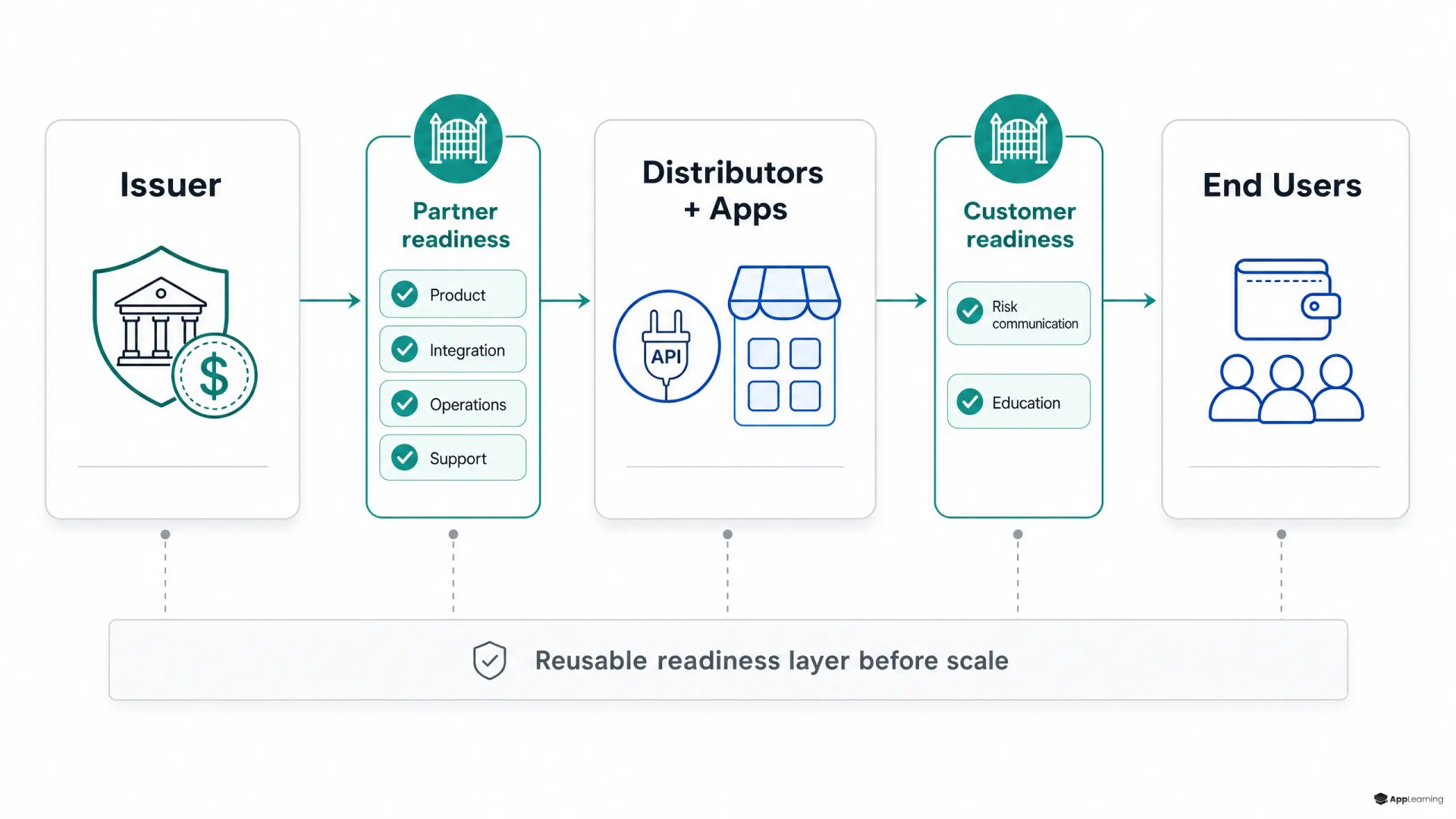
The missing layer is a reusable standard that turns issuer policy and technical material into role-specific competence. Stablecoin partner training should be treated as product infrastructure. It needs owned content, release management, version control, assessment rules and an auditable record of completion.
- Product truth: what the stablecoin is, what it is not, and where its value proposition stops.
- Role clarity: who owns issuance, conversion, custody, transaction review, complaints and incident communication.
- Risk communication: how to describe redemption, wallet controls, fraud exposure, eligibility and service limits without improvised language.
- Support handoffs: when a case stays with the distributor, when it moves to the issuer, and what evidence travels with it.
- Change control: how new features, policy changes and incident learnings reach every relevant partner role.
Four tracks prevent one-size-fits-none training
A single onboarding deck creates false confidence. Stablecoin onboarding should separate the work people must perform, then give each group the minimum knowledge and practice needed to do it well.
- Integration track: APIs, wallet and whitelist logic, test scenarios, monitoring, failure states and escalation routes.
- Operations track: settlement flows, reconciliation, compliance triggers, exception management and evidence capture.
- Support track: approved explanations, case triage, vulnerable-customer signals, complaint routing and prohibited claims.
- Customer-education track: clear in-app guidance on access, conversion, wallet verification, transfer constraints and the difference between a payment instrument and an investment product.
This is where a stablecoin academy earns its place. Rather than sending every partner a static knowledge base, issuers can provide modular learning inside a distributor’s web or mobile product, paired with internal role training. App-Learning can support that system with branded learning journeys, multilingual content, quizzes and analytics that reveal where understanding still fails.
Good to know
What is a B2B2C stablecoin rollout?
It is a model in which the issuer reaches end users through regulated distributors and application partners. In Anchorpoint’s B2B2C model, authorised distributors provide customer-facing access and supporting services while the issuer manages the core stablecoin framework.
Why is stablecoin partner training different from product documentation?
Documentation explains the product. Training prepares people to act in real workflows, including failed transfers, compliance questions, support handoffs and risk communication. Each role needs scenarios that match its decisions and accountabilities.
What should a distributor readiness check include?
It should verify role-based learning completion, scenario assessment results, tested integration and incident paths, approved customer education, escalation contacts and operational ownership. The check should be repeated when material product or policy changes occur.
Readiness must be evidenced before go-live
Partner enablement becomes a launch gate when it produces evidence, not attendance. Before a distributor goes live, the issuer should require role completion, scenario-based checks, named escalation owners, tested support routes and approved customer copy. The goal is not to make every employee a stablecoin specialist. It is to ensure that each person can make the next correct decision.
Measure the system before expanding access. Track completion by role, assessment performance by topic, time to resolve test cases, failed handoffs, support-contact reasons and the knowledge gaps found in live journeys. These signals show whether the distribution layer is ready for higher volumes and broader customer segments.
Turn issuer documentation into an operating readiness system.
TalkReadiness compounds with every new partner
The long-term advantage is not a polished first launch. It is a repeatable operating layer that can be deployed to the next distributor, market or use case without rewriting the basics. Regulated stablecoins will win trust through consistent behaviour across the network. The issuer that makes partner competence measurable builds a stronger route from technical availability to reliable adoption.