

Key takeaways
- Frontline competence means accurate explanations, clear boundaries and reliable escalation.
- Customer scenarios reveal judgment that recall-only crypto quizzes cannot measure.
- MiCA, AML and product changes require a maintained training release process.
- Short mobile learning supports frequent refreshers within frontline work.
The customer dialogue is the new job
Crypto has moved from a specialist innovation topic into a frontline readiness issue for banks that offer, plan or support digital-asset services. GenoAkademie’s 2026 crypto programme lists blockchain and regulatory courses and frames its formats for people working internally or in customer dialogue. The operational implication is simple: crypto training for banks must prepare staff for the questions customers actually ask.
That pressure is also regulatory. The EU’s MiCA framework has applied fully since 30 December 2024, creating a common rulebook for crypto-asset service providers. Yet a customer does not begin with the rulebook. They ask whether the bank holds their assets, whether a wallet is safe, whether MiCA makes an investment safe, or whether the adviser recommends buying a specific token.
A relationship manager who passes a crypto quiz but cannot handle those questions in plain language is not ready. The problem is not a lack of definitions. It is a gap between knowledge recall and customer-facing judgment.
Bounded competence beats specialist depth
For institutions providing crypto-asset services, ESMA distinguishes between staff who give information and staff who give advice, with a higher expected level of knowledge and competence for advice. Information staff still need to understand product features, risks, costs, relevant regulation and the practical effects of core technology. That does not require protocol-engineer depth. It requires a reliable working model of the services the bank makes available.
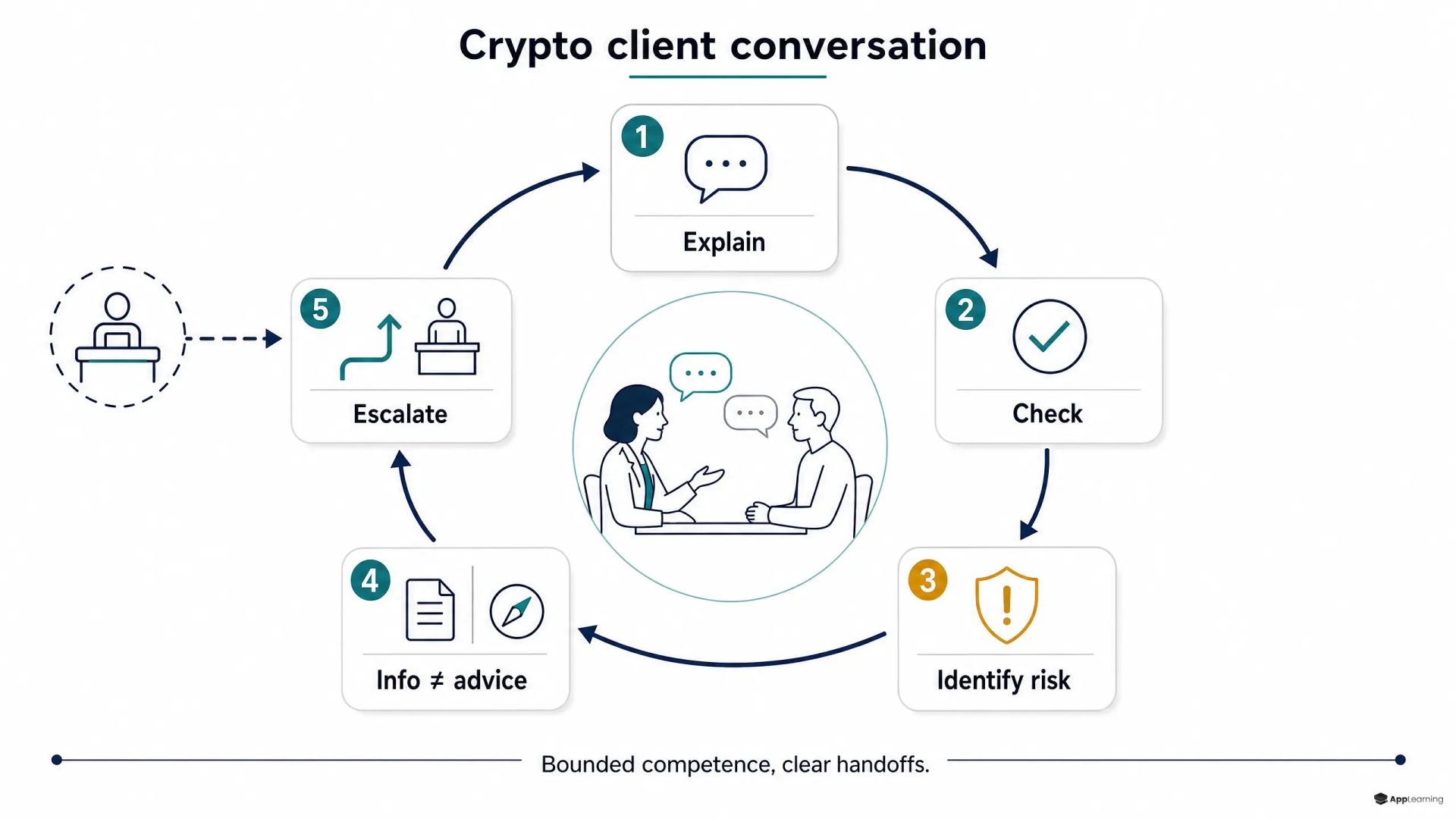
A useful digital asset training standard separates three actions:
- Explain the bank’s offering, custody model, customer responsibilities, costs, key risks and the limits of regulation in clear language.
- Clarify common misconceptions without making assurances, predictions or product recommendations outside the employee’s remit.
- Escalate personalised investment requests, suitability questions, complex transfers, suspected fraud, AML concerns, tax or legal questions, and incidents beyond the approved service path.
Custody should be a mandatory scenario. Staff need to distinguish between the bank’s custody arrangement, a customer-controlled wallet and the consequences of losing access credentials. They also need to avoid presenting regulation as a guarantee or confusing a crypto-asset holding with a protected bank deposit. This matters because ESMA expects information staff to understand how MiCA safeguards differ from MiFID II protections.
A quiz cannot observe a customer conversation
Recall-only tests remain useful for checking terminology. They cannot show whether an adviser will overstate protection, confuse information with advice or fail to escalate. Crypto training for advisers should therefore assess short, realistic customer exchanges rather than only multiple-choice answers.
Build branching scenarios around the moments that create operational risk. A customer asks whether a stablecoin is risk-free. Another wants to transfer assets to an unsupported network. A third asks which token the adviser would buy. The learner must select the next response, explain the reason in plain language and choose the correct hand-off path.
Score the observable behavior, not confidence or jargon. A robust bank staff training rubric checks whether the employee gives an accurate explanation, identifies the applicable boundary, avoids unauthorised advice, uses the approved customer wording and escalates with enough context for the specialist team to act.
Good to know
What should frontline staff know about crypto?
They should understand the bank’s approved services, custody model, major risks, customer responsibilities, relevant disclosures and escalation routes. Their knowledge should match the role they actually perform.
When should an adviser escalate a crypto question?
Escalation should begin when the customer seeks a personalised recommendation, a suitability judgment, legal or tax interpretation, support for an unsupported transaction, or help with a suspected fraud or financial-crime concern.
How should banks measure crypto training effectiveness?
Measure performance in realistic customer scenarios, especially explanation quality, role-boundary decisions and escalation accuracy. Completion and quiz scores are supporting signals, not proof of customer readiness.
Compliance updates need a content operating model
Training cannot be treated as a one-off launch module. ESMA published its MiCA knowledge-and-competence guidelines on 28 January 2026, and they apply six months after publication in all EU languages. The guidelines also call for ongoing reviews of staff needs, attention to regulatory and market developments, and training before a provider offers a new type of crypto-asset or service.
L&D therefore needs a release process, not a static curriculum:
- Assign clear owners for regulatory monitoring, product changes and customer-risk signals.
- Translate each change into a small learning delta with approved wording and an escalation rule.
- Target the right roles instead of reassigning a full programme to every employee.
- Revalidate changed decisions through a short scenario before staff return to the customer interaction.
- Keep version history, completion data and performance evidence together for compliance review.
Short mobile modules work well here because the unit of change is often small: a revised custody flow, a new disclosure, a product launch or an updated escalation path. App-Learning can turn these changes into focused simulations that fit frontline work and generate evidence beyond course completion.
Build crypto readiness around the customer moment.
PlanReadiness must be visible at the customer moment
Measure readiness by task. Track scenario performance by customer intent, product, risk type and escalation decision. Review where people give correct facts but choose the wrong next step. Compare update assignment dates with validated readiness. Use supervised cases as a bridge when a new employee has not yet shown independent competence.
The standard is not whether employees can repeat the definition of blockchain or MiCA. It is whether they can help a customer understand the service, state the relevant limits, avoid crossing into unauthorised advice and bring in the right expert at the right time. Train that conversation, test that judgment and keep the evidence current.