

Key takeaways
- LMS tools are strongest where assignment, certification, and audit evidence need firm control.
- Employee microlearning works best for short, role-based decisions inside the flow of work.
- Content volatility and proof requirements should determine the learning architecture.
- App-Learning supports modular paths with measurable outcomes across compliance and capability topics.
The decision is about control and cadence
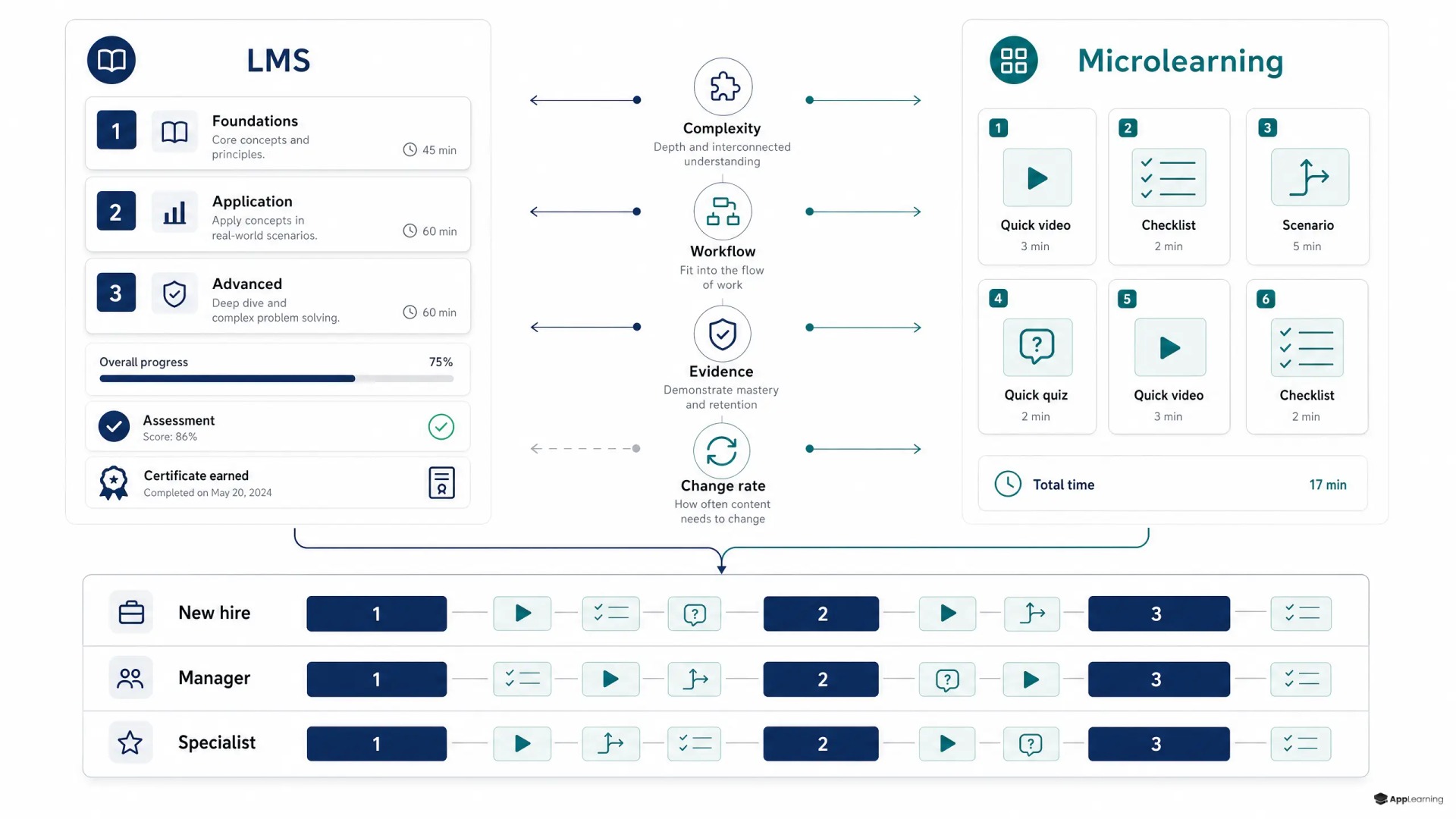
The <strong>LMS vs microlearning platform</strong> decision is often framed as a choice between old and new. That framing misses the real issue. An LMS is primarily a system for organising training: users, enrolments, curricula, prerequisites, certificates and reporting. A microlearning platform is primarily a delivery model for focused learning moments. The right choice depends on four operating conditions: training complexity, learner workflow, evidence requirements and the rate of content change.
A learning platform should match the work it must support. If a team needs to assign a multi-part certification programme, control access by role and retain completion records, an LMS is the natural centre of gravity. If a team needs to help staff recognise a new fraud pattern, explain a product change or rehearse a customer conversation, a short module delivered close to the moment of need is often more useful. A systematic review of 40 microlearning studies describes microlearning as targeted, action-oriented content designed for a specific objective in a short period.
Structure and moments serve different learner needs
- Learner experience: LMS programmes ask people to set aside time and complete a defined path. Microlearning gives them a concise lesson, scenario or quiz that solves one immediate knowledge need.
- Administration: LMS tools concentrate control. They are built for assignments, cohorts, approvals, recertification cycles and standard reports. Microlearning reduces the effort needed to publish and consume small updates.
- Content design: Long-form curricula can carry policy context, practice and formal assessment. Short modules work when each unit has one clear decision, behaviour or concept.
- Evidence: Completion is only one signal. Regulated teams also need to see who received which version, what they understood, where they failed and whether the content reached the right role.
Compliance needs a reliable evidence layer
For finance and crypto companies, compliance training should not become a library of long, forgotten courses. It needs controlled assignment, version discipline and defensible records. The exact duty varies by market and activity. For example, FINRA Rule 3110 requires relevant education, documentation of that training and follow-up in its correspondence supervision context. In the EU, Article 13 of DORA requires financial entities to make ICT security awareness and digital operational resilience training compulsory for employees and senior management.
That does not mean every compliance topic needs a 45-minute course. Use a formal path for the policy, attestation and assessment. Then use employee microlearning to reinforce high-risk behaviours when procedures, products or threats change. The learning record must connect both layers: the authoritative programme and the short reinforcement modules that keep it current.
A modular academy removes the false choice
The microlearning platform vs LMS debate becomes less useful when the organisation needs both governance and speed. A modular academy can hold role-based learning paths, certificates and measurable assessments while also publishing short, updateable modules for product knowledge, risk, fraud, onboarding and internal processes. App-Learning’s academy platform is designed around that model, combining tailored paths, content updates, microlearning modules and learner analytics in one branded environment.
This model works well when the learning stack is fragmented. Keep the existing LMS where it remains the system of record or where enterprise integrations matter. Build a focused academy where content owners need to update learning without a release cycle, managers need role-level visibility and learners need training that feels connected to their work. Do not duplicate every course. Separate stable, governed programmes from fast-moving operational knowledge.
Good to know
Can a microlearning platform replace an LMS?
Sometimes, but not always. It can replace an LMS for focused, fast-changing training needs. It is less suitable when the organisation needs complex curricula, formal certification workflows, extensive integrations or a central enterprise learning record.
Which setup is best for compliance training?
Use a governed learning path for mandatory policy, assessment, attestation and evidence. Add short reinforcement modules for recurring risks, procedural changes and role-specific scenarios.
How should HR and L&D measure learning impact?
Track completion and assessment data, then connect them to the job. Look for reduced knowledge gaps, faster onboarding, stronger scenario performance and fewer recurring process errors.
Measure decisions rather than completions
Analytics should answer more than whether people finished. For onboarding, measure time to productive task performance and recurring knowledge gaps. For upskilling, compare confidence and assessment results before and after practice. For compliance, track assignment coverage, completion, version history, quiz performance and overdue groups. For product or risk updates, look for the roles that struggle with a scenario and use that signal to improve the next module.
Build a learning system that keeps pace with your risk and product changes.
TalkChoose the system that fits the work
- Choose an LMS-led setup when training is long, highly structured, centrally administered and dependent on formal certification or audit trails.
- Choose a microlearning-led setup when content changes often and staff need short, role-specific knowledge in the flow of work.
- Combine both when compliance and onboarding need formal learning paths, but product, risk and process knowledge need frequent reinforcement.
- Choose a modular academy when one platform must support structured paths, fast content updates and analytics without forcing every learning need into a traditional course format.
The strongest learning systems do not chase a format. They make the required behaviour easier, keep critical knowledge current and produce evidence that leaders can trust. Start with the work, the risk and the update cycle. The technology choice becomes much clearer after that.