
Key takeaways
- Fluent AI content can still have weak or unclear origins.
- Provenance records make reviews, updates and audits more reliable.
- Source lineage should cover lessons, quiz answers and visual assets.
- Human approval and version history remain central to accountable AI content operations.
AI Learning Content Needs Provenance Records
AI can accelerate course production, but it also breaks the old assumption that a polished module is enough evidence of quality. A lesson may be clear, engaging and instructionally sound while its claims, image rights, quiz answers and edits remain hard to trace. For finance and crypto teams, that is not a minor documentation gap. It is an operational risk when policies, products and regulatory expectations change quickly.
AI assistance creates a lineage problem
Traditional content QA asks whether a module is accurate, usable and aligned with the learning objective. AI-assisted production adds another set of questions. Which approved sources informed this claim? Which model or tool transformed them? Was an answer generated, rewritten or merely formatted? Who checked it against current policy? A recent review of quality assurance in GenAI-mediated education identifies transparency, reliability, governance and assessment integrity as recurring concerns. Pedagogical QA remains necessary, but it cannot answer these lineage questions alone.
The risk often surfaces later. A compliance owner asks why a quiz marks one response as correct. A product rule changes and a team must find every affected lesson. Legal needs to confirm whether a visual asset can remain in use. Without learning content traceability, teams must reconstruct decisions from chat histories, shared drives and individual memory.
The record behind an approved module
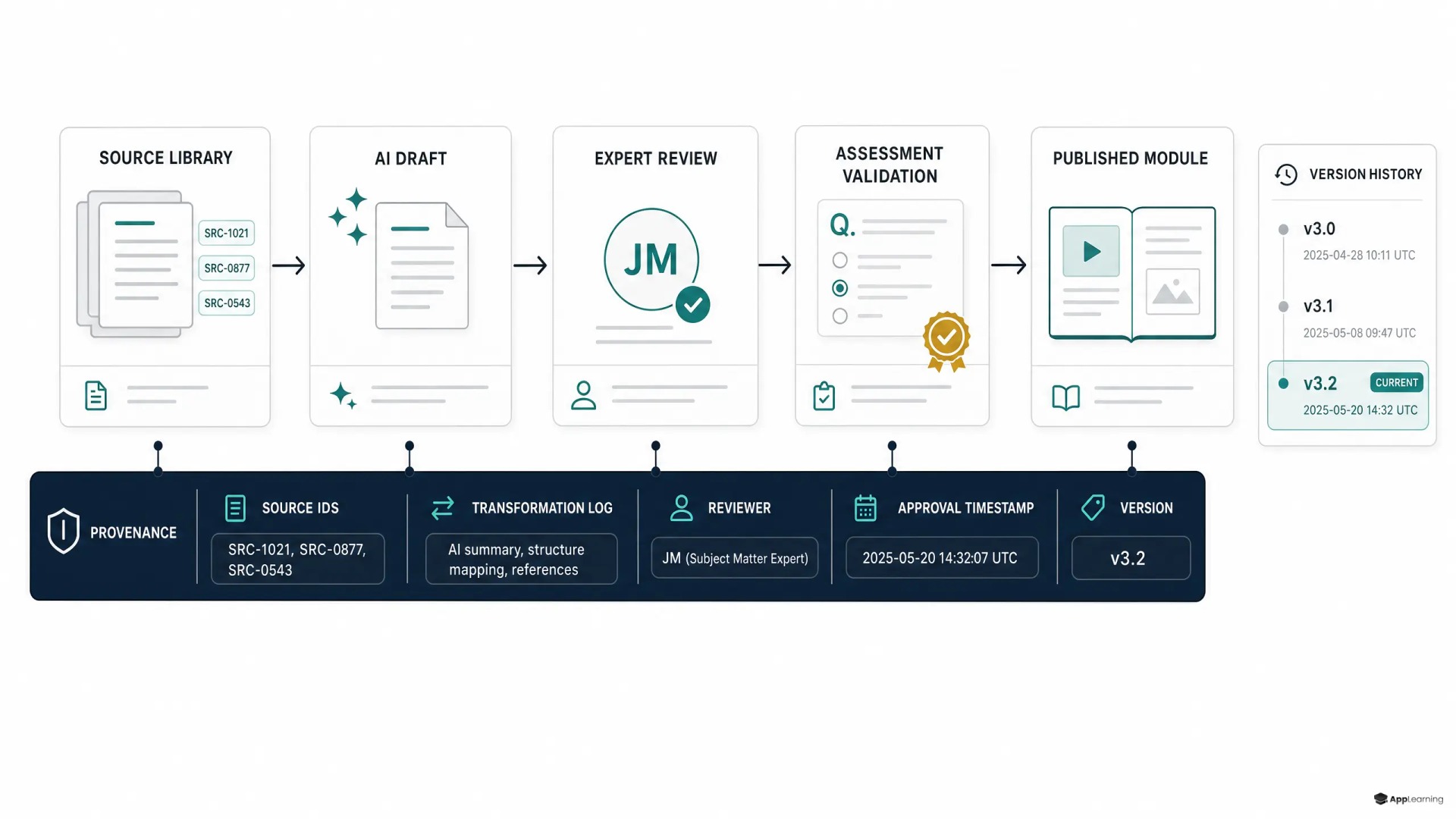
An AI content provenance record is a structured record attached to a module and its component assets. It should not be a long narrative or a folder of screenshots. It should make evidence, transformations and accountable decisions inspectable at the point of use.
- Module identity, owner, audience, learning objective and risk classification
- Approved source references, source dates, rights or licence status and the claims each source supports
- AI transformation details, including tool, model or workflow version, purpose and generated components
- Human reviewers, review criteria, decision, approval state and any conditions for publication
- Version history, change rationale, affected assessments and the next review trigger
- Asset-level lineage for images, video, diagrams, simulations and answer keys
This structure extends source attribution in learning beyond footnotes. It connects a published statement to its underlying evidence and connects a revision to the person who accepted it. The emerging SLPT learning-provenance specification is one useful signal of this shift: it proposes a machine-readable Learning Provenance Record for AI-mediated education. Teams do not need to adopt that specification wholesale to adopt its core discipline.
QA judges quality while provenance proves process
QA is a decision gate. Provenance is the evidence trail behind that decision. A reviewer can approve a lesson for accuracy and still leave later teams unable to see which source supported a sensitive claim, what the AI changed or whether the reviewer checked the assessment logic. Those are different controls, and both matter.
Technical provenance standards can help with part of the picture. OpenAI's May 2026 work on Content Credentials, C2PA conformance and verification focuses on helping people understand how images and audio were created or edited. That is useful for media assets, but it does not replace the learning operations record. A complete auditable content workflow must also capture instructional intent, source validity, SME review, assessment accuracy and formal approval.
Good to know
Does every AI-assisted lesson need a provenance record?
Use the level of detail that matches the content risk. High-impact compliance, product, policy and assessment content needs a stronger record than low-risk engagement copy.
Should teams store every prompt used to create learning content?
Not always. Store enough information to explain the transformation, reproduce the workflow where needed and support review without retaining sensitive data or unnecessary working material.
Can provenance replace SME review?
No. Provenance shows the evidence and decisions behind a module. SMEs still need to judge whether the content is current, accurate and appropriate for the intended role.
A controlled path from source to release
The practical answer is not to slow every author down with manual paperwork. It is to put lightweight controls into the production flow. Treat each module as a versioned product with evidence attached from the first draft, rather than a document that receives proof only when someone asks for it.
- Start with a source pack of approved policies, product material, internal guidance and licensed assets.
- Generate or draft against that source pack, then label AI-assisted sections and flag unsupported claims for review.
- Run pedagogical, factual and assessment QA as separate checks with named reviewers.
- Publish only after a designated owner approves the release record and its version.
- When a source changes, identify dependent modules, update them and preserve the prior approval history.
This is AI training content governance in operational form. It gives L&D a faster route to release, while giving compliance, legal and subject-matter experts a clear place to inspect and approve what matters. It also makes updates cheaper because teams can locate dependencies instead of rereading an entire academy.
Build learning operations that remain accountable as content scales.
Talk to usTraceability turns academies into maintainable systems
For App-Learning, the opportunity is to treat engaging learning experiences and controlled content operations as one system. A modern academy should make a module easy to consume on the learner side and easy to inspect, update and approve on the operator side. That means connecting content objects, assessments, assets, review tasks and version states instead of scattering them across an LMS, a design tool and inboxes.
The goal is not to prove that AI was involved in every sentence. The goal is to make responsibility visible when a lesson informs high-stakes work. Teams that build provenance into production now will not only handle audits with less friction. They will build learning content that can change at the speed of the business without losing its evidence, ownership or trust.