

Key takeaways
- A usable learner interaction gives the architecture a concrete purpose.
- Original documents make source selection and editorial decisions inspectable.
- Automated drafting, editorial review and expert approval are distinct production steps.
- The delivery environment belongs in the demonstration, not just the proposal.
- Available capabilities, prototypes and roadmap items require separate labels.
Show the Finished Lesson Before Explaining the AI Pipeline
The lesson gives the architecture a purpose
An architecture-first presentation asks buyers to imagine the learning experience while decoding agents, CMS components and integrations. Reverse that burden. For an L&D lead evaluating onboarding or compliance training, an AI course generator demo should start with something inspectable: a branded lesson, a meaningful decision and feedback. The architecture can then explain how that experience was produced.
Four minutes establish the evaluation order
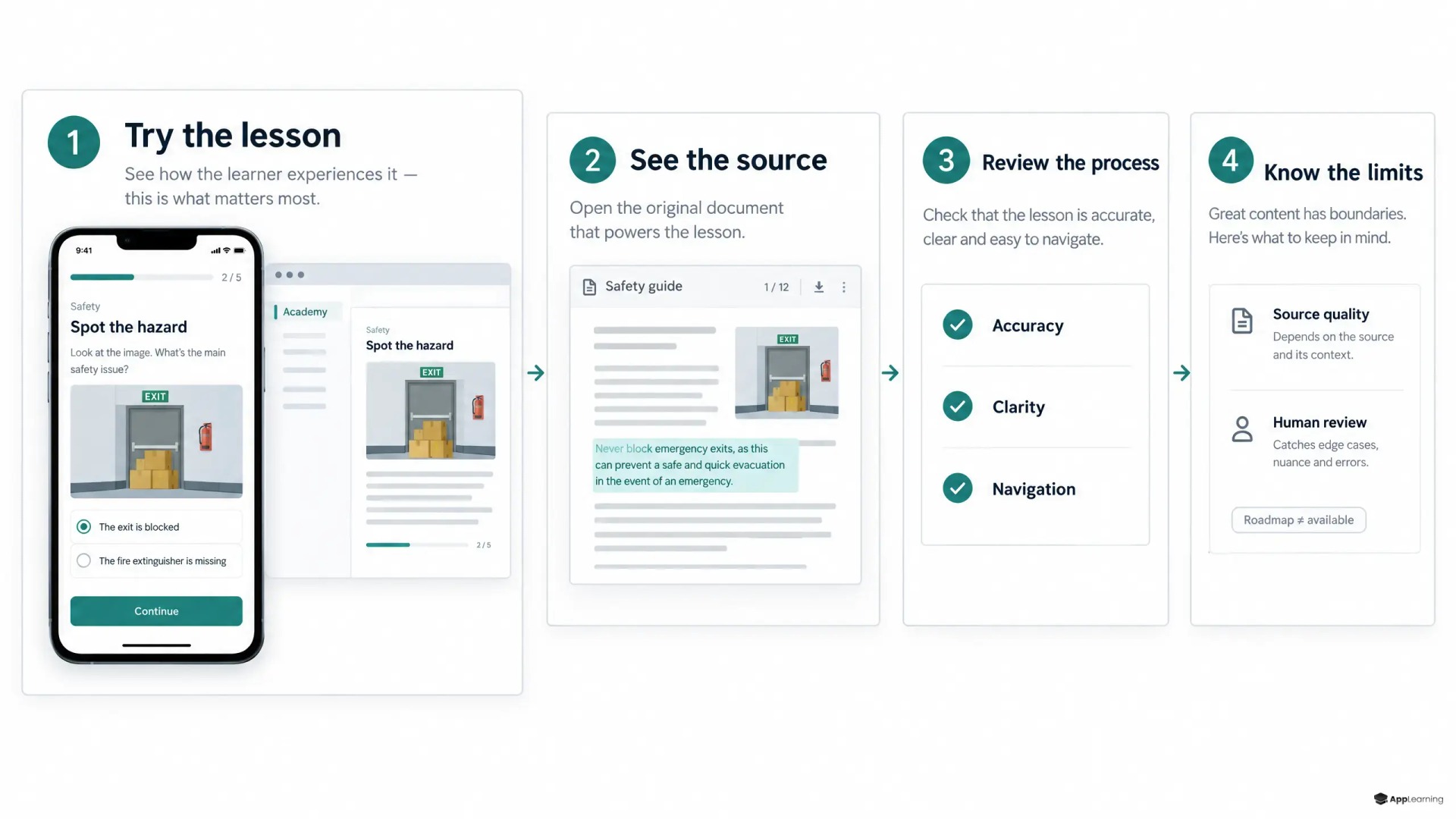
A corporate academy demo can establish the argument in four minutes, leaving deeper technical questions for discussion.
- 0:00–1:00 — Open the lesson, navigate between screens and answer one scenario question.
- 1:00–1:40 — Reveal the original document and the passage behind the lesson.
- 1:40–3:10 — Trace extraction, learning design, quiz drafting, human review and publishing into the actual delivery environment.
- 3:10–4:00 — State current limitations, identify prototypes and separate roadmap intentions from available functionality.
This is a proposed presentation sequence, not evidence of improved conversion or learning outcomes. For App-Learning, it offers a way to present an end-to-end learning experience without implying that every production step is automated.
Source documents expose editorial decisions
NIST’s generative AI profile describes provenance as information about content’s origin and history. (nvlpubs.nist.gov) Applied to a document to course workflow, that suggests showing the source version, selected passage and resulting lesson together. The presenter should explain what was shortened, omitted or rewritten—and which policy qualifications remained intact. A polished screen alone leaves those decisions invisible.
One quiz question makes review inspectable
NIST also identifies confidently stated false content as a generative AI risk. (nvlpubs.nist.gov) A useful demonstration therefore traces one answer and its feedback to evidence, rather than treating fluency as accuracy.
In a fictional onboarding policy, account activation might require manual review. The demo should connect that rule to the correct answer, explain the distractors and identify who checked the interpretation. Automated drafting, editorial revision and subject-matter expert approval should remain separate labels. Any unsupported question should stay unpublished.
Delivery must survive the preview
A microlearning platform proof of concept should run where learners would actually encounter it, not stop inside an authoring preview. The operational check covers hosting, login, permissions, document access, learner records and export.
ADL defines xAPI as a specification for documenting and communicating learning experiences. (github.com) Naming that standard does not demonstrate an integration. A credible test follows an actual learner event into the receiving system. Analytics should distinguish completion, answer accuracy and later performance checks rather than presenting one dashboard number as proof of impact.
Capability boundaries come before the roadmap
NIST’s AI Risk Management Framework calls for evaluation under conditions similar to deployment and documentation of limitations. (airc.nist.gov) For LMS platform evaluation, each demonstrated capability should carry a clear status: available, prototype or roadmap. Manual workarounds and untested integrations belong beside those labels. The buyer should know which parts of the experience can be repeated today before hearing what may arrive later.
Plan a learner-first academy demo with App-Learning.
Plan demoA shared rubric makes demos comparable
The evaluation can use five criteria, each marked demonstrated, documented only or unverified.
- Learner journey and feedback quality
- Source traceability and version control
- Editorial ownership and expert approval
- Delivery environment and observable records
- Capability boundaries and unresolved dependencies
The finished lesson is not proof of deployment readiness, learning impact or ROI. It is the starting point for testing them. A credible demonstration connects the learner’s decision to approved evidence, named reviewers and a verified delivery path—without asking a roadmap to fill the gaps.