

Key takeaways
- Task sequences and decision points matter more than paragraph summaries.
- Preconditions, exceptions and escalation rules belong inside the exercise.
- Every assessment answer needs evidence from an exact source section.
- Rights clearance and expert validation are separate release gates.
- Decision quality reveals more than document coverage or completion.
The Procedure PDF That Became a Decision Drill
A technical manual organizes information for reference. A learning module must prepare someone to make the next correct decision. That distinction should govern PDF to microlearning conversion. A shorter document is not yet a learning experience.
An industrial-learning preparation review considered public access guides, workflow instructions and maintenance material as demonstration inputs. This was document review and a proposed exercise, not a production rollout or evidence of improved learning.
Three decisions give the module its scope
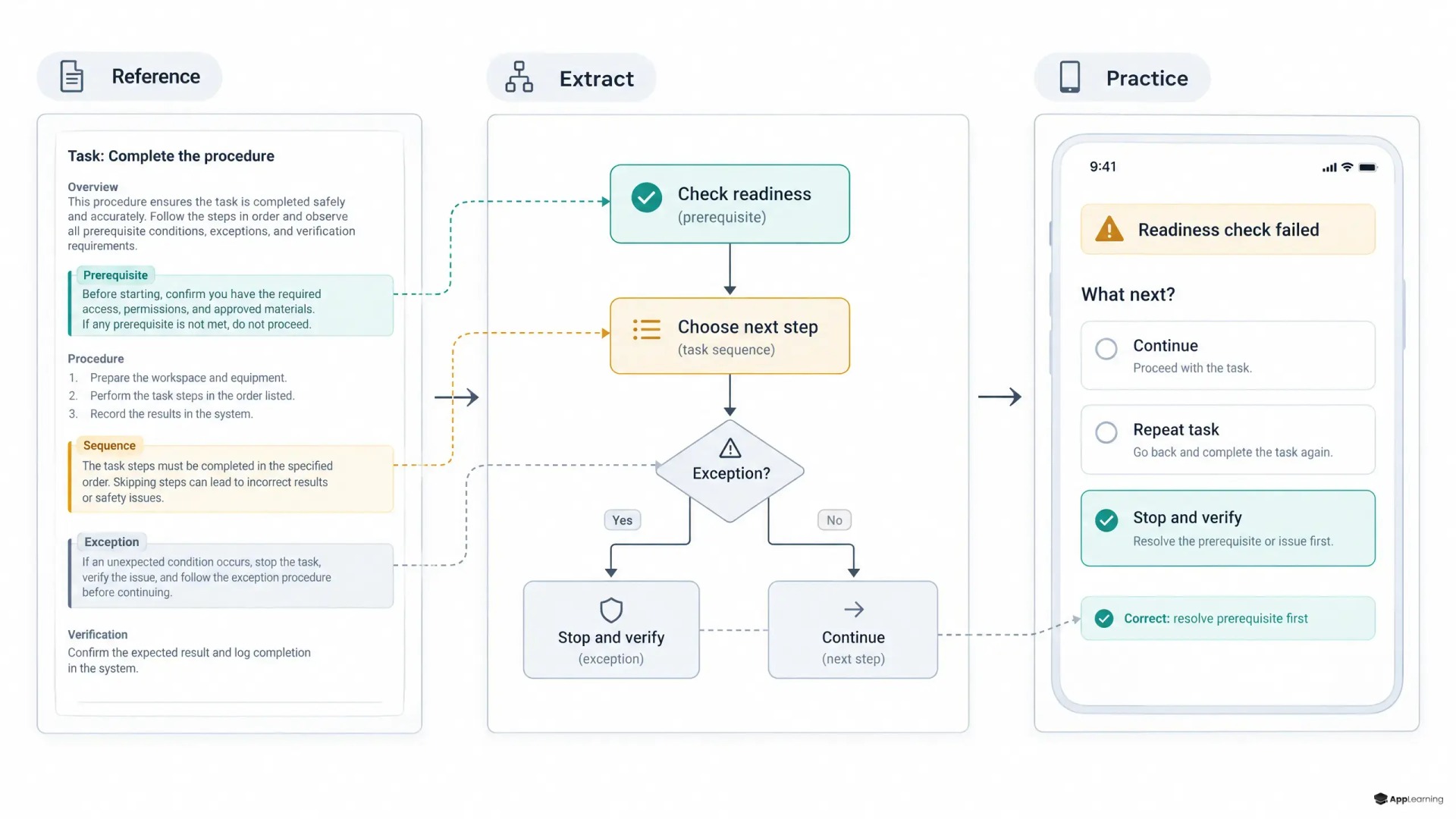
AI course creation from documents should begin with task extraction, not summarization. The working record needs the learner’s role, task sequence, prerequisites, authorization rules, exceptions and escalation path. For one work-order exercise, three decisions might define the scope: whether the request is in scope, whether prerequisites are satisfied and whether an exception requires escalation.
The CDC’s training standards connect assessments to learning objectives and call for realistic scenarios with feedback. (cdc.gov) That supports a narrow design brief: practise one consequential task rather than reproduce every chapter.
One work order becomes a branching exercise
The proposed five-minute module opens with a short briefing, a work-order excerpt and the relevant prerequisites. A synthetic example could use these branches, subject to source confirmation and expert validation.
- Proceed when the task is in scope and all required conditions are satisfied.
- Request authorization when approval is missing but no stop condition applies.
- Stop and escalate when a defined exception or safety condition is present.
Each choice should produce feedback explaining the governing condition, the correct next action and why the alternatives fail. This is scenario-based learning, not a recall quiz with operational vocabulary.
Every branch needs traceable evidence
NIST identifies false content, reasoning and citations as generative AI risks. (nvlpubs.nist.gov) A fluent explanation therefore cannot serve as its own evidence. The conversion workflow needs a source map before publication.
Each branch record should contain the answer, rationale, supporting passage, document revision, page and exact section link. The reviewer checks both the rule and its applicability. Missing or conflicting evidence blocks approval rather than inviting AI to complete the procedure.
Rights and technical accuracy are separate gates
WIPO distinguishes online availability from permission to reuse protected material, subject to applicable licences and exceptions. (wipo.int) Rights review should cover the intended adaptation and distribution before content enters the publishing workflow.
The CDC’s developer checklist calls for subject-matter review and a review or expiry date. (cdc.gov) For procedural training, the expert should test every branch, confirm stop conditions and approve the source version. Rights clearance does not establish operational accuracy.
Turn one approved procedure into a reviewable decision drill with App-Learning.
DiscussThe academy should track decisions, not pages
App-Learning’s role as an academy technology partner is to structure this chain into reviewable explanations, decision points, branches, assessments and versioned source links. The mobile module should retain an owner and review date, with source changes triggering review of dependent branches.
CDC evaluation guidance distinguishes learning from workplace application and recommends before-and-after assessment to examine learning change. (cdc.gov) A suitable module measure is first-attempt accuracy on equivalent unseen scenarios, including unsafe-proceed choices and correct escalations. A later supervised work sample can check application.
The shift from technical manual to training is not compression. It is the construction of a small, verifiable decision environment. The manual remains the reference; the module gives employees a place to practise using it.