

Key takeaways
- Override competence combines identification, verification, authorised decisions, escalation and documentation.
- Ambiguous cases test evidence checking rather than recognition of obvious mistakes.
- Front-line staff, risk owners and managers need different intervention boundaries.
- Decision quality includes justified acceptance and escalation, not just rejection.
- Survey priorities and assessment scores do not establish reductions in operational incidents.
Accountability starts at the handoff
An agent recommends rejecting a customer request. The employee must approve, pause or challenge it. AI agent oversight training should test that decision directly. Course attendance alone does not demonstrate evidence checking, authorised intervention or a defensible decision record.
IBM measures priorities rather than proficiency
IBM’s 21 September 2026 study (newsroom.ibm.com) surveyed 1,500 CHROs and 8,800 employees globally. It reports that 71% of CHROs identify supervising, validating and overriding AI outputs as the workforce’s most essential skill, while 29% of employees rank judgment as important. These differently framed survey priorities are not comparable proficiency scores or causal evidence that training reduces incidents.
Judge Learning Solutions’ 2 November 2026 commentary (judge.com) similarly argues for supervising agents rather than merely operating tools. That is vendor analysis, not measured proof of training effectiveness.
Override competence has five observable parts
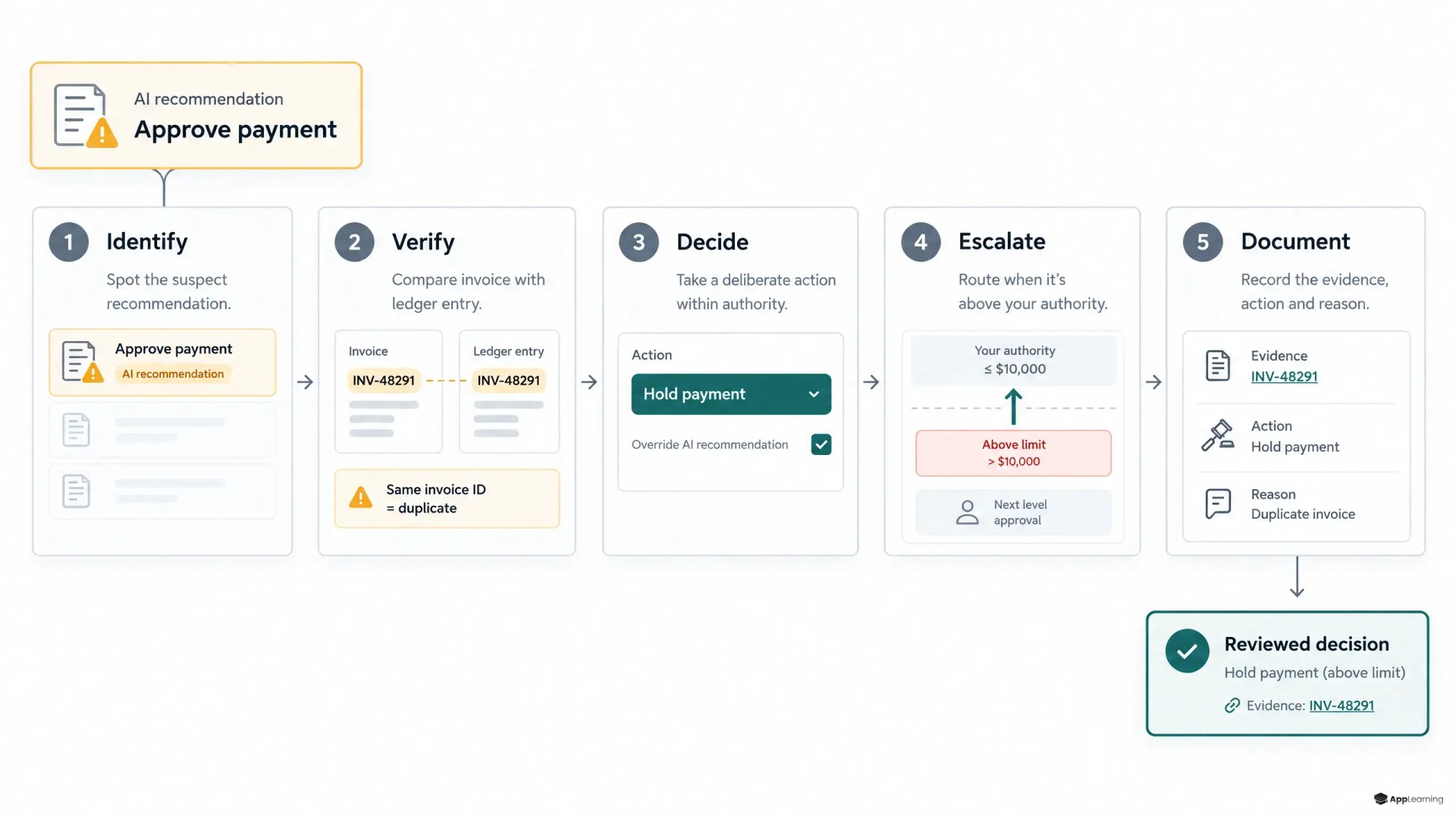
- Identification of the suspect recommendation.
- Verification against records and approved policy.
- Decision within the employee’s authority.
- Escalation when evidence or authority is insufficient.
- Documentation of evidence, action, rationale and ownership.
Buçinca and colleagues’ peer-reviewed experiment (iis.seas.harvard.edu) found that interventions requiring deliberate thought reduced overreliance compared with explanation-only interfaces. It tested interface design, not a bank training programme.
Three minutes expose the decision
Consider an illustrative three-minute bank scenario. An agent drafts a customer message asserting a sanctions breach, but the file shows only a possible name match. The exercise’s approved policy requires specialist review. Front-line staff may pause the message, not clear the alert.
The learner inspects the record, selects an authorised response and writes a handover note. The clue is incomplete evidence, not absurd wording. Other illustrative variants cover an incorrect fraud flag, misrouted workflow and unsupported compliance conclusion.
Safe decisions need more than a button
A proposed AI judgment assessment awards zero, one or two points per behaviour for absent, partial or sound execution. Explanation quality matters alongside the action. A critical authority breach blocks a pass regardless of total points.
Correct recommendations belong in the case bank too. Otherwise, pressing ‘override’ becomes the strategy. Missing evidence should permit a justified pause and escalation, not force certainty.
Calibration separates authority from confidence
NIST’s voluntary AI Risk Management Framework (airc.nist.gov) distinguishes oversight roles and responsibilities. For human in the loop training, managers and employees should first score the same case independently, then reconcile differences against policy with the risk owner.
The rubric should distinguish front-line pause-and-escalate authority, risk-owner disposition decisions and managerial responsibility for unresolved exceptions.
An illustrative App-Learning implementation would turn approved, versioned policy material into role-scoped AI governance microlearning, grade decisions against a human-approved rubric and route uncertain answers to reviewers. These are design examples, not reported client results.
Build a role-scoped override simulation with App-Learning.
DiscussTransfer matters more than completion
Schemmer and colleagues’ peer-reviewed work (cs.ubc.ca) distinguishes appropriate reliance on correct advice from rejection of incorrect advice. A practical dashboard should separate correct interventions among cases requiring action from false overrides among cases requiring none.
Transfer should be checked through fresh scenarios and authorised, sampled live-case reviews after training. A staged rollout with comparable untrained teams would provide stronger evidence than before-and-after scores alone. Case mix and agent changes need tracking.
The target is not more overrides. It is a defensible decision at the right boundary, supported by evidence and handed to someone with authority to act.