

Key takeaways
- Job redesign defines the tasks and decision rights a credential should verify.
- Microlearning prepares learners for simulation rather than replacing hands-on performance.
- Sandbox evidence should capture errors and recovery against a role-specific rubric.
- Simulation scores and workplace transfer require separate measures.
- Vendor surveys and simulation metrics do not establish on-the-job competence.
Why a Robotics Credential Begins With Job Redesign
ABB Robotics’ 21 October 2026 announcement describes physical AI training using NVIDIA technologies, with planned hands-on RobotStudio and Omniverse practice and a completion certificate. (abb.com) The release distinguishes available simulation software from an official learning program still described in future tense. It does not establish an enrolment date, independent accreditation or workplace effectiveness. The signal is a connection between role change, rehearsal and credentials—not proof of workforce readiness.
The learning brief begins with decision rights
Deloitte’s 2026 enterprise research reports that 84% of surveyed companies had not redesigned jobs around AI. (deloitte.com) ABB highlights the same figure, but its supporting white paper’s precise sample and methodology could not be verified. The percentage is vendor-reported context, not a finance-sector estimate.
The design implication is straightforward. A capability map should specify the changed task, the human decision owner, permitted AI actions, escalation conditions and acceptable evidence before anyone writes lessons. Otherwise, training leaves the operating model untouched.
Microlearning prepares the task rather than replacing it
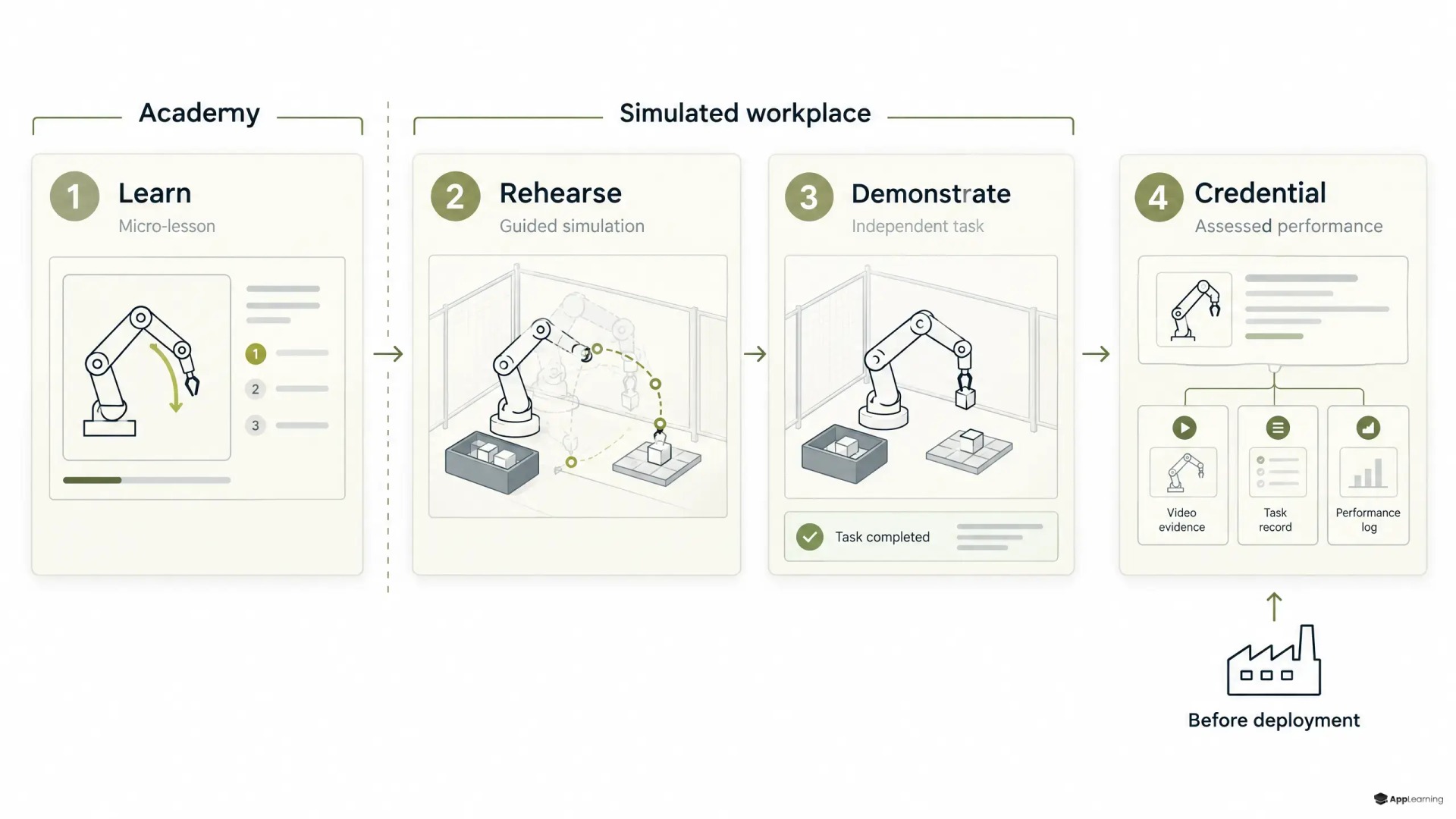
For software and product vendors, I would build simulation based learning around four connected stages.
- Concept preparation uses focused microlearning to explain one decision, its limits and likely failure modes.
- Guided action places the learner inside the partner’s sandbox with prompts and immediate feedback.
- Independent performance introduces a changed case without hints and records decisions, errors and recovery.
- Review applies a role-specific rubric to the task evidence and assigns targeted practice where needed.
The lesson explains the judgement. The sandbox makes that judgement observable. A quiz can check conceptual preparation, but it should not stand in for the independent task.
The robotics pattern transfers through workflow design
Consider a proposed robotics exercise—not an announced ABB assessment. A learner tests a picking workflow after lighting changes, identifies unreliable recognition, stops the simulated process and documents the conditions for another test. The rubric evaluates diagnosis and intervention, not just throughput.
A financial-operations equivalent could use synthetic payment cases. An AI assistant recommends release despite conflicting evidence. The analyst must identify the conflict, apply the scenario’s hold-and-escalate rules and record a rationale. This transfers the learning architecture, not industrial safety assumptions or regulatory approval.
A credential needs a bounded evidence claim
ABB promises a certificate on completion; its announcement does not describe a role-specific assessment rubric. (abb.com) In the proposed academy, a skills credential would require demonstrated performance. Critical failures, such as bypassing a required escalation, should not disappear inside an average score.
The evidence record should connect learner identity and role to the scenario, product and policy versions, rubric, decisions, hints, retries and reviewer outcome. Employee and partner readiness could then be mapped to specific workflows rather than a generic AI badge.
Workplace transfer needs a separate check. A proposed follow-up after 30 days would review supervised work samples for rework, escalation quality and control adherence against a baseline. Faster processing alone would not establish better performance or training ROI.
Map one high-stakes workflow into an evidence-based academy with App-Learning.
DiscussThe academy and simulator should remain separate
A product education academy need not recreate the vendor’s simulator. App-Learning could provide the white-label learning layer around preparation, pathways and readiness reporting, while practice remains inside the partner product. An agreed integration would return task evidence to the learning record. This is a proposed implementation pattern, not an ABB or NVIDIA partnership.
The credential belongs at the end of a redesigned workflow, not at the end of a content library. Its value rests on a clear claim about what someone demonstrated, under which conditions, and what still requires observation at work.