

Key takeaways
- AI coordination requires competencies beyond general employee AI literacy.
- A clear mandate and role-to-decision map give the academy its structure.
- Realistic scenarios make diagnostic tools and difficult handoffs trainable.
- Reviewed work products demonstrate execution more clearly than attendance.
- Changes to AI tools and policies should trigger targeted learning updates.
Fraunhofer makes the coordination role concrete
Fraunhofer IAO’s 22 October 2026 announcement sets out a second ORGANIZING.AI cohort beginning in January 2027, following a first cohort involving 17 organisations. The learning journey combines six deep dives, participants’ practical cases and peer exchange. Its tools include a role configurator, a maturity and relevance profile, and an AI governance roadmap. The announcement describes a program, not a causal evaluation of learning impact.
The program description also specifies transfer assignments for application within participants’ organisations. That provides a useful design principle for an internal academy: coordination should produce work, not just course completions.
The mandate comes before the modules
For a bank, the useful distinction is between understanding AI and coordinating its use. General literacy can explain limitations and acceptable use. AI coordinator training should address a different problem: who decides, who supplies evidence and where disagreements go. The coordinator’s mandate should define decision rights, escalation routes and boundaries. Coordination must not become informal authority to overrule risk, compliance or technology owners.
Six pathways turn responsibilities into practice
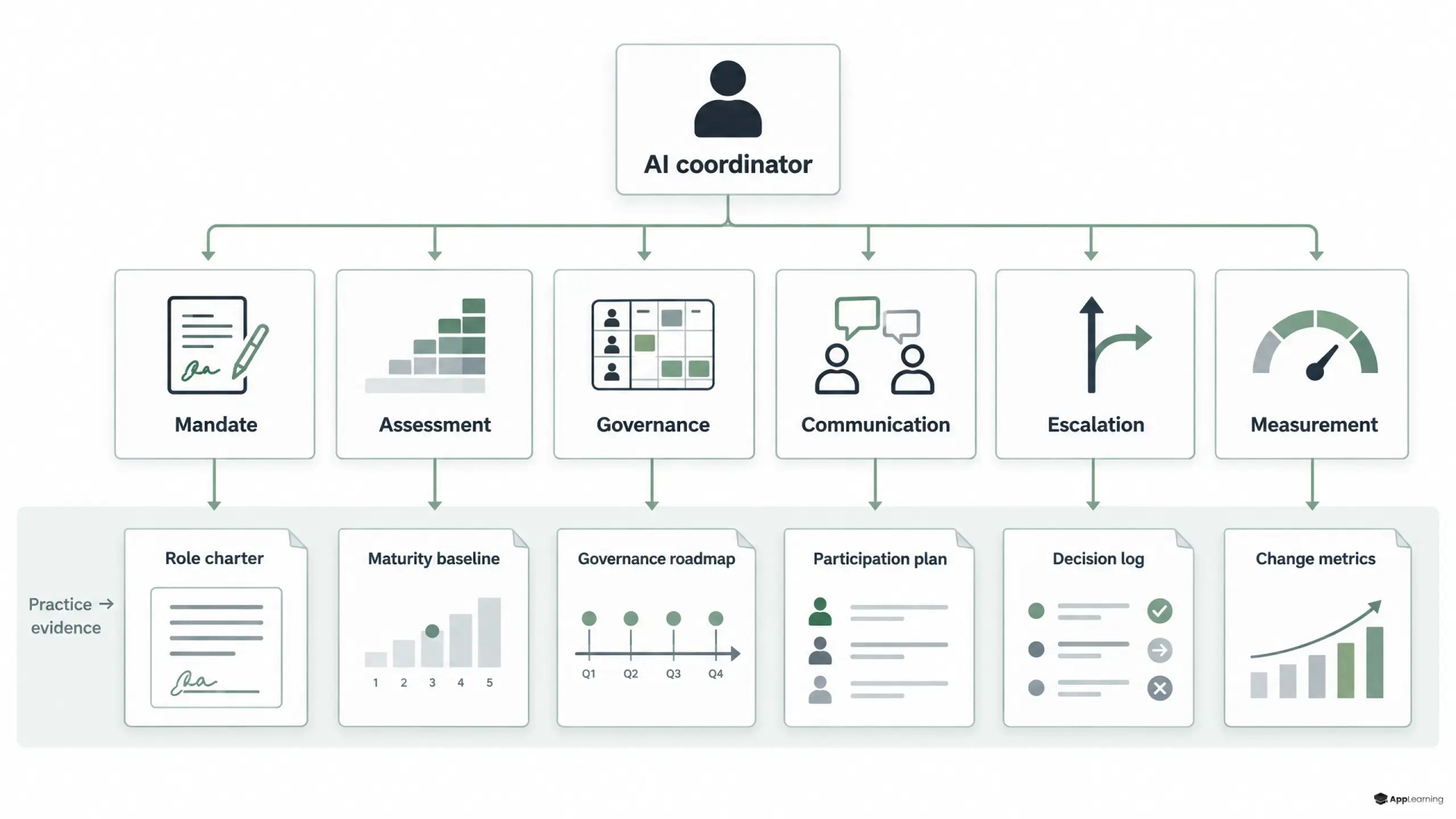
The following AI Coordinator Academy is a proposed internal design, not Fraunhofer’s syllabus. Each compact pathway pairs a scenario question with a practical checklist and a reviewable work product.
- Mandate and ownership — Which decision has two owners? Resolve the overlap in a role-to-decision map and draft the coordinator’s mandate.
- Use-case triage — Which proposal should advance? Compare value, risk and data readiness, then produce a risk-prioritisation map.
- Policy and data — Can this workflow use client information? Apply the bank’s checklist and document unresolved questions for the relevant specialists.
- Change communication — Who needs to participate? Adapt a rollout message for relationship managers and operations, then incorporate their feedback.
- Incident handoffs — Who receives a suspected data disclosure? Rehearse the bank’s escalation route with a complete handoff record.
- Evaluation — What would justify expansion? Define baseline performance, quality checks and conditions for stopping or scaling a pilot.
Conflicting decisions become the assessment
Consider a hypothetical client-summary assistant. The business owner wants a launch, IT has approved a test environment, and compliance has unresolved concerns about the proposed inputs. The learner must distinguish technical readiness from permission to proceed. A strong response records the unresolved issue, identifies the authorised decision-maker and proposes a bounded next step. The coordinator does not manufacture agreement or treat one approval as approval for everything.
Evidence replaces attendance as the success measure
AI governance upskilling needs an assessment rubric covering decision reasoning, responsibility mapping and handoff completeness. Evidence can include an approved mandate, a prioritisation map and a reviewed incident record. Per-role analytics should show where learners need practice, while reporting completion separately from demonstrated ability. An App-Learning academy design would connect those short exercises to reviewed workplace artifacts rather than treat quiz scores as proof of execution.
Build your bank’s AI Coordinator Academy around real decisions.
Plan pilotA 30-day pilot tests the operating model
- Days 1–5 — Interview nominated coordinators and business, IT, risk and compliance counterparts; agree the mandate and baseline scenario.
- Days 6–12 — Build six short pathways using approved policies and synthetic banking cases.
- Days 13–23 — Run practice sessions, collect artifacts and hold cross-functional reviews.
- Days 24–30 — Reassess the scenario, report remaining gaps and assign owners for updates when tools or policies change.
The test of enterprise AI enablement is whether decisions become clearer and handoffs become usable. Role-based AI learning should make those improvements visible. AI coordination becomes a trainable job when the mandate, the practice and the evidence all describe the same work.