

Key takeaways
- The policy covers banks and specified regulated entities, with applicability varying by institution type.
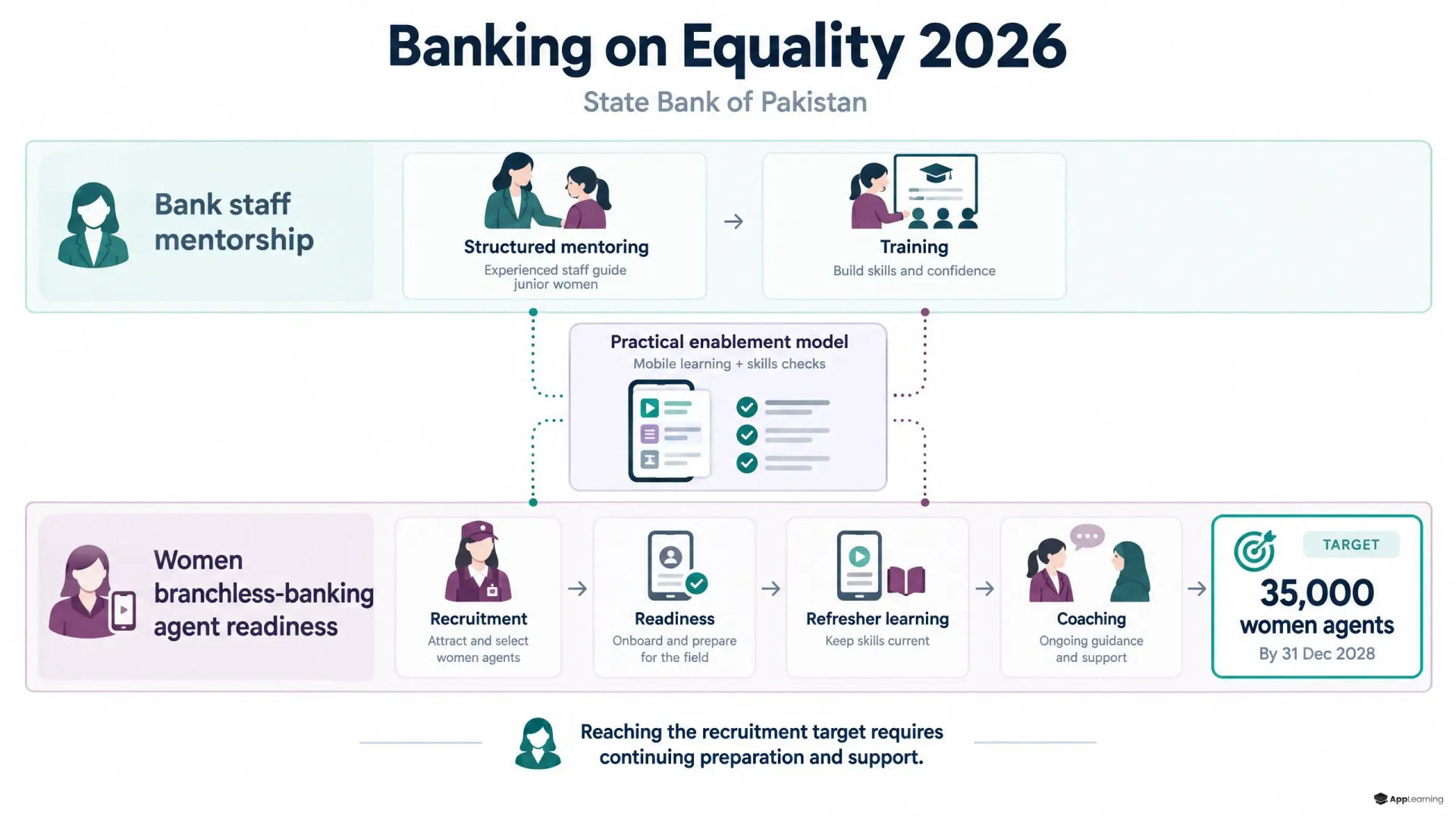
- The 35,000-agent target is a network total by end-2028, not new hires or certified learners.
- Structured mentoring and training for junior women staff is separate from the agent-network target.
- Build distinct pathways for agents, branch women champions, junior staff and frontline managers.
- Track demonstrated readiness alongside representation and account activity, while designing for language,...
The Training Work Behind a 35,000-Agent Target
A network target is not a readiness plan. Recruiting an agent does not establish whether she can resolve a failed payment, protect customer information or get help when a situation becomes unsafe.
The policy separates outreach from careers
SBP’s circular register dates the Banking on Equality Policy 2026 to October 13, 2026. Read its outreach and workforce measures as separate implementation responsibilities.
The operative circular covers commercial, digital, Islamic and microfinance banks, plus DFIs, bank-owned exchange companies, EMIs, credit bureaus and payment system operators/providers where applicable. Section 3.1(v) sets a target of 35,000 women branchless banking agents across the overall network by December 31, 2028. That is not 35,000 new hires, certified learners or agents per institution. The circular says institution-specific targets will follow using a June 2026 baseline; confirm your allocation before assigning quotas.
Four roles need different preparation
SBP’s customer-facilitation instructions also address branch women champions and gender-sensitivity training for all staff. Do not collapse these roles into the agent pathway. Customers need financial education, not employee certification.
Design four pathways. Agents need transaction and service readiness. Branch women champions need customer communication, product guidance and referral practice. Junior women staff need career development. Frontline managers need coaching, fair work allocation and escalation skills. Share relevant foundations, but assess each role against its actual decisions.
Agent readiness needs a supervised launch
Build a branchless banking academy around a staged journey rather than a course catalogue. Start recruitment with a practical check of language, device access and support needs. Then prepare agents to perform defined tasks.
- Onboard with short lessons on payment operations, cash handling, consumer protection, privacy and personal safety.
- Practise failed payments, disputed fees, fraud attempts and difficult customer conversations through realistic scenarios.
- Assess decisions and observed tasks before granting an internal scenario certificate.
- Launch under supervision with a named coach and clear escalation routes.
- Assign refreshers after process changes, service errors or identified knowledge gaps.
Treat this as a proposed operating model, not an SBP-prescribed certification scheme. Financial inclusion training should make safe action easier, not merely generate completion records.
Career development needs protected practice
Separately, section 2.2(a)(ii) instructs structured mentorship, coaching and training for junior women staff. Give that pathway a named mentor, protected learning time, relevant work assignments and scheduled feedback.
Connect fintech employee upskilling to the next role’s responsibilities. Assess an employee’s ability to explain a digital service, handle an exception or lead an improvement—not just recall terminology. Managers should document development opportunities as well as assessment results.
Measure capability without claiming compliance
SBP’s gender-disaggregated data framework requires account, credit and payment data and monitoring of women’s account activity. Keep those policy measures distinct from learning evidence.
Track scenario performance, supervised sign-off, recurring errors, refresher needs and coaching follow-through alongside representation and account activity. Attendance alone should never stand in for competence or policy compliance.
Build a role-based readiness pathway with App-Learning.
DiscussA shared academy still needs local ownership
A partner-academy model could reuse learning structures across providers while each institution owns its procedures, approvals and learner data. App-Learning’s contribution could be multilingual mobile microlearning, scenario assessments and progression tracking. Design for low bandwidth, shared devices and accessibility from the start. An LMS is an implementation choice, not a requirement of this circular.
The target names the reach. The operating system must establish who is ready, who needs help and who owns the next intervention. Build that system before recruitment numbers become a substitute for reliable service.