
Key takeaways
- Recruiting without enablement leaves the capability gap intact.
- Time to productivity belongs next to time to hire.
- Onboarding should operate as a learning system, not an HR checklist.
- Talent strategy only works when acquisition and activation are designed together.
Europe does have a talent shortage. But many companies still misdiagnose the operational bottleneck. They treat it as a pure recruiting problem when it is increasingly a productivity problem: how fast a new hire becomes useful, confident, and autonomous in the real work of the role.
That distinction matters. If a company improves sourcing but leaves onboarding weak, manager enablement inconsistent, and role knowledge fragmented, it does not solve the shortage. It just moves the constraint downstream.
The shortage is broader than headcount
The policy signal from Europe is already clear. The European Commission’s 2024 action plan framed labour and skills shortages as a system issue that touches training, education, working conditions, mobility, and talent attraction—not recruitment alone.
The market signal is just as clear. The Employment and Social Developments in Europe 2025 report states that 78% of EU SMEs faced difficulties recruiting workers with the right skills, while the Council’s March 2026 recommendation on human capital linked persistent shortages directly to competitiveness, innovation, and investment.
Human capital is Europe’s greatest asset.
The mistake many employers make is assuming that once a contract is signed, the shortage has been partially solved. In practice, an unactivated hire does not yet close a capability gap. The role only starts to pay back once the person can navigate tools, products, processes, customer context, and decision norms without constant rescue from colleagues.
The hiring funnel hides the activation gap
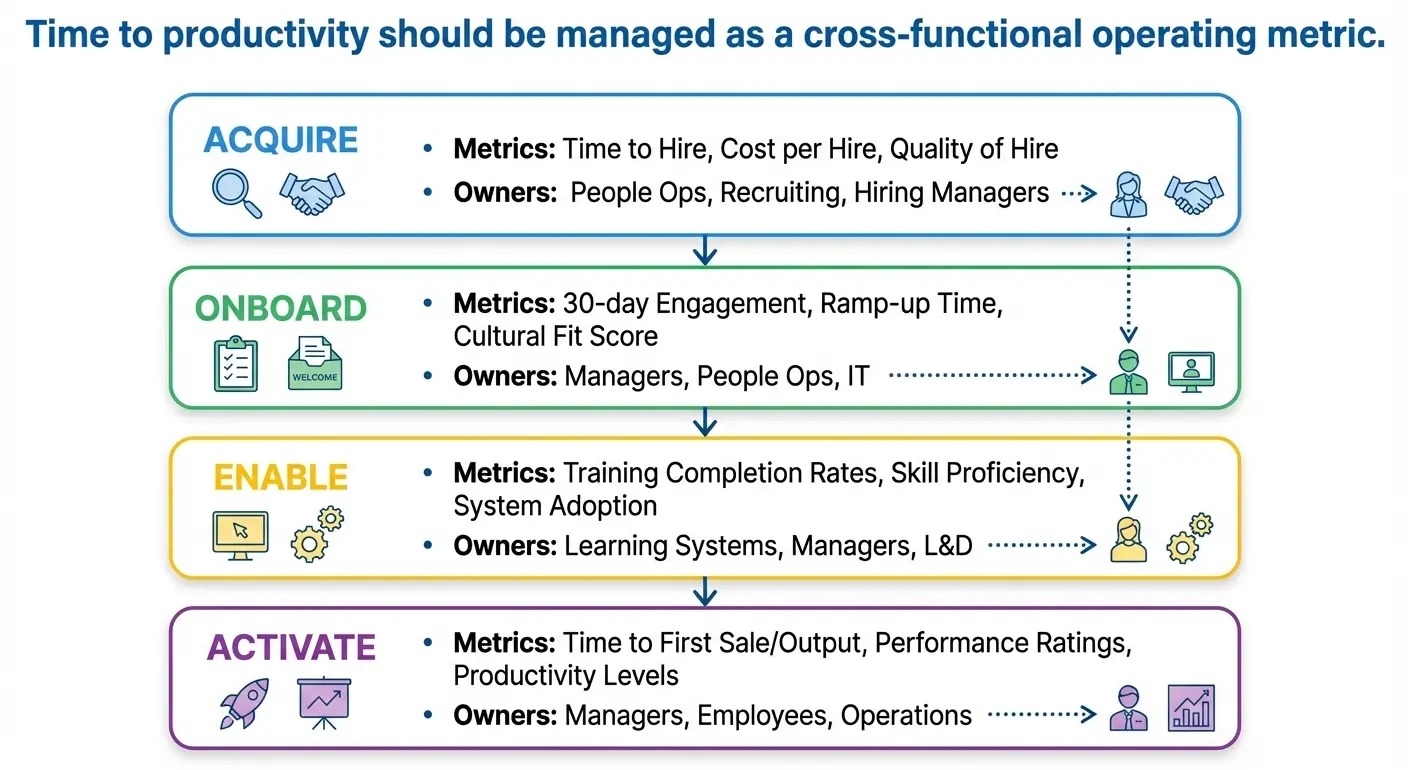
People Ops teams are usually measured on requisition speed, cost per hire, and acceptance rates. Those are necessary metrics. They are not enough. They tell you how efficiently talent enters the organization, but not how quickly talent starts creating value.
This is where many companies leak capacity. They hire into complex environments, then rely on scattered documentation, manager memory, shadowing, and ad hoc Slack answers to get people up to speed. That may feel normal. It is still a slow, expensive, low-reliability system.
- Product knowledge lives in decks, docs, and tribal memory instead of a structured path.
- Managers own onboarding in theory, but lack the time or repeatable assets to deliver it well.
- Role readiness is assumed after a fixed number of weeks rather than evidenced through practice and assessment.
- Talent teams report hiring success while line leaders still experience a productivity shortfall.
This is also why labour shortages can coexist with internal inefficiency. As Cedefop’s 2024 analysis argues, shortages are not driven by skill demand alone; they also reflect mismatches, mobility frictions, and unattractive job conditions. Inside companies, one more friction layer is often overlooked: weak integration after hire.
Learning systems are integration infrastructure
If the hidden bottleneck is time to productivity, then onboarding has to be designed like infrastructure. Not a welcome sequence. Not a document dump. A system.
That system should break role activation into explicit capabilities: what a new hire needs to know, do, recall, and apply by day 7, day 30, and day 90. It should combine product knowledge, workflow guidance, scenario practice, reinforcement, and proof of readiness. It should also reduce dependence on individual manager quality by making the learning path more consistent across teams and locations.
This is the practical case for App-Learning. When onboarding and role readiness are turned into structured microlearning flows, companies can shorten ramp time, standardize critical knowledge, and spot readiness gaps earlier. The point is not to replace managers. It is to give managers a repeatable activation system instead of asking them to improvise one every time.
See how App Learning reduces time to productivity.
See App LearningActivation needs its own operating metrics
A talent strategy that ends at hiring creates false confidence. A stronger operating model tracks both acquisition and activation. That means measuring not just whether someone joined, but whether the organization made that person productive fast enough to matter.
- Time to first independent task completion
- Time to role-specific proficiency
- Knowledge completion and assessment performance during onboarding
- Manager-rated readiness after 30, 60, and 90 days
- Ramp variance across teams, locations, and hiring cohorts
These metrics change behavior. Once time to productivity is visible, onboarding stops being an HR formality and becomes a business system. It becomes easier to justify investment in learning design, manager enablement, content operations, and role-based reinforcement because the cost of slow activation is finally measurable.
Europe’s shortage will not be solved by posting more jobs and widening the top of funnel. Employers still need better sourcing. But recruiting alone cannot fix a system that takes too long to convert hires into capability. The strategic shift is simple: move from acquisition thinking to activation design. The companies that do that will not just hire better. They will get productive faster from the talent they already worked so hard to win.
Good to know
What does time to productivity mean in practice?
It is the time between start date and reliable role contribution. For People Ops, that usually means defining a concrete readiness threshold with hiring managers instead of using tenure alone as a proxy.
Why is recruiting alone not enough during a talent shortage?
Because a signed offer does not equal usable capability. If onboarding, product knowledge, and manager enablement are weak, the organization still experiences a shortage even after hiring.
Where should People Ops start?
Start by mapping one critical role’s first 90 days, defining the capabilities required for independent performance, and turning that path into a repeatable learning flow with clear checkpoints.