

Key takeaways
- Operational completion is not onboarding success.
- Post-KYC users still need guidance before meaningful action.
- Embedded education is strongest when it appears at moments of uncertainty.
- Customer onboarding best practices should measure downstream behavior, not access.
Access is not activation
Many fintech teams treat signup and KYC as the end of onboarding because these steps are visible, measurable, and operationally critical. The user created an account. The identity check passed. The compliance gate opened. The dashboard loaded. On paper, the onboarding journey looks complete.
But the user has not yet learned how to use the product. They may not understand the first action, the risk model, the fee structure, the security setup, or the difference between buying Bitcoin once and building a long-term habit. In a Bitcoin product, that gap matters more than in most categories because the product carries emotional weight. People worry about losing money, making a technical mistake, choosing the wrong wallet setting, or misunderstanding custody.
KYC is not the problem. It is a required control in regulated financial services. The customer identification rules describe identity verification as part of a written Customer Identification Program, not as a product activation system. That distinction is important. Compliance establishes permission to serve the customer. Onboarding establishes the customer’s ability to act.
The strongest customer onboarding best practices start from this separation. Signup and KYC unlock access. Post-access onboarding creates momentum.
The hesitation begins after the gate opens
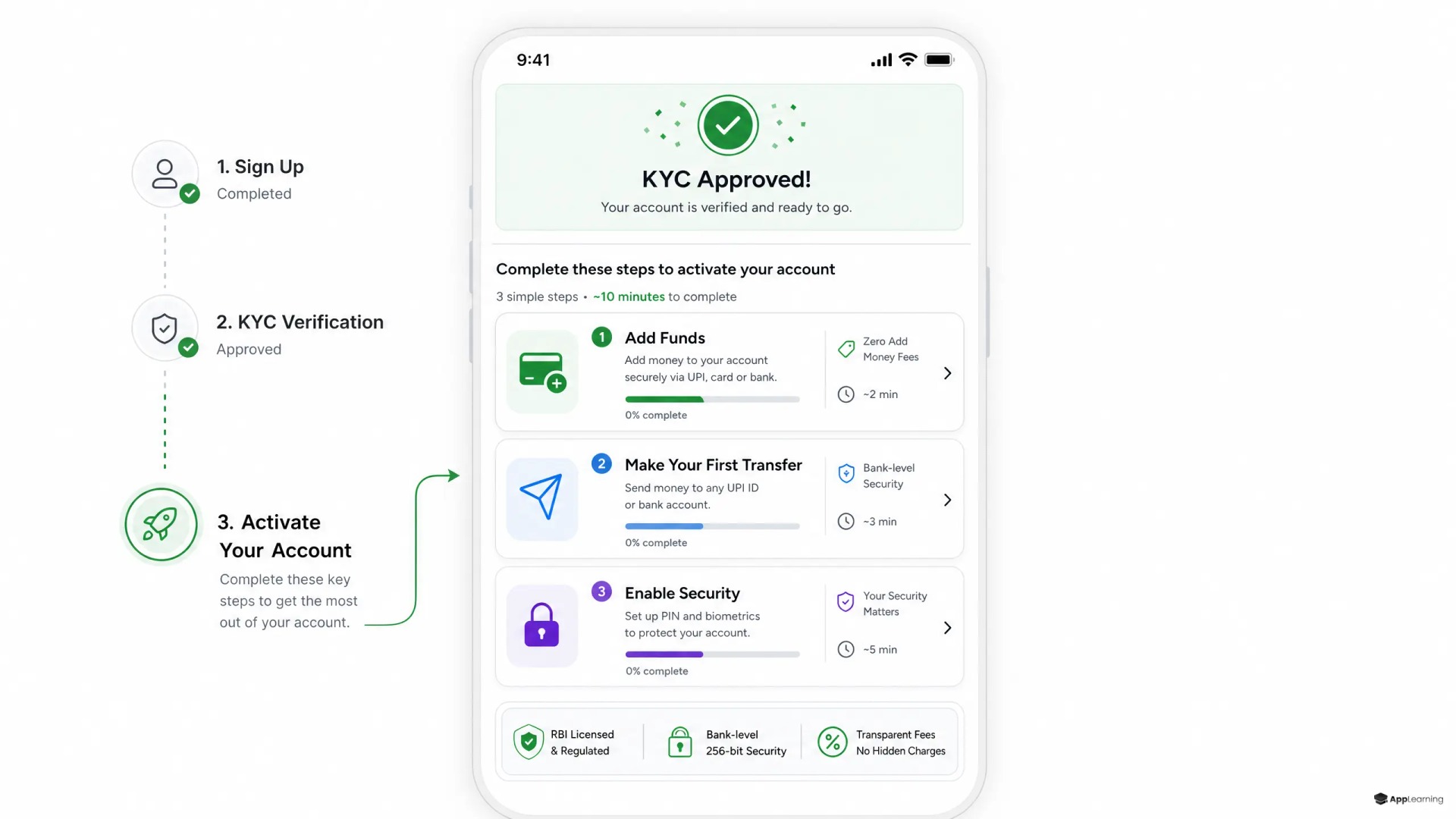
The first post-KYC screen is often a moment of silence. The product says, in effect, “You are approved.” The user then has to decide what to do next. Buy Bitcoin. Connect a bank account. Set up a recurring buy. Transfer to a wallet. Enable two-factor authentication. Read a risk disclosure. Learn what a seed phrase means. Each option may be useful. Together, they create cognitive load.
Public crypto onboarding journeys show the same sequence. Binance’s beginner guide frames the path as account creation, identity verification, payment method selection, and first purchase, with education around security and product use placed around those actions rather than before all of them in one abstract lesson block. The guide says users are “one step closer” after account verification, then moves them toward the first crypto purchase through concrete next steps in the Binance beginner journey.
That is the real product challenge. Users are not only blocked by forms. They are blocked by uncertainty. They ask internal questions that rarely appear in funnel dashboards.
- Is this the right moment to buy Bitcoin?
- What happens after I connect my bank account?
- Should I use a one-time purchase or a recurring plan?
- What does custody mean in this product?
- Can I undo this action if I make a mistake?
- Why is this security step important now?
If the product does not answer these questions in context, users pause. Some leave. Some complete one action but never build a habit. Some contact support for basic explanations that should have been embedded in the flow.
Post-access onboarding needs a different system
A better model treats KYC completion as the start of the activation phase. The operating question changes from “Did the user get in?” to “What should this user understand and do next?” That shift forces product, growth, compliance, support, and education to work from the same event map.
For a Bitcoin product, the post-access map should usually separate four layers.
- Access events such as signup, email verification, KYC approval, and payment method eligibility.
- Confidence events such as completing a short lesson, answering a security check, or acknowledging custody tradeoffs.
- Value events such as first buy, first recurring plan, first wallet setup, first transfer, or first savings goal.
- Habit events such as second purchase, recurring buy completion, balance check, learning return, or feature reuse.
This structure prevents a common mistake. Teams optimize the operational gate because it is easy to see, then wonder why approved users do not convert. In reality, the activation system is downstream. The product must help the user move from permission to understanding, then from understanding to action.
A CoinDCX growth case study describes a similar operational lens. The team treated onboarding as a journey to be completed within 14 days after registration, with drop-off points across email verification, KYC, and bank account verification before users reached the first purchase, after which active users continued to buy or sell based on market conditions in the CoinDCX onboarding analysis. The useful lesson is not that every Bitcoin company should copy the same funnel. The lesson is that onboarding quality depends on the chain of actions after registration, not on one completed gate.
Guidance belongs inside the next action
Post-KYC onboarding fails when education is detached from the user’s immediate task. A help center article may be accurate. A video course may be well produced. A long academy may cover every concept. But if the user is staring at a “Buy” button and does not understand volatility, fees, limits, custody, or timing, the learning asset is in the wrong place.
Embedded education works because it reduces the distance between confusion and action. It does not ask users to leave the product, search, read, remember, return, and then decide. It gives them the minimum useful explanation at the moment of friction.
In practice, that means the product needs several education formats, each matched to a job.
- A short contextual card before the first Bitcoin purchase that explains what will happen next.
- A two-minute lesson after KYC that explains the safest first action for a beginner.
- A quiz before self-custody setup that checks whether the user understands seed phrase responsibility.
- A glossary tooltip for terms such as spread, Lightning, address, wallet, private key, or recurring buy.
- A progress path that shows users which steps build confidence, not only which steps unlock features.
The key is restraint. Embedded education should not become a lecture layer placed on top of the product. It should remove a specific uncertainty that blocks a specific action.
Activation metrics must move downstream
If the dashboard stops at KYC completion, the team will optimize for access. If the dashboard tracks the first meaningful action, the team will optimize for activation. Product analytics tools increasingly frame activation around a value moment after signup, including conversion from signup to that value moment, time to activation, and drop-offs along the way in the Userpilot activation dashboard model.
For a Bitcoin company, the activation event should not be generic. It should reflect the product’s promise and the user’s intent. A beginner who came to buy Bitcoin safely may activate when they complete KYC, connect a payment method, finish a short risk and security module, and make a first small purchase. A more advanced user may activate when they set up a wallet, transfer funds, or configure recurring buys.
Useful post-access metrics include:
- KYC-approved to first meaningful action conversion.
- Time from KYC approval to first purchase or wallet setup.
- Lesson completion before high-risk or high-anxiety actions.
- Quiz failure patterns before self-custody, transfer, or recurring buy setup.
- Support tickets per activated user in the first 30 days.
- Second action rate after the first purchase.
- Recurring buy adoption among users who completed education versus those who skipped it.
These metrics expose whether onboarding is creating capability. A user who completes every operational step but never buys, never saves, never transfers, and never returns has not been onboarded. They have only been processed.
Good to know
Why is KYC completion not enough for customer onboarding?
KYC completion only proves that a user passed an identity and compliance gate. Onboarding succeeds when the user understands the product and completes a meaningful action that creates value.
What should Bitcoin companies measure after signup and KYC?
They should measure downstream actions such as first purchase, payment method connection, wallet setup, recurring buy creation, security setup, second purchase, and support needs during the first weeks.
Where should education appear in a post-KYC journey?
Education should appear at the moment of uncertainty. Examples include the first buy screen, recurring purchase setup, wallet transfer flow, seed phrase backup, and security configuration.
How can embedded education reduce support volume?
It answers repeated beginner questions inside the product before users need to contact support. This is most useful for concepts such as custody, fees, volatility, private keys, wallet addresses, and recurring buys.
Embedded education turns uncertainty into motion
Bitcoin users arrive with uneven knowledge. Some understand self-custody, Lightning, volatility, and long-term savings. Others have only heard that Bitcoin is risky, technical, or speculative. The OECD has warned that many crypto-asset users lack basic digital financial literacy, and that higher literacy can help people use crypto-assets according to their own risk appetite and understand the risks involved in the OECD report on crypto-asset users.
That creates an onboarding design requirement. The product cannot assume one knowledge level. It must adapt. A beginner needs plain language and confidence. An experienced Bitcoiner needs speed and control. A cautious user needs risk context. A curious user needs a first safe action. A returning user may need a prompt toward savings plans, wallet features, or better security.
This is where App-Learning’s in-app model fits. In the Invity Academy project, App-Learning helped turn static education into a structured academy embedded directly in the app, with a React integration delivered in under two months, 19 lessons, six quizzes, bilingual content, certificates, illustrations, and contextual product calls to action in the Invity Academy case study. The important part is not the format alone. It is the operating pattern: learning, product context, and next-step guidance live in the same user journey.
For a Bitcoin product team, that changes the work. Education stops being a side project owned by content. It becomes part of activation architecture. The academy is not a destination users may visit later. It is a product layer that can appear after KYC, before first buy, during wallet setup, or when a user hesitates around a more advanced feature.
The operating model for Bitcoin teams
The best post-KYC onboarding systems are built from small, testable parts. They do not start with a large course catalog. They start with the few moments where user uncertainty blocks value.
- Define the first high-value action for each user segment.
- Map the knowledge needed before that action feels safe.
- Place one short explanation inside the product at that moment.
- Add a lightweight check for understanding when mistakes would be costly.
- Measure whether the user completes the downstream action faster or more often.
- Localize and reuse the module across markets once the pattern works.
This approach also protects internal focus. Product teams keep building the core experience. Compliance keeps the gates clear. Support gets fewer repeated beginner questions. Growth gets cleaner activation data. Education becomes modular, measurable, and tied to behavior.
Make onboarding teach the next confident action.
TalkThe real finish line
Signup and KYC are necessary, but they are not proof of onboarding success. They only show that the system accepted the customer. The real test comes later, when the customer has to understand the product well enough to act with confidence.
For Bitcoin companies, that difference is strategic. The category already carries trust, risk, and comprehension barriers. If onboarding ends at access, users are left alone at the exact moment when guidance matters most. If onboarding continues into the first purchase, savings setup, wallet action, or security decision, the product turns education into activation. That is the work: not pushing users through more screens, but helping them complete the next action they can understand, trust, and repeat.