

Key takeaways
- Activation improves when users understand the next step clearly enough to act.
- Product education works best inside the journey, not beside it.
- In-app guidance can shorten time to first value in complex fintech products.
- Activation and education should be measured together, not in separate teams.
The pause before first value
Fintech activation rarely fails because the product has no value. It fails because the user has to make a financial decision before the product has created enough understanding. A user signs up, reaches identity verification, a bank connection, a first deposit, a card setup, a tax form, a crypto purchase, or a savings rule. Then the flow asks for action. If the user does not know what the action means, what risk it carries, or why it is needed now, the safest move is to stop.
This is the activation problem that product education can solve. The point is not to teach everything. The point is to teach the next thing well enough that the user can continue. In fintech, that next thing often includes trust, risk, personal data, money movement, or regulation. A tooltip that says “continue” is not enough. A ten-page help article is too far away. The right answer is education embedded into the journey.
Access does not create understanding
Many teams treat activation as a product access problem. They remove fields. They shorten forms. They add a checklist. These changes can help, but they do not close the knowledge gap. A user may have access to a portfolio tool and still not understand diversification. A merchant may complete payment setup and still not understand reserves. A crypto user may open a wallet and still not understand custody, fees, or transfer finality.
External documentation puts the burden on the user to notice a gap, search for the right answer, leave the flow, read the content, and translate it back into action. That is too much work during onboarding. The W3C guidance on context-sensitive help frames help as information tied to the function currently being performed, so users can avoid mistakes without losing their place. That principle is exactly what fintech onboarding needs. Product education should appear where hesitation happens.
Measurement starts at the hesitation point
Before changing activation flows, high-performing teams define the moments where users stop because they do not understand. This is different from measuring page exits alone. A drop-off tells you where the user left. It does not tell you what they failed to understand.
- Primary activation event such as first funded account, first transfer, first invoice, first card transaction, or first portfolio action.
- Precursor events that must happen before value, including KYC submission, bank linking, risk profile completion, permissions, or terms acceptance.
- Stall points such as repeated field errors, long idle time, skipped disclosures, failed document uploads, or abandoned funding screens.
- Education exposure such as lesson views, glossary opens, quiz completion, guided prompt interactions, or short concept checks.
- Confidence signals such as successful retry, first action after guidance, lower support contact rate, or fewer reversed actions.
- Support reasons tagged by concept, not only by screen, so teams can see which financial ideas create friction.
This turns education into an activation variable. Teams can compare users who received a specific piece of guidance with users who did not. They can test whether a two-screen explainer before a high-risk action works better than a long article after abandonment. They can decide where to remove friction and where to add clarity.
Guidance belongs inside the hard moments
Good embedded guidance is already visible in mature fintech infrastructure. Stripe’s embedded onboarding documentation describes guided account onboarding that reads requirements, validates data, supports document uploads, handles identity verification, and updates for changing compliance needs. Plaid’s Link documentation shows the same operational logic for bank connection, including credential validation, multi-factor authentication, error handling, and account selection inside a controlled flow.
These are not product education platforms. They prove a more basic point. Complex financial actions need guided sequences. The user should not have to understand the full operating model before starting. The product should reveal the right explanation at the right step.
- Use task-level prompts before irreversible or sensitive actions.
- Add inline explainers for terms such as APY, margin, spread, gas fees, reserves, chargebacks, risk score, or settlement delay.
- Show short interactive previews before the first live action.
- Use concept checks when misunderstanding can create user harm or support load.
- Let users resume guidance after dropout instead of restarting the whole flow.
- Trigger lifecycle education when a user reaches a new product tier, not only during first signup.
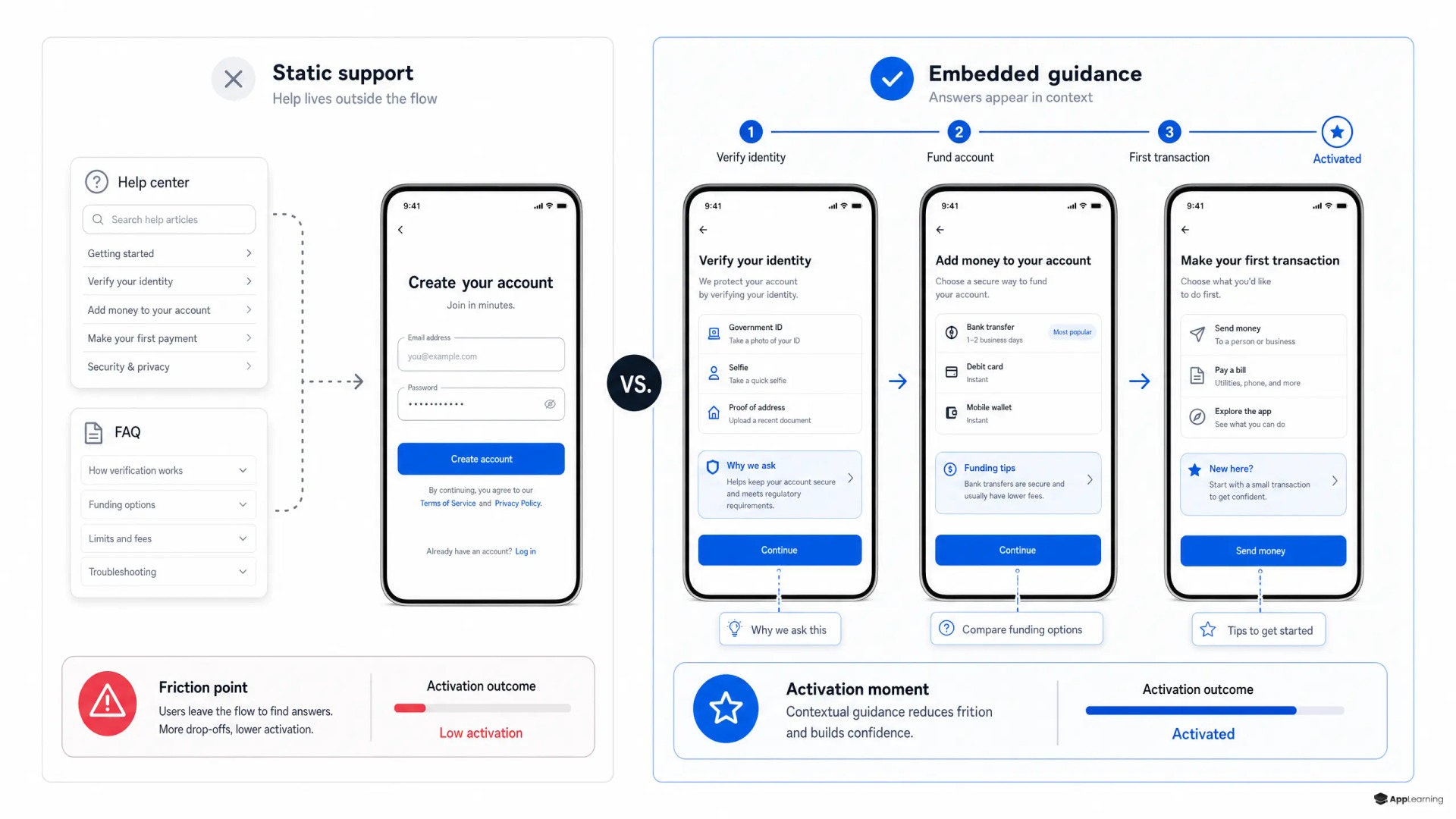
The best pattern is not always a tour. Tours often front-load information before the user has context. Fintech users usually need a smaller unit of learning later, at the point of decision. A product tour explains the map. Embedded product education helps the user cross the next bridge.
External docs cannot carry activation alone
Help centers still matter. They are useful for edge cases, policies, deep dives, and users who already know what they need. But they are weak activation tools when used alone. They have poor timing. They do not know the user’s state. They often use internal product language. They are hard to measure against activation outcomes.
Embedded product education has four operational advantages. It can use the user’s current context. It can reduce the next action to one clear decision. It can reuse the same approved explanation across product, lifecycle, and support. It can be measured against the activation event that matters. That is the difference between content that exists and education that moves a user forward.
Good to know
How is product education different from customer support content?
Customer support content usually answers questions after confusion appears. Product education is designed earlier. It teaches the concept, action, or risk that helps the user move through onboarding, activation, or a new feature with confidence.
Which activation events should fintech teams connect to education?
Connect education to first-value milestones such as first deposit, first transfer, first investment, first invoice, first card use, completed KYC, bank linking, or risk profile completion. The right event depends on the product’s core value promise.
Should education appear before or after KYC?
Both can be useful. Before KYC, education should explain why the data is needed and how the process works. During KYC, it should reduce field-level confusion. After KYC, it should guide the user toward the first valuable product action.
How can a team prove that product education improves activation?
Measure education exposure, completion, and interaction alongside activation milestones. Compare cohorts, track time to first value, monitor support reasons, and test whether specific guidance reduces dropout at known friction points.
The operating model behind activation education
The hard part is not writing more content. The hard part is deciding which knowledge belongs in which product moment. Product, Growth, CX, Compliance, and Content need one shared map. Otherwise, the product team ships flows, the marketing team writes educational articles, and CX explains the same concept in tickets. The user experiences the gaps between teams.
- Define the first-value promise for each segment.
- Name the concepts that block that promise.
- Choose the smallest useful education format for each concept.
- Place it in the product state where the user needs it.
- Measure education completion and activation in the same dashboard.
- Review support tickets monthly to find the next concept gap.
This model keeps education practical. A bank-linking flow may need one reassurance screen and one fallback explanation. A crypto purchase flow may need a three-step primer on volatility, fees, and custody. A lending product may need a short APR module before offer comparison. The format should match the risk and complexity of the action.
The academy layer inside the product
This is where App-Learning fits for fintech teams. The goal is not to replace the product interface with a course catalog. The goal is to create a structured learning layer that can be linked, embedded, measured, and reused across onboarding and lifecycle journeys. App-Learning’s platform combines content authoring, learning management, quizzes, gamified mechanics, and analytics, so teams can turn approved subject matter into short lessons and track completion, drop-off, time spent, and reporting.
The Invity Academy case shows the pattern in a fintech context. Invity moved from static content to an in-app academy, launched 19 lessons and 6 quizzes in English and Czech, and tied learning moments to product moments inside the app. The important part is not the number of lessons. It is the system: clear concepts, short interactions, product context, and measurable progression.
A fintech team can use the same logic for onboarding, activation, trust-building, and retention. New users get the explanation they need before the first valuable action. Returning users get education when they encounter a new feature or higher-risk behavior. Product and Growth see whether learning supports activation. CX sees fewer repeated explanations. Compliance gets a clearer record of what was taught and completed.
Build product education into the moments where users hesitate.
TalkActivation becomes a learning system
Product education improves customer activation when it becomes part of the product system. It should not sit in a support corner and wait for confused users to find it. It should be mapped to friction, triggered by behavior, written in the language of the user’s next decision, and measured against first value.
The strongest fintech onboarding flows do not ask users to become experts before they act. They give users enough understanding to take the next safe step. That is the practical job of product education. It turns hesitation into informed action, and it turns activation from a funnel problem into a learning system.