

Key takeaways
- A lean 30-day plan is the minimum structure a fast team needs.
- Week one should remove ambiguity before work gets delegated.
- Weeks two and three should focus on supervised practice and early wins.
- Day 30 should test readiness, not just completion.
- Measure confidence, recurring confusion, and time to first useful contribution.
Rushed onboarding looks efficient because it removes meetings, documentation, and training. In practice, it usually just shifts the work onto managers and teammates, who then spend the month repeating context, correcting avoidable mistakes, and answering the same questions in private. A 30-day onboarding plan is the leaner option because it turns that hidden support work into a repeatable system.
Speed breaks when onboarding stays tribal
The U.S. Office of Personnel Management makes a useful distinction between orientation and onboarding. Orientation is the short-term setup around the first days. Onboarding is the broader process of helping someone become productive and engaged over time. Its supervisors toolkit frames onboarding as the bridge between selection and productivity, with clear communication, social integration, peer support, and organizational knowledge doing most of the work.
That matters for growing startups because the real bottleneck is rarely information volume. It is information access, priority clarity, and role interpretation. When knowledge lives in managers' heads, each hire creates a temporary support queue. The team thinks it is moving fast, but it is really paying for missing structure in interruptions.
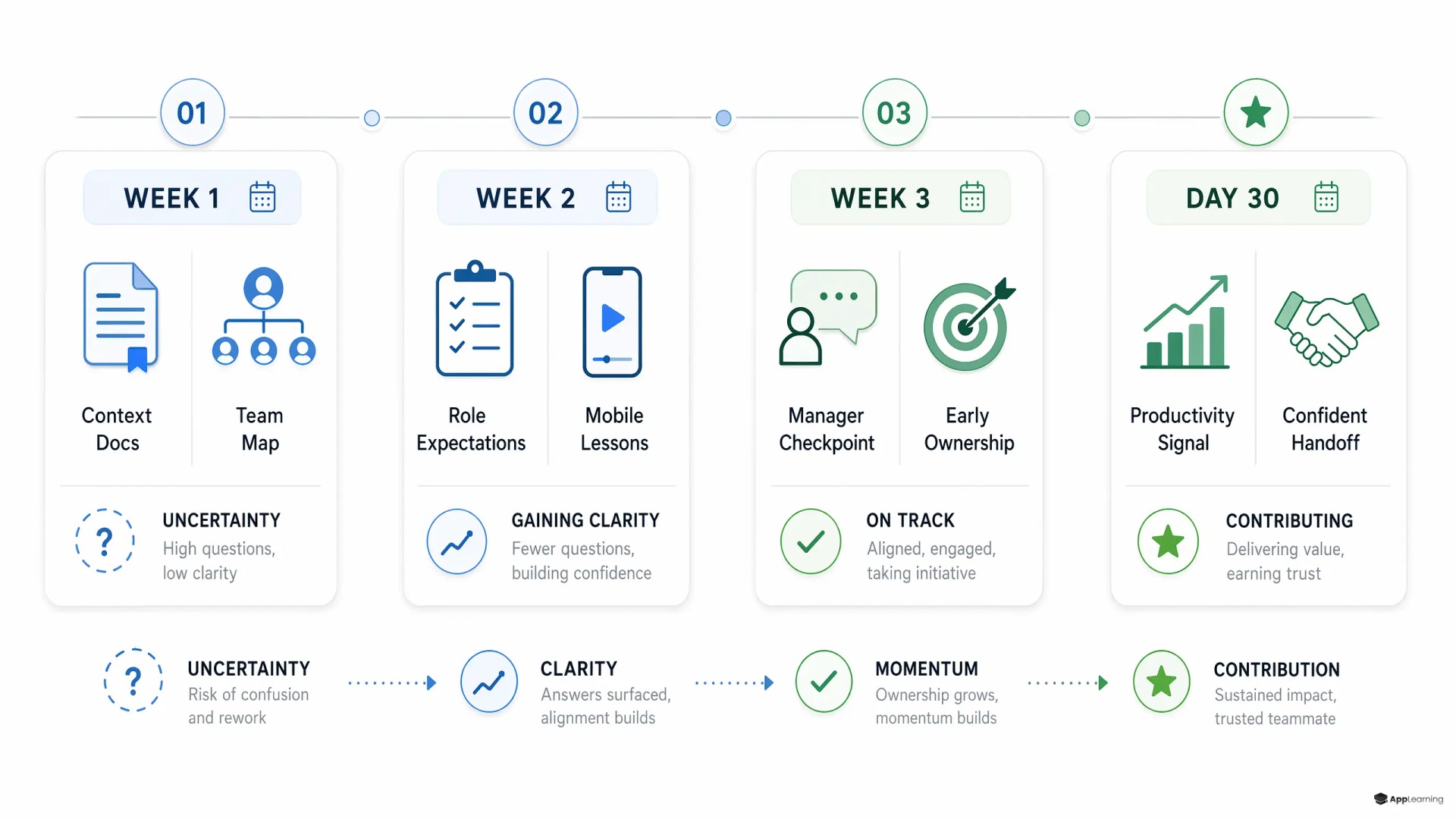
Week one is for context and constraints
Week one should not try to teach everything. It should establish the few things a new hire must understand before independent execution starts. The SHRM onboarding guide puts early emphasis on expectations, objectives, role clarity, and a one-month check-in rather than a one-day information dump. For founders, that is the right design principle: remove ambiguity first, then layer in role depth.
- Company context: mission, current stage, priorities, and what the team is trying to achieve this quarter.
- Role boundaries: what this person owns, what they support, and where decisions escalate.
- Ways of working: tools, rituals, response-time norms, documentation standards, and meeting cadence.
- Key relationships: manager, cross-functional partners, subject-matter go-to people, and buddy.
- Definition of a good first month: expected learning, first tasks, and what counts as a useful early contribution.
Weeks two and three turn knowledge into useful output
This is where onboarding either becomes practical or collapses into passive reading. GitLab's public playbooks are instructive here. Its remote onboarding guide spreads onboarding across the first weeks instead of expecting instant contribution, and its Revenue Academy is designed to get new hires role-ready within 30 days through focused content, buddy support, practice, and clear readiness gates. The underlying logic is solid for startups too: teach only what is needed now, attach it to real work quickly, and review the result while the feedback is still cheap.
- Assign one safe starter task tied to a real workflow, not a fake exercise.
- Pair the task with the exact documents, examples, and people the hire should use.
- Review the first output quickly and give concrete corrections, not broad encouragement.
- Repeat with slightly higher complexity so confidence comes from execution, not from familiarity with slides.
- Capture the recurring questions and unclear handoffs, because those are the next items to document.
Day 30 should prove readiness
The first month does not complete onboarding, but it should complete the handoff from guided learning to accountable execution. According to SHRM's onboarding measurement guidance, time to productivity, retention thresholds, and informal feedback are core ways to evaluate whether onboarding is working. A useful day-30 review therefore checks both performance and confidence, because low confidence usually predicts more dependency even when output looks acceptable on the surface.
- Can the new hire explain their role, priorities, and success metrics in their own words?
- Can they find the right source of truth without asking first?
- Can they complete the most common recurring task with light rather than constant support?
- Do they know where to escalate blockers, approvals, and cross-functional issues?
- Has the manager identified the next skill gap that should be developed over days 30 to 90?
Good to know
Is 30 days enough for every new hire?
It is enough to establish context, role clarity, early habits, and a clean handoff into normal execution. Deep role mastery and broader company learning should continue after that.
Who should own onboarding in a startup without HR?
The hiring manager should own role readiness. Operations or People can own logistics, reminders, and documentation so the manager is not improvising the process every time.
Does every role need the same onboarding plan?
No. Keep the company context and operating basics consistent, then swap the role modules, starter tasks, and readiness criteria by function.
What should founders measure first?
Start with time to first useful contribution, new-hire confidence, manager confidence, and the questions that repeatedly create confusion. Those signals show whether speed is coming from understanding or from guesswork.
A lean system beats a heavy process
Startups usually do not need an L&D department to run this well. They need a simple delivery layer that keeps knowledge in one place, spaces learning across the month, and reminds managers when human conversations matter. App-Learning is built around short lessons, quizzes, role-based paths, and progress tracking for internal onboarding, which makes it a practical fit for teams that want consistency without building a heavy HR process.
- Pre-start lessons for company basics, tools, and first-day logistics.
- Week-one checks for values, policies, workflow basics, and role expectations.
- Role-specific micro lessons attached to real tasks instead of generic training blocks.
- Manager prompts for day 1, day 7, day 14, and day 30 conversations.
- Simple readiness tracking so founders can see where onboarding is working and where it keeps breaking.
See how App-Learning can turn your onboarding plan into a repeatable system.
See itSignals improve the plan before drift sets in
The plan gets better when you measure friction, not just completion. SHRM's recommended onboarding measures include time to productivity and informal feedback. In a startup, the most practical version is a short pulse at the end of week one and day 30, paired with a manager review of the first useful output and the questions that kept repeating.
- Time to first useful contribution.
- New-hire confidence after week one and day 30.
- Manager confidence in the hire's independent execution.
- Repeated questions, blockers, and documentation gaps.
- Early retention signals such as confusion about role, expectations, or team norms.
Fast teams do not need longer onboarding. They need fewer hidden dependencies. A focused 30-day plan replaces guesswork with context, turns tribal knowledge into repeatable instruction, and gives managers a cleaner handoff into normal performance management. That is what actually makes a growing team faster: not less onboarding, but better sequencing.