
Key takeaways
- Reskilling usually fails in the operating model, not the ambition.
- Long courses rarely create role readiness on their own.
- Transfer depends on relevance, motivation, manager support, and workflow fit.
- Measure movement into target roles, not attendance in learning.
Reskilling breaks when work stays unchanged
Companies are not wrong to focus on reskilling. The World Economic Forum’s Future of Jobs Report 2025 says 51% of employers plan to move people from declining to growing roles internally, and 77% expect to reskill or upskill their workforce in response to AI by 2030. The mistake is assuming a training catalog can carry that transition on its own.
Most failed reskilling programs do not fail because employees refused to learn. They fail because the operating model is abstract. The business needs people who can perform in a new role, under real constraints, with real tools, at a defined standard. What employees get instead is a long course, a vague skills promise, and no clean path from learning to role entry.
The content trap
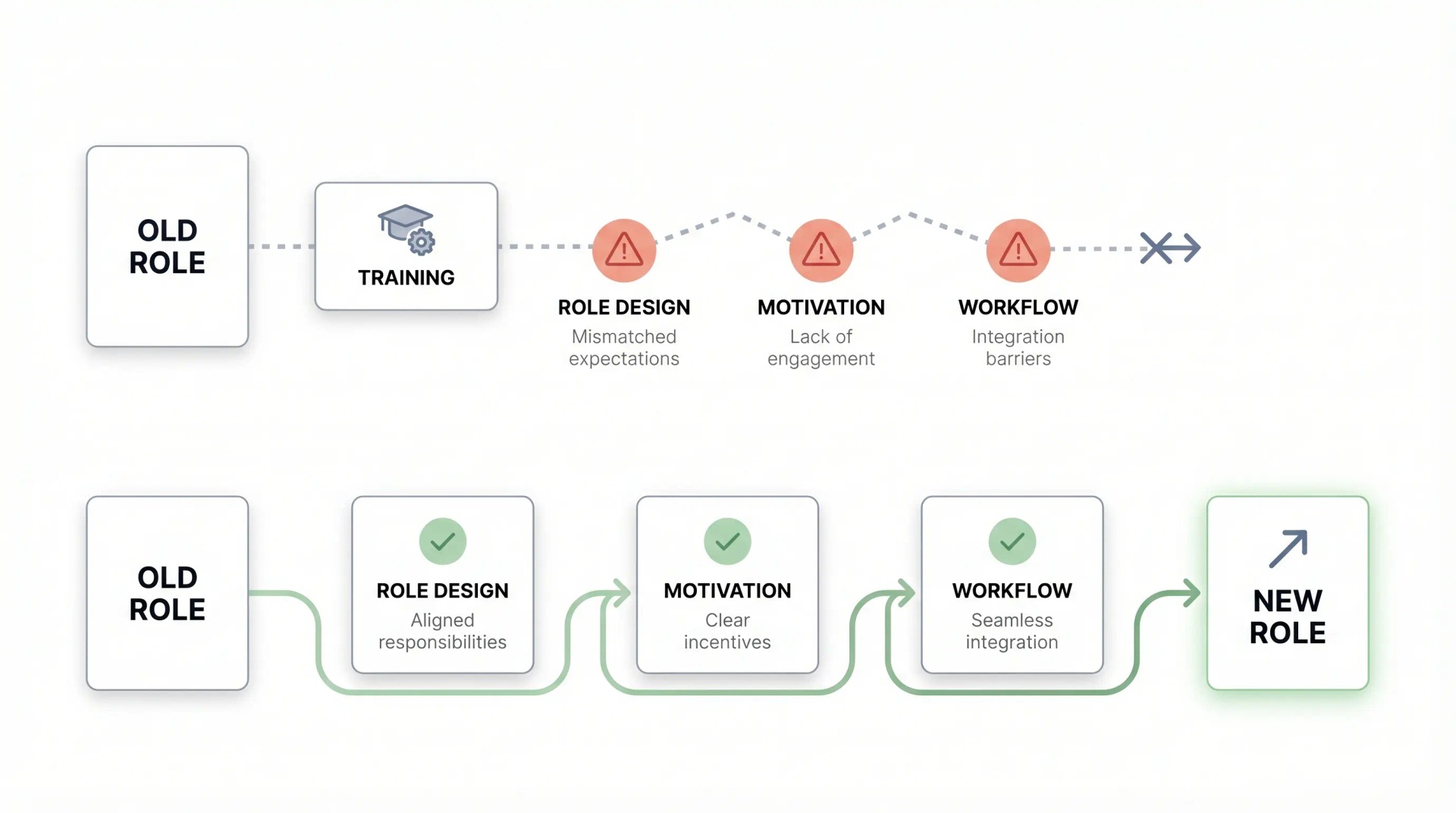
This is the most common design error in corporate reskilling. Leaders define the challenge as a content gap, then build a content response. They buy libraries, launch academies, assign learning hours, and track completion. But role transitions are not content consumption problems. They are coordination problems across job design, manager behavior, workflow access, incentives, and proof of readiness.
- Generic skills programs with no clearly defined destination role
- Long-form curricula that delay any visible performance gain
- No protected time to practice on real tasks
- Managers treated as bystanders instead of transition owners
- Success measured in enrollments, completions, and satisfaction scores
When programs are built this way, L&D can show activity while the business still sees no usable movement in talent. That is why many reskilling initiatives look busy but feel strategically hollow.
Role transitions fail before courses end
An OECD analysis of occupational mobility shows that switching occupations is not primarily a matter of task distance alone. That matters because it shifts the design question. The hard part of a transition is often not learning one more concept. It is converting existing capability into trusted performance inside a new context.
The OECD’s work on skills-first transitions makes the same point from another angle: outcomes depend on implementation quality, coordination across actors, and better data on skills demand and skills outcomes. In practice, that means reskilling fails when nobody has designed the handoff between learning, assessment, staffing, and internal mobility.
Motivation is a system variable
Many companies still treat motivation as an employee mindset issue. The evidence points somewhere more operational. A 2024 systematic review on professional upskilling and training transfer found that transfer improves when training is relevant to actual job tasks, learners see the value, and organizations provide managerial support, feedback, and chances to apply new skills.
This is why long, detached programs stall. People do not sustain effort for an abstract future state. They sustain effort when the target role is visible, the learning blocks feel usable, progress is recognized, and someone in the system is making room to apply what was learned. Content matters, but context decides whether content turns into behavior.
If an employee finishes a program and returns to the same meetings, the same KPIs, the same permissions, and the same manager expectations, the company has educated them without actually moving them.
Good to know
What is the first step in fixing a reskilling program?
Start with the role transition, not the curriculum. Define the destination role in terms of tasks, tools, decisions, and proof points, then work backward into learning and assessment.
Why do long reskilling courses so often disappoint?
Because they delay application and hide progress. When employees cannot connect learning to a near-term task, project, or role move, motivation drops and transfer weakens.
What should HR and L&D measure first?
Begin with transition rate, time to first independent task, and manager-verified performance after the move. Those measures show whether learning is producing usable capability.
Where does App Learning fit in reskilling?
It fits best as the delivery layer for modular, role-linked practice inside the workflow. It should support the transition pathway rather than act as a standalone content library.
Operational reskilling starts with pathway design
A better model starts by reducing transition friction. The OECD argues that flexible learning systems, recognition of prior learning, modularisation, and micro-credentials help adults reskill in a more timely and efficient way. The ILO’s work on adult apprenticeships points in the same direction by emphasizing work-based learning rather than treating adults like full-time students.
Flexible learning systems enable employers to up-skill or reskill their workforce in a timely manner.
That logic fits the App Learning model well. App-based learning is most useful when it functions as transition infrastructure: modular content linked to a target role, practice prompts tied to real tasks, spaced reinforcement in the flow of work, lightweight assessments, and visible readiness signals. That is very different from shrinking a course into a phone screen.
- Define the destination role at task level, not as a broad capability theme
- Map skill adjacency so people are not retrained on what they already know
- Break learning into small blocks that unlock specific work tasks
- Embed practice inside workflow with manager-supported application windows
- Use assessments that show role readiness, not just content recall
- Connect completion to an internal opportunity, project, stretch task, or role move
The design standard is simple. Every learning element should answer one operational question: what does this make the learner able to do in the target role that they could not do before?
See how App Learning can turn reskilling into a measurable transition system.
ExploreMeasure movement, not participation
The OECD’s skills-first framework explicitly calls for better data on workforce trends, skills demand, and outcomes. For HR and L&D, that means shifting the dashboard away from learning activity and toward transition evidence.
- Transition rate into target roles or role-adjacent projects
- Time to first independent execution of a role-critical task
- Manager-verified performance after 30, 60, and 90 days
- Assessment pass rates on role-specific scenarios or work samples
- Internal fill rate for emerging roles
- Retention and progression after the move
- Business KPIs affected by the role shift, such as productivity, quality, safety, or cycle time
These measures are harder than counting course starts. They are also the only ones that tell you whether reskilling is changing workforce capability or just producing learning data.
The companies that get reskilling right do not treat it as a content program. They treat it as a transition system. They define the role move, remove pathway friction, embed learning in workflow, make managers part of the mechanism, and measure whether people become deployable in new work. If that operating model is missing, even excellent content will underperform. If it is present, reskilling stops being an HR promise and becomes a workforce instrument.