

Key takeaways
- Cutting entry-level roles weakens the future capability pipeline.
- AI changes junior work but raises the need for structured readiness.
- Young people outside work and education want training and progression.
- Role-based onboarding should produce evidence of capability, not just completions.
- Regulated teams need learning paths that stay current and auditable.
An entry-level contradiction
The entry-level hiring skills shortage is not a shortage of people alone. It is a design failure in the route between raw potential and useful work. The Open University’s Business Barometer 2026 surveyed 1,500 UK business leaders and 1,000 young people aged 16 to 24 outside education, employment or training. It found that 51% of employers say AI is changing how they hire, while 42% of employers reducing early-career recruitment connect that reduction to wider AI use.
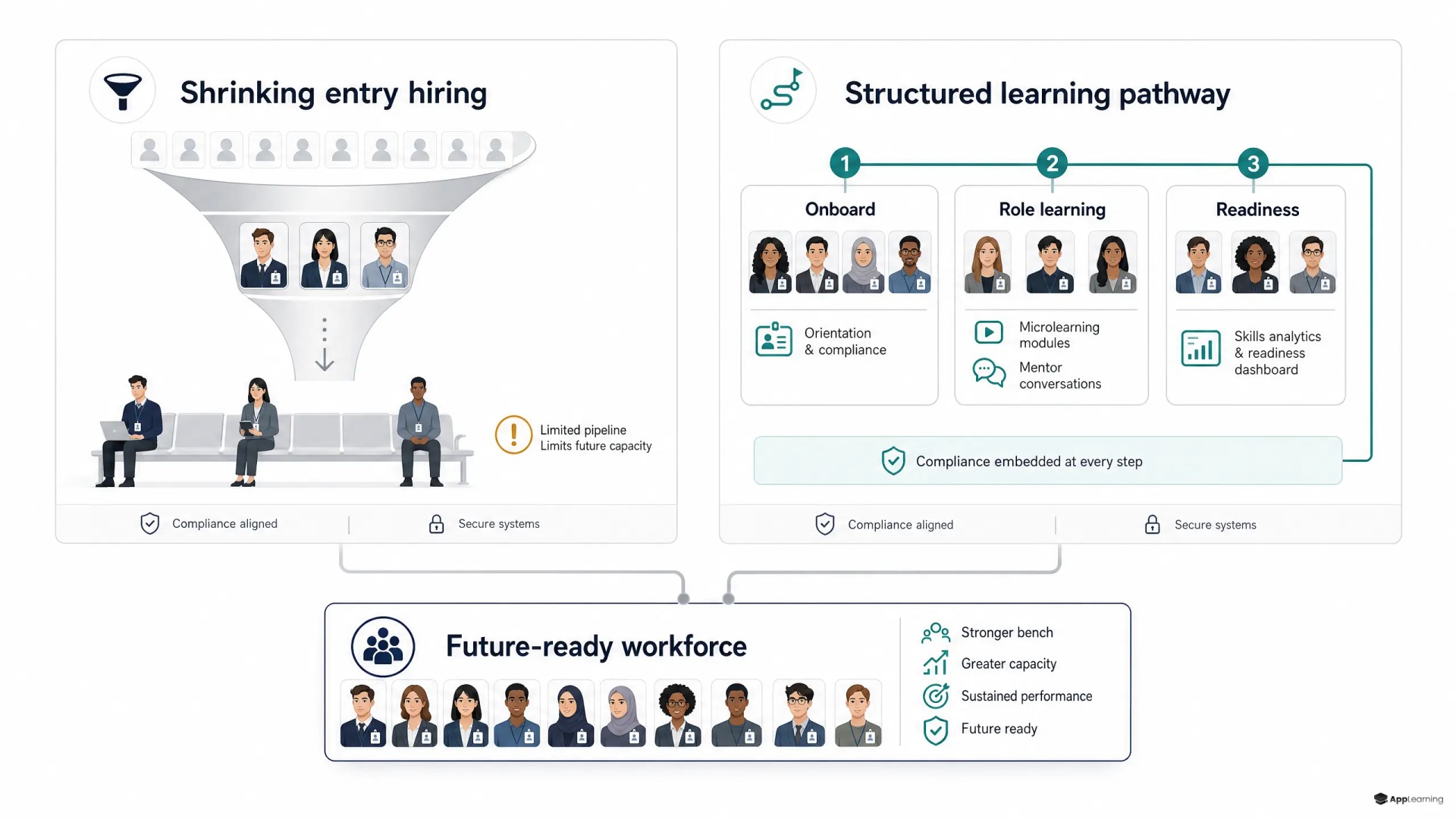
Cost pressure makes the decision understandable. Junior work often includes repeatable research, drafting, triage, administration, and support tasks. AI can reduce the volume of that work. But removing junior roles without replacing their learning function removes the place where people learn systems, judgement, customer context, and escalation habits. A company may save headcount today while narrowing its future young talent pipeline.
AI removes tasks, not the need for a pipeline
AI and early-career recruitment should not be framed as a choice between automation and people. The operational question is which tasks have changed, which human decisions remain, and how a new hire will learn to make those decisions safely. In finance and crypto, that includes recognising risk signals, explaining product limits, handling sensitive information, following controls, and escalating exceptions.
This shifts the entry role. New hires need less time on low-value repetition and more time on guided practice. That only works when the role has a defined capability model. If managers hire only people who already know the work, the business competes for scarce experience instead of building it.
A pool of potential without a route in
The available talent is larger than many hiring plans suggest. The Office for National Statistics estimated that 1.012 million UK people aged 16 to 24 were not in education, employment, or training in January to March 2026, equal to 13.5% of that age group. The ONS also cautions that these Labour Force Survey estimates remain official statistics in development and should be interpreted carefully.
This group is not defined by a lack of ambition. The Open University reports that 70% of surveyed young people not in education, employment, or training want to upskill for their careers, while only 6% want to remain outside work, training, or education. Yet the same research points to a weak employer offer: only a small minority of organisations directly target this group, despite widespread claims that employers are prepared to train new entrants.
The gap is practical. A candidate may need confidence, work evidence, basic sector knowledge, and a first credible step. Generic careers content does not create those conditions. A structured pathway does.
Readiness needs a system
HR and L&D teams can reduce readiness risk by treating onboarding as production of capability, not distribution of information. Start with the role and work backwards. Define the decisions a new hire must make, the errors they must avoid, the systems they must use, and the evidence that shows they are ready for supervised work.
- Set a role baseline that separates mandatory controls from job-specific capability.
- Break the first 30 to 90 days into short learning and practice milestones.
- Use realistic scenarios, knowledge checks, and reviewed tasks instead of passive completion alone.
- Give managers simple progress signals that show confidence, assessment results, gaps, and overdue actions.
- Use early evidence to adapt support before a small gap becomes a performance issue.
This model also makes entry-level hiring more defensible under cost pressure. Leaders can see time to readiness, assessment performance, manager sign-off, and the recurring gaps in the cohort. The discussion moves from whether junior talent is a cost to whether the organisation can build role-ready talent faster than it can buy it.
Good to know
What is the pipeline risk of cutting entry-level roles?
The immediate saving can create a delayed capability gap. Fewer entry roles mean fewer people learning the systems, judgement, and organisational context needed for more skilled roles later.
How should finance and crypto teams measure onboarding?
Track more than completion. Measure role assignment, knowledge checks, scenario performance, reviewed tasks, manager sign-off, time to supervised contribution, and recurring gaps by cohort.
Can short learning modules replace manager support?
No. Short modules make learning easier to repeat and track, but managers still need to set context, review applied work, give feedback, and increase responsibility at the right pace.
Role pathways for regulated work
Regulated sectors need tighter design. A generic induction cannot prepare a crypto operations hire, a customer-support specialist, and a compliance analyst for the same work. Each role needs a shared foundation in conduct, security, product risk, and escalation. It then needs a separate path for the decisions that role actually owns.
For example, an early-career operations pathway can combine product fundamentals, fraud and transaction scenarios, internal tool practice, escalation drills, and manager-reviewed cases. A customer-facing path can add clear product explanation, vulnerability awareness, complaint handling, and boundaries on what the employee may say. Content should change when products, controls, policies, or responsibilities change—not at the next annual training cycle.
Build a learning pathway your new hires can prove.
PlanLearning infrastructure that keeps pace
The learning stack must support this operating model. App-Learning’s academy platform combines role-based paths, short modules, quizzes, certificates, content updates, and progress analytics for employee onboarding, compliance, risk, and product knowledge. That matters when a regulated team needs to update a control quickly without sending learners into a fragmented library of slides, PDFs, and disconnected courses.
The aim is not to turn every new hire into a finished expert in week one. It is to make progress visible and safe: learn the rule, recognise the scenario, make the right decision, show the evidence, and move to the next level of responsibility. Employers that preserve this pathway will build future capability while others merely compete for it.