

Key takeaways
- Heavy AI adopters are still adding junior talent rather than cutting it.
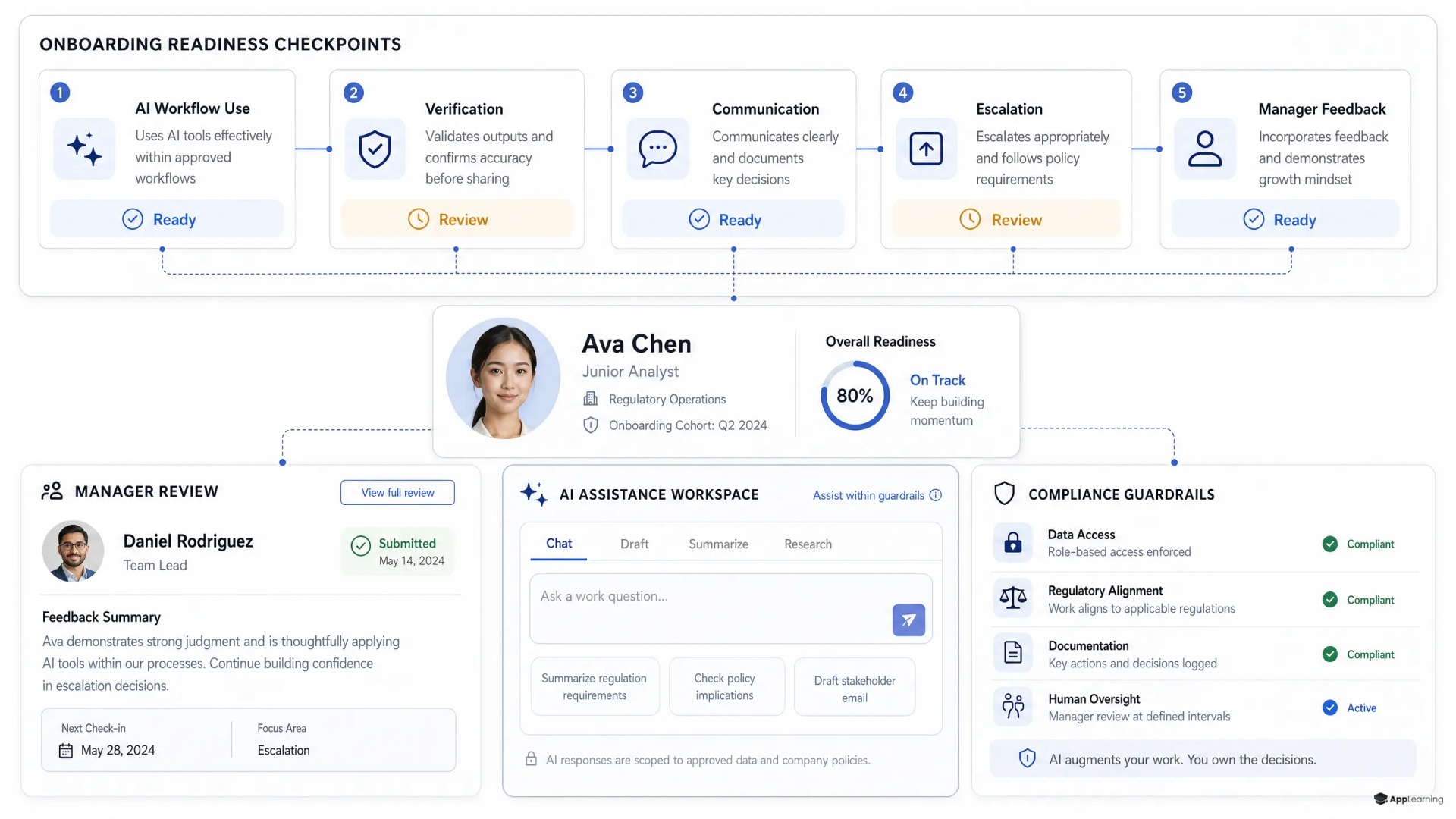
- AI changes junior work toward judgment, verification, escalation, and communication.
- AI onboarding needs role-based practice, not informal tool experimentation.
- Readiness signals matter more than course completions in regulated teams.
The simple AI labor story says junior roles disappear first. The latest firm-level evidence is less neat. Learning News reported on July 1, 2026 that companies making the largest AI investments were increasing entry-level hiring, based on new work from Ramp and Revelio Labs.
That finding does not make AI safe by default. It changes the management problem. Heavy adopters are not removing the bottom rung as much as changing what the bottom rung must be ready to do. Entry-level hiring and AI now belong in the same operating discussion as onboarding, role design, supervision, and evidence of competence.
The data cuts against the easy layoff story
The Ramp and Revelio paper linked observed AI vendor spending from Ramp card and bill-pay data to Revelio Labs workforce records for 21,559 US firms. It found that employment growth was driven mainly by high-intensity adopters. Total headcount was 10.2% higher for those firms over the first 24 months after adoption, while low-intensity adopters showed no statistically significant change.
The junior result is the sharper signal for HR and L&D. Entry-level headcount rose 12% among high-intensity adopters, and the entry-level share of employment also increased. The paper is careful about selection. AI adopters were often larger, more technical, and already growing. Still, the result challenges the idea that serious AI investment automatically means fewer early-career roles.
Junior work becomes a readiness problem
AI removes some beginner tasks. It does not remove beginner accountability. A junior analyst, compliance associate, client support agent, or product operations hire may now draft faster, search wider, and summarise more. But the role also demands stronger checks. The employee must know when an AI output is plausible but wrong, when data cannot be entered into a tool, when a customer answer needs review, and when a risk case must move to a senior owner.
- Choose approved tools for the task and data class
- Verify sources, calculations, and assumptions before use
- Escalate regulated, ambiguous, or client-impacting decisions
- Explain AI-assisted work clearly to managers and reviewers
- Keep records that support audit, QA, and compliance needs
Regulated teams cannot leave this informal
In finance and crypto, informal AI experimentation creates two risks at once. First, new hires learn habits from whoever sits closest to them. Second, compliance teams cannot prove which habits were taught, tested, corrected, and retained. That matters in Europe because DORA requires financial entities to include ICT security awareness and digital operational resilience training as compulsory staff training modules. AI onboarding has to fit that discipline, not sit beside it as an optional innovation track.
The same logic applies outside DORA. A regulated company cannot accept a training model where the only evidence is that a course was assigned. If junior employee onboarding now includes AI-supported workflows, the learning system must show whether people can apply the workflow under realistic constraints.
Good to know
Does AI mean finance and crypto companies should stop hiring juniors?
No. The current evidence is more mixed than that. The Ramp and Revelio research found entry-level headcount growth among high-intensity AI adopters, but the operational bar for those hires is rising.
What should AI onboarding test for junior employees?
It should test tool choice, data handling, prompt quality, source verification, escalation judgment, communication, and the ability to work inside approved controls.
Why are course completions not enough for AI readiness?
Completions show exposure. They do not prove that someone can make a correct decision in a regulated workflow, spot a weak AI answer, or know when to involve a manager.
Where does App-Learning fit in this problem?
App-Learning helps regulated teams turn onboarding, compliance, product knowledge, and role readiness into mobile, trackable learning paths with quizzes, analytics, and certificates.
Readiness needs signals, not completions
Completion data is a weak proxy. It says the person reached the end. It does not say they can handle a risky prompt, reject a bad answer, or explain an escalation. Workforce readiness for AI adoption needs stronger signals, built into the path from preboarding to role certification.
- Scenario checks that mirror real customer, risk, and operations cases
- Question-level analytics that expose repeated misunderstandings
- Role-based paths for support, compliance, product, operations, and leadership
- Manager views that show who is ready, stuck, overdue, or high risk
Build AI onboarding your teams can prove.
TalkThe learning layer has to sit close to work
This is where learning architecture matters. App-Learning’s academy platform supports role-based learning paths, microlearning modules, quizzes, certificates, and analytics across web and mobile. For finance and crypto teams, that means AI readiness can be built as a structured pathway rather than a loose collection of policies, tool tips, and recorded workshops.
The goal is not to make every junior hire an AI expert. The goal is to make safe, useful AI behavior repeatable. A strong path teaches the approved workflow, tests the decision points, records the evidence, and gives managers enough visibility to intervene early. That is a practical learning system, not a content library.
The firms spending deeply on AI still need people. They may need junior people even more, because growth creates coordination, support, control, and customer work. The difference is that junior readiness can no longer be left to time, proximity, or confidence. If AI changes the work, onboarding must become the operating system that makes new workers useful, careful, and measurable.