
Key takeaways
- Peer influence can outperform generic group training for AI adoption.
- Champions need business translation skills, not only technical enthusiasm.
- Real workflow examples are more persuasive than abstract tool demos.
- Champion activity and downstream adoption should be measured separately.
Tool access is not adoption
Banks often treat AI rollout as a technology milestone. The tool is approved. The launch email goes out. A webinar explains prompting. Then usage fragments. Some teams experiment daily. Others wait. Many employees do not know which task is safe, which data is allowed, or how good output should look before it leaves their desk.
For European banks, this is now a control issue as well as a change issue. Article 4 of the EU AI Act has required AI literacy measures since 2 February 2025, and the European Banking Authority’s June 2026 risk assessment links AI use in finance to operational, bias, data quality, legal, cyber and third-party risks. Training cannot stop at awareness.
Champions make adoption local
The strongest AI champions program works because it changes the messenger. A colleague in internal audit can make AI real for another auditor faster than a central training team can. The same WSJ report said Citi scaled its program to more than 4,000 champions and accelerators, with a practical audit-report drafting use case helping shift perception from abstract AI promise to visible workflow value.
Ropes & Gray shows the same pattern in a different regulated environment. The firm said in July 2026 that nearly 2,200 employees were generating more than 282,000 monthly prompts, supported by a network of more than 60 champions. The lesson is not that every bank needs the same ratio. The lesson is that peer learning needs structure.
The role is translation, not enthusiasm
A Slack channel can coordinate champions. It cannot prepare them. A good champion role has a job description, not just a badge. Champions should translate business work into safe AI patterns, surface objections, collect useful examples, and feed product teams with evidence from the front line.
- Map common workflows in their unit
- Explain approved tools and boundaries
- Demonstrate repeatable prompt patterns
- Run short peer sessions
- Capture failed attempts and risks
- Escalate unclear use cases
This matters because trustworthy AI is operational, not rhetorical. The NIST AI Risk Management Framework treats trustworthiness as a mix of validity, safety, security, accountability, transparency, explainability, privacy and fairness. Champions help turn those properties into daily decisions.
Use cases need owners
Real workflow examples beat generic demos. A relationship manager wants to see AI help prepare a client meeting. A compliance officer wants a faster first pass on policy comparison. An operations lead wants fewer manual handoffs. An AI enablement platform should make these examples searchable, role-specific and governed.
- Workflow trigger
- Role and business context
- Approved tool
- Prompt pattern
- Data boundary
- Quality check
- Escalation path
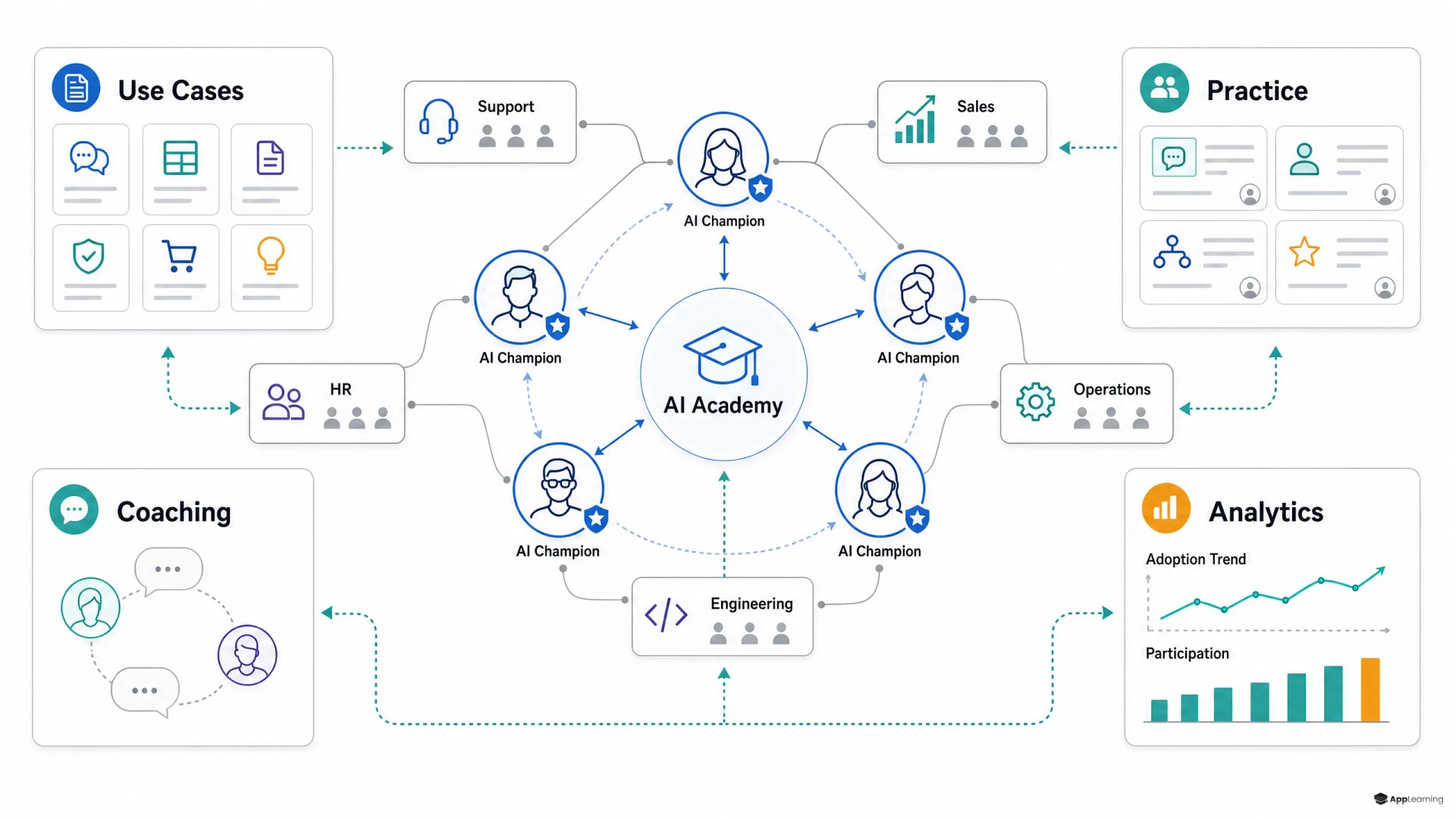
This is where App-Learning would treat the AI champions program as an enablement product. Short learning paths prepare the role. Scenario practice builds judgment. Searchable use-case libraries reduce repeated explanation. Recognition keeps voluntary effort visible. Analytics show whether the network changes behavior beyond course completion.
Good to know
How many AI champions does a bank need?
Start with workflow coverage, not headcount. Each major function should have champions close enough to daily work to translate AI into real tasks.
Should champions be technical experts?
Not necessarily. The strongest champions understand business context, risk boundaries, and how to explain practical AI use to peers.
What belongs in an AI enablement platform?
Role-based learning paths, scenario practice, governed use cases, peer-support workflows, recognition, feedback loops, and adoption analytics.
Practice makes the risk visible
Prompt training alone is too thin. Champions need practice scenarios that force judgment. A simulated client request can test data handling. An audit-summary exercise can test verification. A chatbot response can test hallucination checks. The aim is not to make every employee an AI expert. The aim is to build enough shared judgment that people know when to use AI, when to verify, and when to stop.
Turn your champion network into a measurable learning system.
PlanAnalytics must separate activity from adoption
Course completion is a weak signal. Champion activity and downstream enterprise AI adoption should be measured separately. The NIST AI RMF Core puts documented measurement and evaluation into the operating model, which is the right discipline for banks.
- Champion health: active champions, coverage by unit, peer sessions, submitted use cases, response time, unresolved questions.
- Adoption impact: active users, repeat use, approved use-case reuse, task penetration, quality checks, time saved, risk escalations.
AI champions can accelerate change, but only if the bank gives them a system. The durable advantage is not enthusiasm. It is a repeatable loop of role preparation, practice, use-case capture, peer support, feedback and measurement. Without that loop, the network becomes noise. With it, AI peer learning becomes part of the bank’s operating model.