

Key takeaways
- Complex products need guided adoption beyond documentation.
- Developer education must combine implementation, safety and governance.
- Partner certificates create a visible readiness signal.
- Learning analytics show adoption bottlenecks and content gaps.
Documentation breaks at the handover to real work
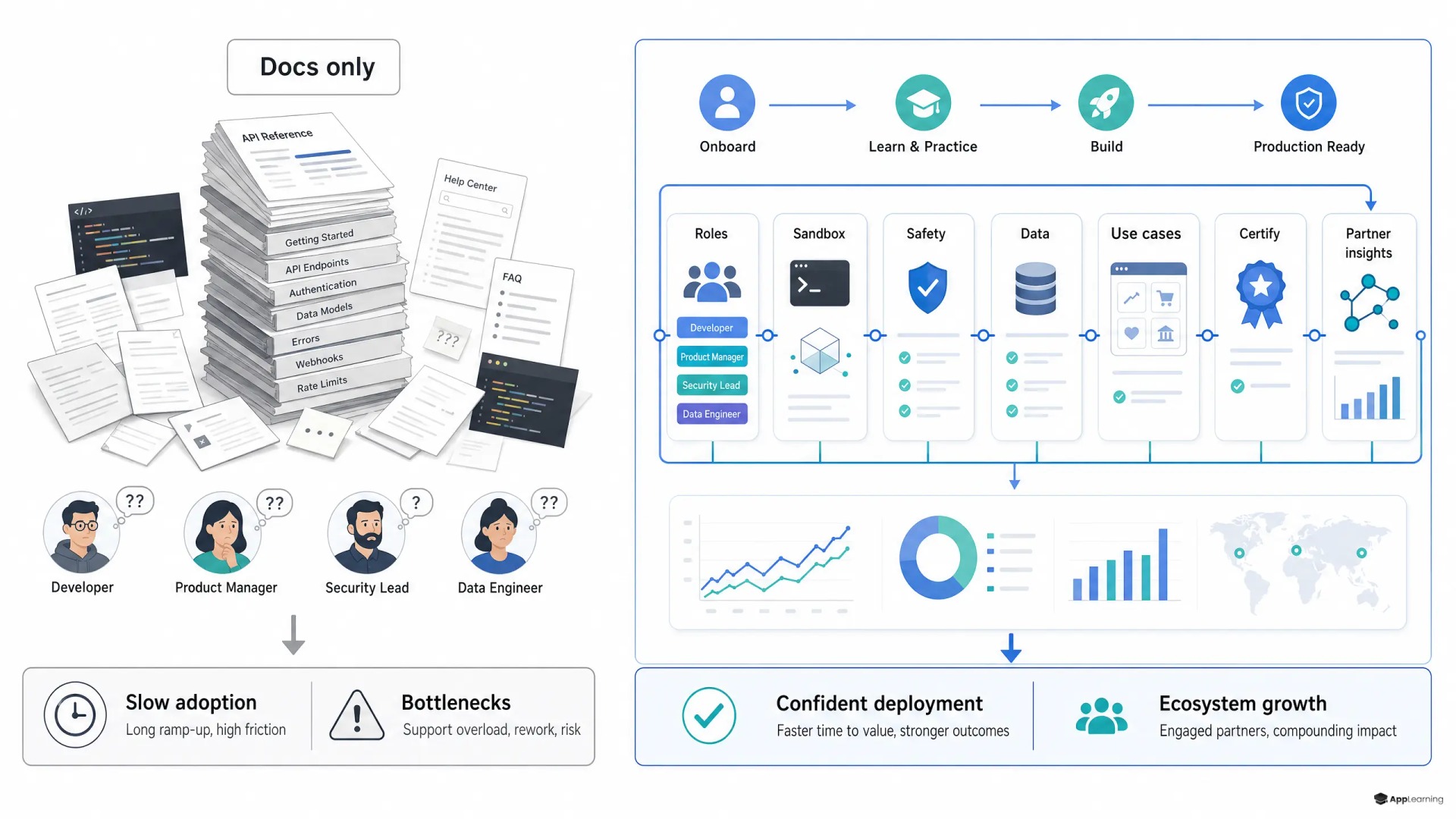
Documentation is a reference layer. It lists endpoints, parameters, SDKs, rate limits and examples. That is useful, but it is not adoption. Adoption starts when a developer must combine the API with data flows, security rules, model behavior, fallback logic, monitoring and customer constraints.
AI makes this gap wider. A partner can read the docs and still build a fragile workflow. They may call the model correctly, but handle data poorly, miss a safety boundary or ship a demo that cannot survive production. Founders know the same pattern from internal onboarding. Knowledge exists, but it sits in Slack, Notion pages and senior people’s heads.
Google’s India signal is ecosystem education
On July 14, 2026, Google used I/O Connect India to connect AI education with developer tools, safety and enterprise deployment. The Economic Times described the event as a move beyond models toward deployment, data localization, security and education. Times of India reported in-country Gemini processing for enterprise AI workloads in India.
This is not a side program. It is product distribution through capability building. Reuters reported Google’s three-year one billion dollar commitment for AI training, tools and institutional partnerships in U.S. higher education. The lesson for AI vendors is clear. If the product is complex, education becomes ecosystem infrastructure.
Regulation turns learning into an operating control
For European vendors and partners, this is also a governance issue. The European Commission says Article 4 of the AI Act requires providers and deployers to ensure sufficient AI literacy for staff and others dealing with AI systems on their behalf. The same guidance says relying only on instructions for use may be ineffective and insufficient in many cases.
That changes the role of API training. A serious developer education platform must teach implementation and the rules around implementation. The curriculum has to cover when data may be sent, how outputs should be checked, where human oversight sits and which use cases are outside acceptable policy.
A path has jobs, checks and context
Product education for developers should follow the work, not the marketing site. The path starts with roles. An app developer, solutions architect, data engineer, implementation partner and compliance lead do not need the same sequence. Each needs the minimum path to build safely in their context.
- Product model and core concepts
- API training with working environments
- Authentication, limits and failure modes
- Data handling and privacy boundaries
- Safety, governance and escalation rules
- Real customer use cases
- Practical checks before certification
The goal is not content consumption. The goal is repeatable implementation. A good path makes the first correct build easier than the first wrong build.
Good to know
Do learning paths replace documentation?
No. Documentation stays the reference layer. Learning paths turn that reference into guided implementation for specific roles and use cases.
When does a partner academy make sense?
It makes sense once partner quality starts affecting customer outcomes, sales cycles or support load.
What should AI API training include?
It should include setup, calls, errors, data handling, safety rules, governance checks and realistic implementation scenarios.
Can a startup run this without an L&D team?
Yes. The practical route is a modular academy with templates, reusable content blocks and analytics from day one.
Certificates make readiness visible
Certificates often look cosmetic. In partner ecosystems, they can solve a real coordination problem. Sales needs to know which integrator can support a regulated customer. Customer success needs to know who understands migration paths. Product teams need to know where partners keep failing.
A weak certificate rewards video watching. A useful certificate requires setup, an API call, error handling, a data boundary decision, a safety review and a final scenario. It should also expire when the product or regulatory environment changes. That makes certification part of partner quality, not a badge factory.
The academy becomes a feedback system
A partner academy should not only deliver lessons. It should show where adoption breaks. If many learners fail authentication, the docs or SDK may be unclear. If partners pass the technical module but fail data handling, governance enablement is behind. If one region drops out of a course, language or localization may be blocking scale.
This is where App-Learning fits. A white-label partner academy can combine modular curricula, practical checks, certificates, multilingual delivery and analytics without forcing a growing company to build an L&D department. The same content architecture can support internal onboarding, partner enablement and customer education.
Build a partner academy your ecosystem can trust.
TalkAdoption is a capability problem
The next competition in AI platforms will not be won only by model quality or API breadth. It will be won by the ecosystem that can build correctly at scale. Documentation remains necessary, but it is not enough. A serious AI developer enablement system teaches the sequence of work, proves readiness and shows the vendor where adoption is breaking. That is the difference between an API people try and a platform partners can trust.