
Key takeaways
- Self-directed AI learning creates uneven capability.
- Tool access does not equal adoption.
- Role redesign and training must happen together.
- AI readiness should be tracked by behavior, not attendance.
The hidden limit of informal AI learning
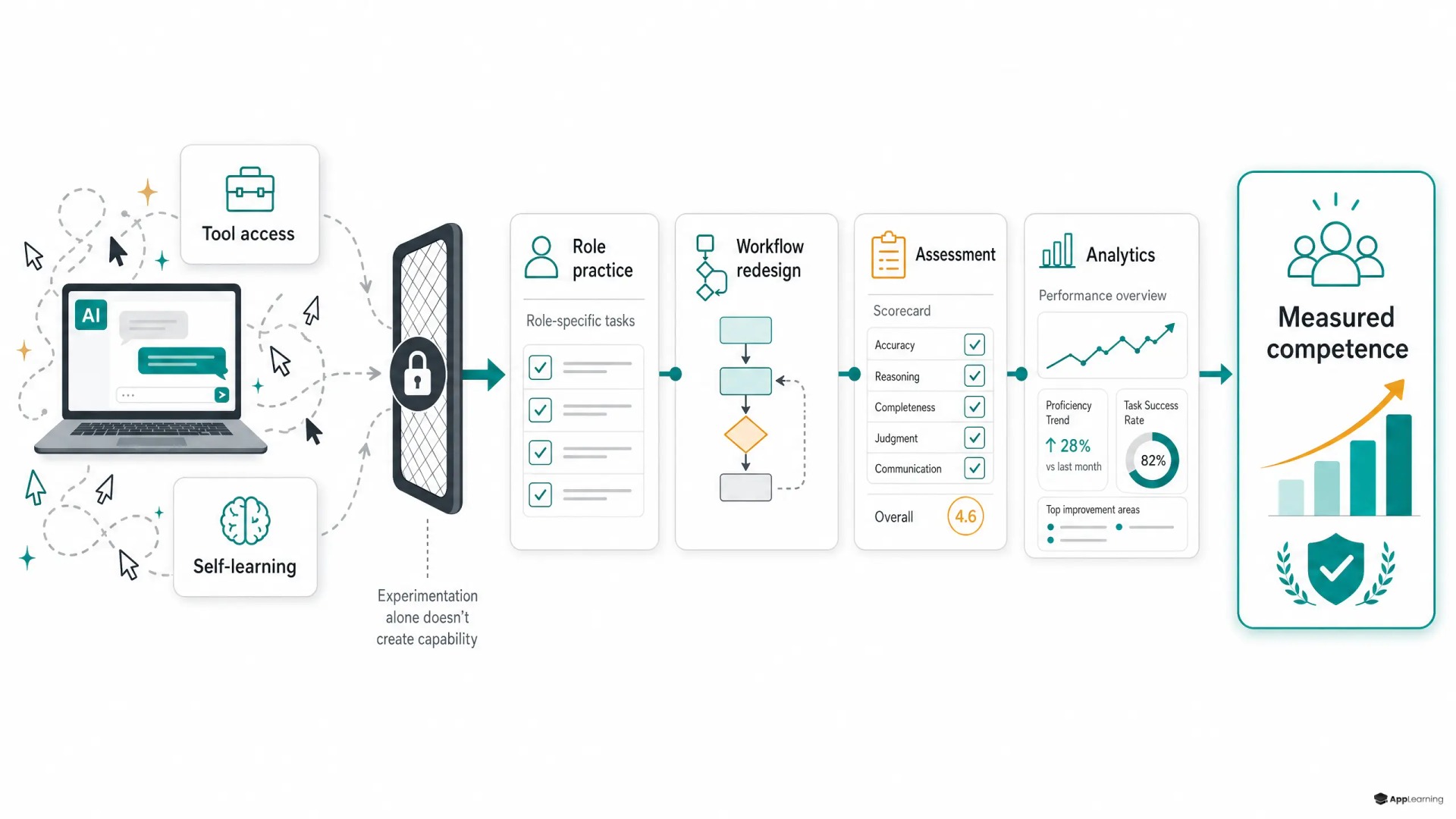
Most AI enablement starts too casually. A company opens access to a model, shares a prompt guide, runs a webinar and waits for productivity to appear. Some employees move fast. Others avoid the tool. A third group uses it in ways the business cannot see, test or govern.
That is not a learning strategy. It is unmanaged variation. Reuters reported in January 2026 that EY’s Julie Teigland warned companies will not gain from AI unless they invest in people and redesign work, not just deploy tools.
There is no ROI if you’re not willing to change the job descriptions.
The point is practical. AI workforce training only becomes useful when it changes how work is done. If the job stays the same, AI becomes an accessory. If the workflow changes without training, risk increases. Commercial value sits between those two failures.
Personal confidence is not workflow competence
Private AI use can create false confidence. An employee may be comfortable asking a public model to rewrite an email, yet unsure how to use approved AI inside credit analysis, fraud review, customer onboarding, compliance monitoring or crypto transaction screening.
For finance and crypto firms, that gap matters. The same tool that speeds up a draft can weaken auditability, expose sensitive data or produce a plausible but wrong interpretation of policy. In regulated work, AI readiness is not a feeling. It is the ability to use AI within rules, controls and evidence requirements.
Role redesign turns interest into output
Role-based AI training starts with the job, not the tool. It maps where AI can support work and where it must not. It defines what the employee now needs to judge, verify, escalate and document.
- Which tasks AI may draft, classify, summarize or check
- Which tasks remain human-only because risk is too high
- Which controls sit before and after AI use
- Which evidence must remain for audit and supervision
- Which skills shift from production to review and exception handling
This is also where compliance and capability building meet. The European Commission says Article 4 of the AI Act requires providers and deployers to ensure sufficient AI literacy for staff, considering knowledge, experience, training and context of use.
That wording points in the right direction. Generic AI upskilling is not enough. A payments analyst, compliance officer, product manager and customer support agent need different practice because they face different decisions, risks and handoffs.
Good to know
What makes AI enablement different from general AI training?
AI enablement connects training to real work. It defines use cases, controls, role expectations, practice scenarios and measurable competence.
How should a regulated finance or crypto company start?
Start with high-volume workflows where AI is already being used or requested, then map tasks, risks, controls and the skills each role needs.
What should L&D measure beyond completions?
Measure scenario performance, approved use case adoption, output quality, escalation behavior, policy exceptions and manager-observed workflow change.
Scenario practice creates safe transfer
Self-directed prompts rarely include the hard parts of real work. Scenario-based learning does. It puts employees inside realistic cases with unclear inputs, policy constraints, time pressure and consequences.
- A fraud analyst reviews an AI-generated alert summary and decides what evidence is missing.
- A relationship manager uses AI to prepare a client note without exposing restricted information.
- A compliance officer checks whether an AI-assisted answer meets internal policy and regulatory expectations.
This is the operational layer App-Learning focuses on: microlearning, scenarios, assessments and analytics tied to specific roles. The unit of design is not the model. It is the task, the risk, the decision and the evidence.
Build AI capability where the work happens.
TalkAI readiness needs operating metrics
Attendance is a weak proxy for AI readiness. Completion data proves that someone opened a module. It does not prove they can use AI safely in a workflow.
- Approved use case activation
- Scenario pass rates by role
- Quality of AI-assisted outputs
- Escalation accuracy
- Policy exceptions and control breaches
- Confidence calibrated against observed behavior
A measurable AI enablement program links learning data to business behavior. It shows where adoption is healthy, where risk is rising and where managers need to redesign work before asking people to move faster.
The companies that benefit from AI will not be the ones with the most licenses or the longest prompt libraries. They will be the ones that convert curiosity into role-based practice, redesign workflows around clear controls and measure competence where the work actually happens.