

Key takeaways
- Skills gaps still block AI value more than tool availability.
- Role-based practice beats broad AI awareness training.
- Managers need reinforcement loops, not one-off enablement decks.
- Readiness metrics must track application, confidence, and capability progress.
The missing layer behind AI productivity
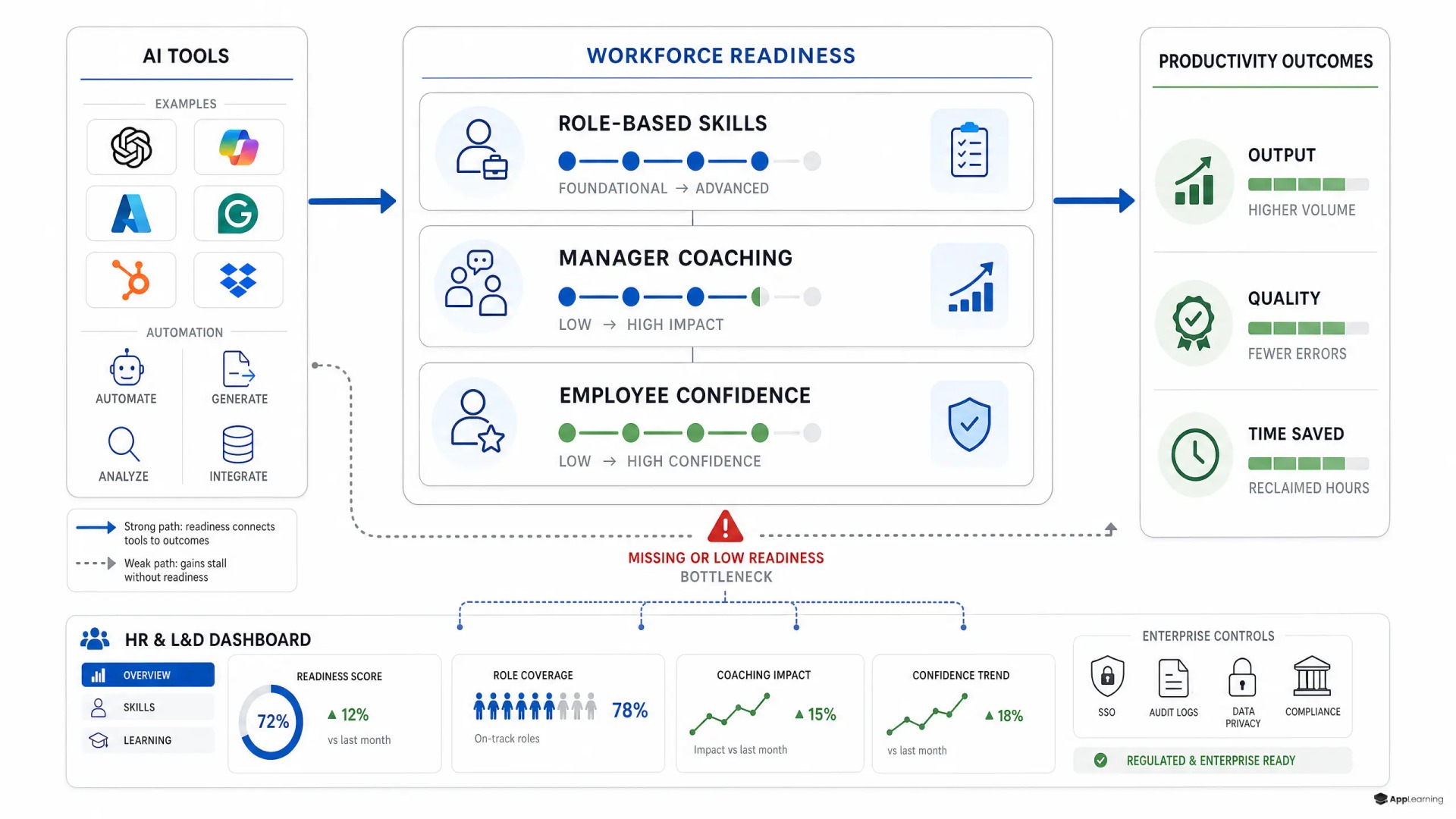
Employers are buying AI tools faster than their workforces can absorb them. That is the wrong sequence. As HR Magazine reported, the WEF findings put skills, not access to technology, at the centre of the AI productivity problem.
The gap is operational. Employees may have a copilot, chatbot, or workflow assistant, but still lack the judgement to use it on live work. They are unsure which tasks are safe, which outputs need review, which data can be used, and when a human decision must override the machine.
The role is the unit of change
Generic AI productivity training creates awareness. It does not create dependable behaviour. AI workforce readiness has to start with the role: compliance analyst, relationship manager, onboarding specialist, fraud investigator, product marketer, support lead. Each role has different decisions, risk points, data boundaries, and value moments.
- Draft a KYC summary from approved inputs
- Review an AI-generated customer response
- Compare policy changes against internal rules
- Document a human override decision
- Escalate uncertain outputs before they become risk
Managers turn experiments into habits
AI adoption fails when experimentation stays private. Managers sit between the tool rollout and changed behaviour. They define acceptable use, inspect work quality, surface edge cases, and reinforce new routines. L&D should give them the system: short scenarios, coaching prompts, checklists, and evidence points. Without this layer, AI upskilling strategy becomes content distribution, not capability building.
- Before work, define the approved AI use case
- During work, apply the decision rule
- After work, review quality and risk
- Over time, update the playbook
Finance needs narrower patterns
Finance, banking, and crypto teams cannot treat AI use as informal productivity hacking. The WEF report on AI in financial services describes a sector rich in data and language work, but also exposed to risks around privacy, cybersecurity, transparency, and misinformation. In Europe, the Commission’s AI literacy guidance also points toward training that reflects the target group, context, and purpose of use.
That changes the design brief. AI productivity training in regulated sectors must be narrow enough to be safe and practical enough to be used. A prompt library is not enough. Teams need examples, boundaries, escalation rules, and proof that people can apply them.
Good to know
Where should an AI workforce readiness programme start?
Start with two or three high-value roles and map the real tasks where AI can help without increasing risk.
How is AI productivity training different from AI awareness training?
Awareness explains concepts. Productivity training builds safe role-based behaviour through scenarios, practice, reinforcement, and measurement.
What should L&D measure beyond completions?
Measure application quality, confidence, scenario performance, manager validation, and recurring gaps by role or team.
Completions are weak evidence
Completion data proves access. It does not prove readiness. Leaders need to see whether people can apply skills for AI adoption inside real workflows. The measurement model should move from course activity to capability signals.
- Role coverage across priority AI use cases
- Scenario scores and confidence shifts
- Manager observations after live application
- Recurring gaps by team, risk area, or task
Build measurable AI readiness into daily work.
TalkA readiness architecture that scales
A practical AI workforce readiness system links roles, use cases, risk levels, learning paths, manager reinforcement, and analytics. This is where short mobile learning has an advantage. It fits between work moments, supports repetition, and can be updated as policies, tools, and risks change.
For App-Learning, this is the useful angle. Its academy platform supports branded microlearning, role-based learning paths, quizzes, certificates, and analytics for employee education. In a finance or crypto context, that means AI readiness can sit alongside compliance, onboarding, risk, product knowledge, and internal processes instead of becoming another disconnected initiative.
The productivity case for AI will not be won by access alone. It will be won by employers who turn AI from a tool people can open into a work system people can use well. Readiness is the bridge between ambition and output.