

Key takeaways
- Tool usage is not proof of responsible capability.
- Measure training coverage against active AI users, not licenses purchased.
- Segment the ratio by role, data sensitivity and decision risk.
- Completion matters, but assessment and work behavior provide stronger readiness evidence.
Adoption dashboards can hide a readiness deficit
A startup can report AI licenses, weekly active users and prompt volume, then call the rollout a success. None of those AI adoption metrics show whether people know what data they may enter, how to verify an output, or when a human must take over. At 50 people and beyond, that gap stops being informal. New hires copy the habits of the people around them, while managers teach different rules in different teams.
The same pattern is visible beyond the workplace. Instructure’s July 2026 survey found that 68% of K–12 educators and 61% of higher-education educators used AI in class at least occasionally, while 45% and 41% respectively reported no formal AI training. It is an education sample, not a workplace benchmark. But it exposes the measurement error: activity is easy to count, while preparation is often invisible.
For founders, the operational risk is not that every employee uses AI. It is that AI use spreads before the company has a shared operating model. Sales may paste customer context into a tool. Support may trust a confident but wrong answer. Product may use generated research without checking sources. The company sees adoption while capability remains uneven.
A ratio that tests the rollout
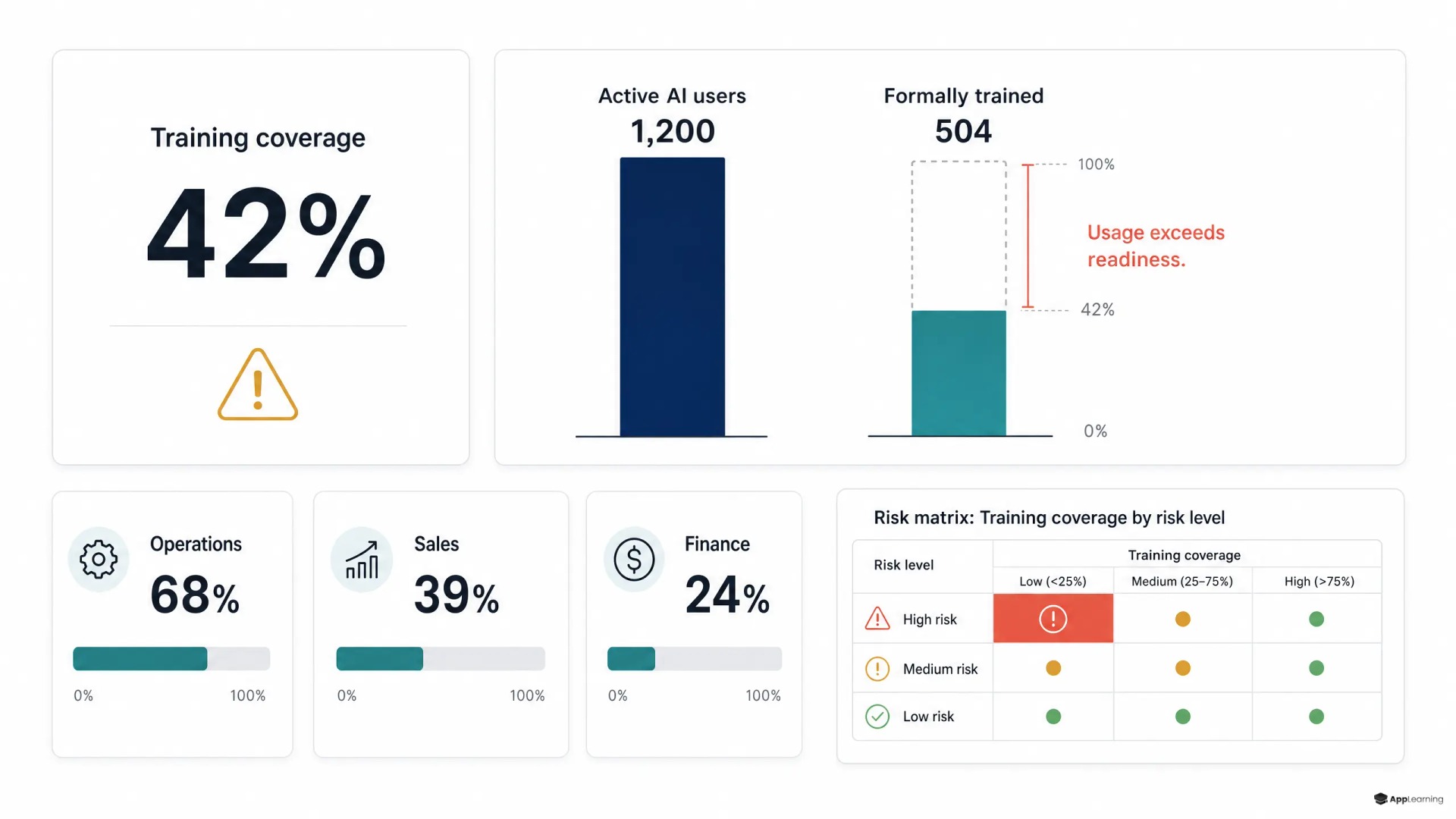
The training coverage ratio is a proposed AI readiness KPI, not an established industry standard. It compares people who actively use AI with the subset who have current, role-relevant learning evidence.
Training coverage ratio = active AI users with current role-relevant training and a passed assessment ÷ active AI users
Define active AI users from tool telemetry with a fixed rule, such as anyone who used an approved AI tool during the trailing 30 days. Count someone as trained only when they completed the relevant path, passed a short scenario-based assessment and remain within the renewal period. A ratio of 0.40 means 60% of active users are operating without verified formal AI training for their role.
This prevents a common reporting mistake. Purchased seats belong in a procurement dashboard. Enrolled learners belong in a learning dashboard. The training coverage ratio joins them only where they matter: among people who are already using the tools.
Risk changes the denominator
One company-wide ratio is useful as a headline, but it is too blunt to manage. Segment it by function, use case and risk. A designer using AI to create internal workshop ideas does not need the same learning path as a recruiter screening candidates or a support agent handling account data.
For a growing startup, three segments are often enough to begin:
- Low-risk internal work such as drafting, brainstorming and meeting preparation.
- Customer-facing work such as sales messages, support replies and published content.
- Sensitive or consequential work involving personal data, hiring, finance, legal claims or operational decisions.
Each segment needs different proof of readiness. The baseline can cover approved tools, data boundaries, output verification and escalation. Higher-risk paths should add realistic scenarios, manager approval and shorter renewal cycles. For companies deploying AI in the EU, Article 4 of the AI Act makes AI literacy an obligation for providers and deployers, while leaving the appropriate level dependent on the people, context and intended use.
Good to know
What counts as an active AI user?
Use a consistent behavioral threshold from approved-tool data, such as at least one meaningful use in the past 30 days. Avoid using licenses as the denominator because a provisioned seat says nothing about actual use.
Should every employee complete the same AI training?
Every employee can complete a short baseline on approved tools, data handling, verification and escalation. Add role-based modules when people use AI in customer-facing, sensitive or consequential work.
Can a startup use this KPI without an L&D team?
Yes. Start with three role and risk segments, one short baseline path, simple scenario checks and a monthly comparison of active users against current learning evidence. Add depth only where use and risk justify it.
Is the training coverage ratio a compliance metric?
It is first an operating metric. It can also support AI-literacy evidence, especially where the EU AI Act requires providers and deployers to take measures for sufficient AI literacy, but it does not replace legal or governance review.
Completion is only the first signal
Course completion is necessary evidence, but it is weak evidence on its own. People can finish a module without changing how they work. A useful AI training coverage system therefore combines completion with signals that test judgment in context.
- Scenario assessment scores for data handling, source checking and human review.
- Confidence and uncertainty checks that reveal where learners need support.
- Manager observation or quality sampling for high-risk workflows.
- Escalation, correction and policy-violation patterns at team level.
Do not turn this into employee surveillance. Use the minimum data needed, aggregate reporting where possible and make the purpose clear: improve the learning system and reduce avoidable risk. Product data should identify capability gaps, not rank people by prompt count.
Turn AI learning evidence into a measurable readiness signal with App-Learning.
ExploreLearning evidence must meet product data
App-Learning can give a startup the missing layer between workforce AI adoption and readiness. Build short role-based paths from the company’s actual AI policy and workflows. Record completion, assessment results and renewal dates. Then match that evidence to approved-tool activity through a shared, privacy-conscious user identifier.
The resulting view is practical. If active use rises while AI training coverage falls, target the roles and workflows where the gap is widening. If completion is high but assessment scores are low, redesign the learning around real decisions rather than add another policy slide. If coverage is high but use is low, the barrier may be workflow design, manager support or tool access rather than skills.
This is the operating discipline that AI rollouts need. AI adoption is not a count of seats, prompts or experiments. It is a controlled capability built into real work, with evidence that the people using the tools are prepared to use them well.