

Key takeaways
- Adaptive learning needs a defined learner-state model, not only an AI prompt.
- Path decisions should be explainable to learners, reviewers and enterprise buyers.
- Skipped, repeated and advanced content must remain versioned and auditable.
- Personalization should be measured through mastery, retention and task readiness rather than engagement alone.
Static catalogs treat the course as the product. Adaptive AI learning changes that. Once a system selects, skips, repeats, or advances content for each person, the sequence becomes a consequential product decision. As Reuters reported, LearnVector plans individualized courses for white-collar workers that track progress and become more advanced as proficiency grows.
Individual courses become live systems
This is a serious shift for personalized corporate training. A course is no longer a fixed package with optional extras. It becomes a live system that interprets evidence, chooses the next intervention, and shapes what a learner is allowed to miss. In finance and crypto, that choice can affect more than convenience. It can determine whether an employee practises a sanctions escalation, revisits a control failure, or moves into a role-specific scenario before the underlying knowledge is secure.
AI course personalization can make learning more relevant and reduce redundant work. But relevance is not enough. If an L&D lead cannot explain why an employee bypassed a mandatory concept, repeated a module, or received a harder scenario, the organisation has created a black-box curriculum. That is difficult to defend to compliance, managers, learners, or enterprise buyers.
Each recommendation changes the curriculum
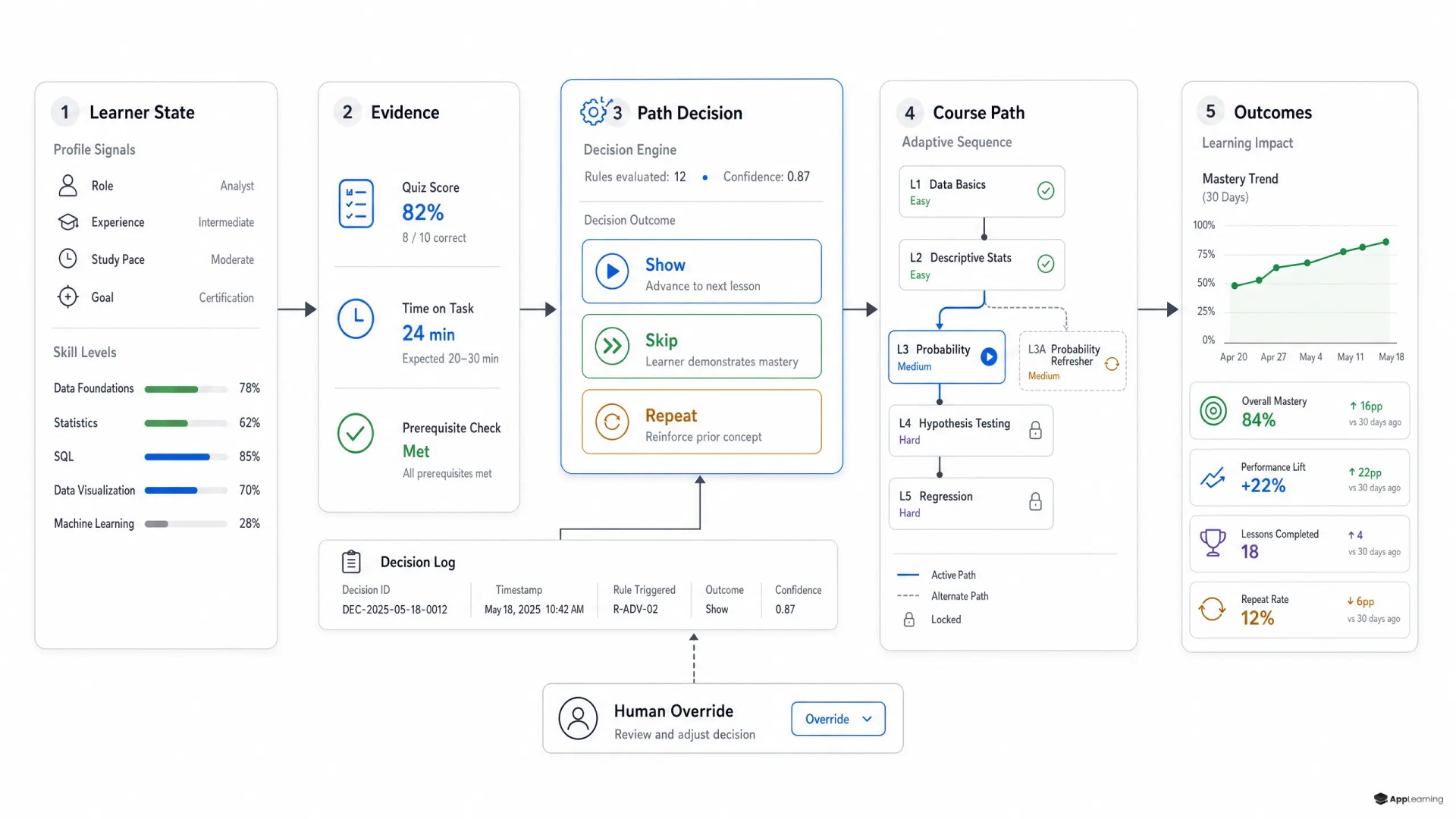
The hidden mistake is to treat an adaptive path as a content-generation feature. It is a progression system. An AI model may suggest a next step, but it should not be the sole definition of readiness. The learning system needs an explicit learner-state model that separates demonstrated capability from weak signals such as time spent, clicks, confidence ratings, or prompt responses.
A useful learner state records what the person can do, what evidence supports that conclusion, what remains mandatory, and how reliable the evidence is. It should also capture role requirements, policy deadlines, and knowledge that has expired because procedures changed. This makes explainable adaptive learning possible without exposing learners to a meaningless technical model trace.
Governance starts with the path rules
A governed adaptive path needs a small number of durable system components:
- A prerequisite map that connects skills, concepts, scenarios, and assessments.
- Gated modules for non-negotiable knowledge, controls, and role requirements.
- Scenario assessments that provide stronger evidence than passive completion.
- Versioned progression rules that define thresholds, exceptions, and escalation paths.
- Decision records that show the learner state, content version, rule version, action, and reason.
The learner-facing explanation can stay simple: “You are repeating this scenario because the last attempt showed a gap in escalation criteria.” The internal record must be richer. It should let a reviewer reconstruct the decision months later, even after a policy or assessment changes. For European operations, Article 4 of the EU AI Act also requires providers and deployers to take measures for sufficient AI literacy among people who operate and use AI systems. That makes operational understanding of the path logic a practical requirement, not a technical nice-to-have.
Good to know
How much explanation should a learner receive?
Give learners a short, actionable reason for the next step. Keep the full evidence, rule version, and decision context available for authorised reviewers.
Does adaptive learning mean that AI decides everything?
No. AI can recommend content and support practice, while authored prerequisites, mandatory modules, and assessment thresholds define the allowed decision space.
Can adaptive paths work with mandatory compliance training?
Yes. Keep required controls and attestations gated, then personalise practice, remediation, examples, and scenario difficulty around those fixed requirements.
Engagement cannot be the success metric
Adaptive systems often optimise what is easy to observe: completion, dwell time, return visits, or recommendation acceptance. None proves capability. In one two-week randomized split test involving more than 5,700 learners, collaborative filtering produced the strongest retention, while a fixed expert path produced the highest mastery. The result is a useful warning: a path that keeps learners active is not automatically the path that builds competence.
Evaluate adaptation against outcomes that matter in the role:
- Performance in scenario-based assessments before and after the path decision.
- Retention checks after 30, 60, or 90 days.
- Time to complete a supervised task at the required standard.
- Error, rework, or escalation patterns where these can be measured responsibly.
- Outcome differences between the adaptive path and a fixed baseline path.
Build adaptive learning paths your teams can inspect and improve.
Talk to usApp-Learning provides the governed foundation
App-Learning can act as the structured operating layer beneath adaptive course delivery. Prerequisite maps define what must be known first. Gated modules protect required learning. Scenario assessments create measurable learner states. Versioned content and path logic preserve an audit trail when the curriculum changes. An AI layer can then personalise practice, examples, pacing, and support within those boundaries rather than quietly rewriting the learning journey.
This gives L&D teams a better operating model. Subject-matter experts own prerequisites and acceptance criteria. Compliance teams can review mandatory gates and decision rules. Learning teams can test whether adaptations improve task readiness. Product teams can adjust the experience without losing sight of the curriculum logic underneath it.
Adaptive systems should make curricula more responsive, not less governable. The standard for learning path governance is simple: every material path decision must have a purpose, evidence, owner, version, and measurable outcome. In regulated capability building, the ability to account for the sequence is part of learning quality itself.