
Key takeaways
- Knowledge checks cannot validate complex task execution.
- Simulations create observable evidence of competence.
- Coaching should shorten confusion without giving away the decision.
- Simulation data can improve onboarding, certification, and product design.
Product knowledge is not operational readiness
A completion record proves that someone opened and finished content. A quiz can show that they remember a policy or recognise the right answer. Neither proves that they can review a transaction alert, select the right action, document a rationale, and route an exception under realistic pressure. The U.S. Office of Personnel Management describes job knowledge tests as measuring what a person knows at the time of testing. That matters, but it is not the same as performing a workflow.
For finance and crypto firms, this gap is material. Training often carries compliance weight, while product releases and changing processes create new points of failure. A product academy simulation turns a workflow into a prove-it task. It gives L&D, compliance, and product teams evidence that a learner can apply the correct process rather than merely describe it.
The task trace exposes what quizzes hide
A well-designed simulation-based training environment captures the route a learner takes, not only the final answer. One peer-reviewed study in an advanced high-stakes setting found that both low- and high-fidelity simulations added predictive value beyond a knowledge test, with the higher-fidelity assessment adding further value beyond the lower-fidelity one. The study record in ERIC is a useful reminder that declarative knowledge and demonstrated performance are related, but not interchangeable.
The simulation should observe the parts of execution that carry operational risk:
- The sequence of decisions and whether critical controls were followed
- The point where a learner hesitated, backtracked, or chose an unsafe shortcut
- Whether help was requested before or after an avoidable error
- The quality of recovery after a wrong turn
- Performance on a second scenario that changes the context but preserves the underlying rule
This creates skills validation that is more useful than a pass mark. It also prevents a common mistake: treating speed as competence. An OECD review of complex-skills assessment notes that simulations can capture pause time and changing strategies, but also warns that not every decision can be inferred reliably from clickstream data. Competency analytics need a clear evidence model, not a dashboard full of undigested events.
AI coaching must preserve the decision
Contextual AI coaching belongs inside practice, not inside a hidden answer key. The learner should first encounter the problem, then receive a prompt that directs attention to the relevant control, product state, or policy condition. The coach can explain the consequence of a choice after it happens. It should not remove the productive struggle that reveals whether the learner can reason through the case.
Separate practice mode from assessment mode. In practice, offer progressive hints, examples, and retries. In assessment, restrict help, define the scoring rubric in advance, and route ambiguous results to human review. This protects the integrity of certification, especially where competence claims affect customer treatment, risk handling, or compliance responsibilities.
The market is moving toward more adaptive practice. On July 9, 2026, Cresta launched a training simulator that creates scenarios informed by real customer conversations and grades practice against quality criteria. The useful lesson is not the vendor feature. It is the operating principle: practice should evolve when live work, product behaviour, or policy requirements change.
Microlearning becomes the entry point, not the finish line
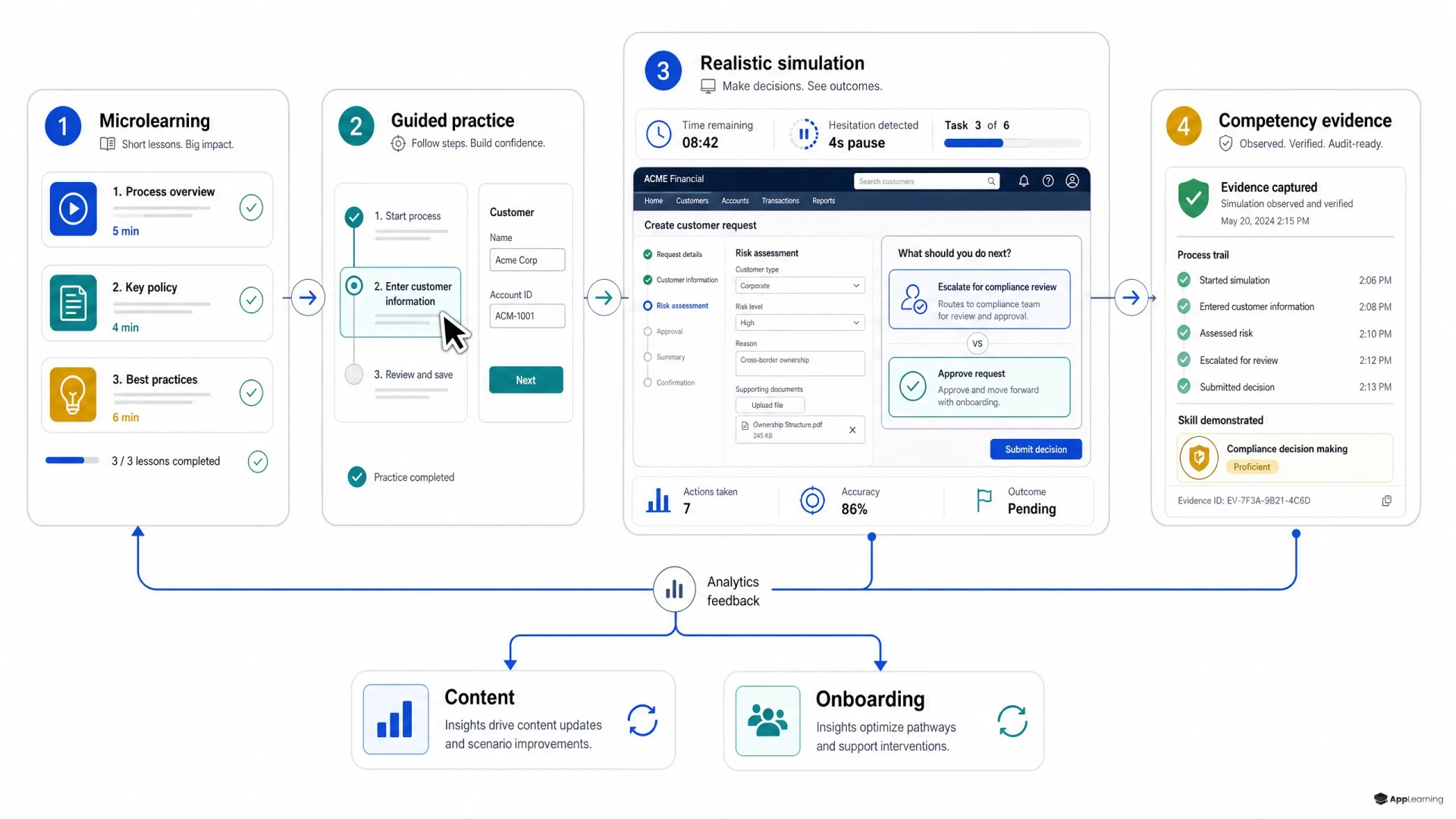
Microlearning still has an important job. It establishes the mental model before a learner enters a complex task. A strong academy links three layers: concise instruction for the rule or feature, guided practice for execution, and certification for independent performance. When the product or policy changes, the same chain identifies who needs a short update, who needs another simulation, and who remains certified.
This structure also keeps content production manageable. Build each scenario around one role, one workflow, a defined success condition, and a small set of observable behaviours. Tag it to the relevant product version and policy version. A customer education platform can then use the same model for employees, partners, or customers while applying different scenarios, access rules, and certification thresholds.
Good to know
Which workflows need simulations first?
Start with high-risk, high-frequency, or fast-changing workflows where a wrong sequence can affect compliance, customers, or operational quality.
Can simulations replace compliance training?
No. They extend compliance training by testing whether learners can apply the required process in a realistic task.
How should certification use simulation results?
Use defined performance criteria, assessment-mode scenarios with limited help, and human review for ambiguous or high-stakes outcomes.
Analytics should drive intervention, not surveillance
Product teams should capture only data that supports a decision. The core measures are independent task completion, critical-control accuracy, time to first correct action, hint dependency, error recovery, and recurring failure patterns by role, cohort, product version, or workflow step. These measures show where the academy needs better instruction, where the interface causes confusion, and where a process itself may need redesign.
Set governance before deployment. Define who can see individual performance, how long data is retained, which results can support certification, and how learners can challenge an incorrect score. The aim is capability building. If the system feels like opaque employee monitoring, learners will optimise for the metric instead of learning the work.
Build the prove-it layer into your academy.
PlanThe prove-it stack starts with usable learning
App-Learning fits at the layer that makes the system usable at scale. It can turn policy updates, product releases, and role-specific procedures into engaging microlearning journeys with measurable rollout. Those journeys should then lead into the right task environment, where learners demonstrate the workflow and teams see where support is still needed.
The objective is not to replace every course with a costly digital twin. It is to add simulations where failure is expensive, the workflow is complex, or a quiz creates false confidence. For regulated organisations, that shift turns learning from a completion obligation into operational evidence of competence.