

Key takeaways
- Product tours guide immediate actions but rarely build durable understanding.
- Customer academies teach context, workflows, and decision-making over time.
- Complex financial products need education where misunderstanding creates risk or hesitation.
- Use tours and academies together instead of forcing one format to do both.
- App-Learning embeds structured learning without pulling product teams into content operations.
The interface is not the lesson
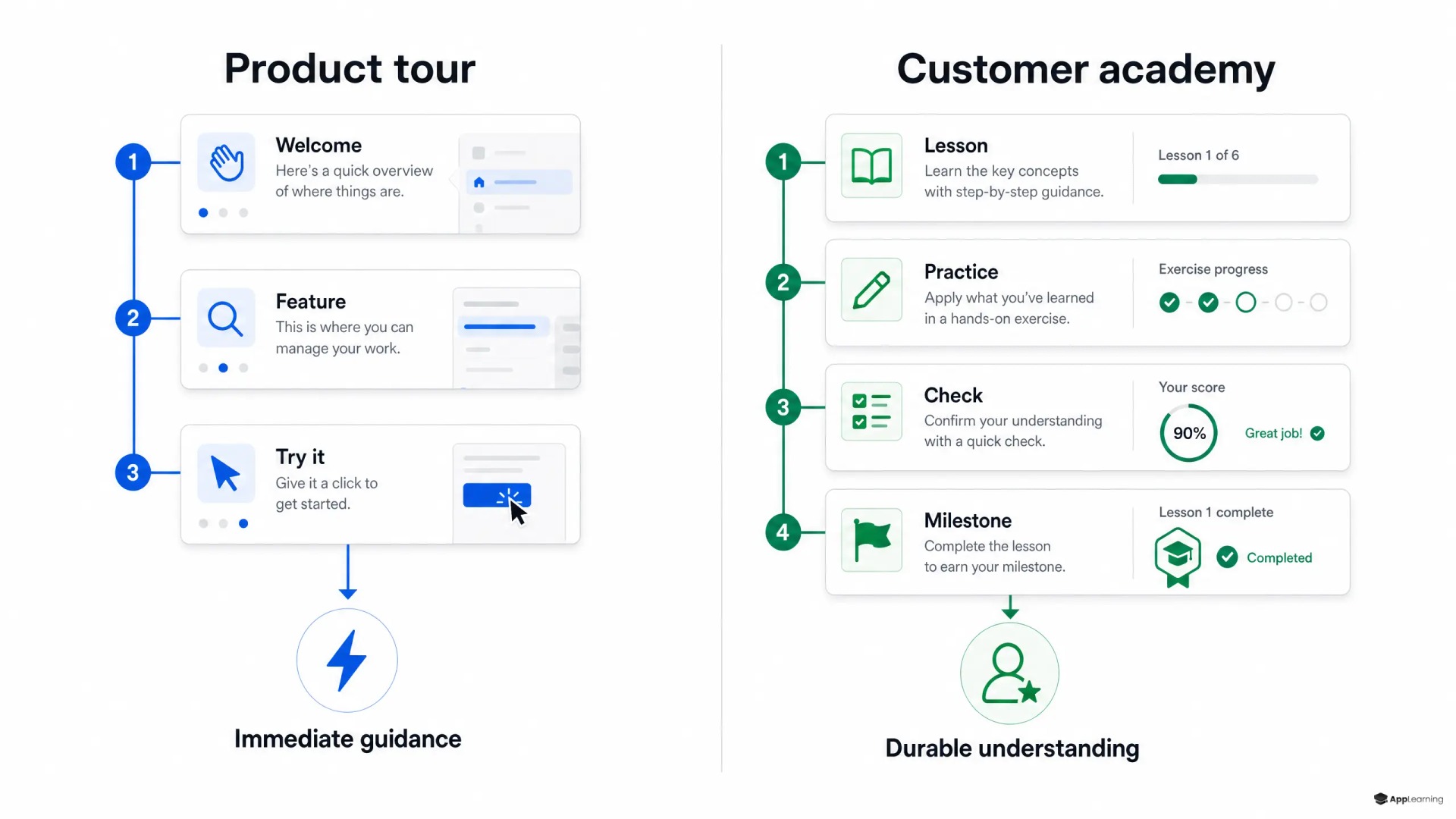
The product tours vs customer academy decision is often framed as a tooling choice. It is not. It is a decision about the kind of learning a user needs before they can act with confidence. A product tour is a short, in-app sequence that points a user toward a task, feature, or first success. As Pendo’s in-app guide example shows, the format is designed to highlight valuable features and speed time to value.
A customer academy has a different job. It is a structured learning environment that helps users build knowledge across concepts, workflows, and levels of proficiency. Skilljar defines a customer academy as a centralized set of structured learning materials, often organized into paths that users can resume and complete over time. The distinction matters because a tooltip can show where a button sits. It cannot reliably explain why a user should choose one financial workflow over another.
Guidance teaches motion, education teaches judgment
Product tours work best when the user already understands the goal and needs help completing it. They can direct first-time setup, draw attention to a new control, or unblock a narrow workflow at the moment of use. The best tours are brief, contextual, and tied to one observable activation event rather than a guided tour of the whole interface.
The product tour vs customer education boundary appears when the user must interpret information before acting. In fintech, that may include custody choices, transaction status, verification steps, pricing logic, risk disclosures, security settings, or advanced trading and savings features. These are not only navigation problems. They are judgment problems. Users need a mental model, examples, and a way to check their understanding before they move money or commit to an unfamiliar workflow.
- Use product tours for a single next action, feature discovery, and contextual reminders.
- Use customer education for concepts that recur across journeys and cannot be understood in one screen.
- Add knowledge checks when mistaken understanding creates financial, compliance, or support risk.
- Create role-, market-, and language-specific paths when the same product serves different user needs.
The complexity threshold
A customer academy becomes necessary when product knowledge is no longer disposable. If users need the same explanation before onboarding, before using a high-value feature, and again when support is involved, the company has a reusable learning problem. Static help content may answer isolated questions, but it does not create a managed path from basic orientation to confident use.
This is especially clear when a product team sees the same pattern in its data: users finish account setup but do not take the first meaningful action; advanced features remain unused; support handles the same conceptual questions; or market expansion creates repeated translation and review work. Each signal points to a missing education layer, not simply a missing tooltip.
The embedded academy layer
A customer academy should not become a detached course catalog that users must remember to visit. It should sit close to the decision point. A lesson on security belongs beside security setup. A short module on an investment mechanic belongs before the related product action. This makes education part of activation, not a separate content destination.
This is where App-Learning fits for product-led fintech teams. The App-Learning academy platform combines short lessons, quizzes, role-based paths, gamified mechanics, analytics, deep links, embeds, and single sign-on. The operating model matters as much as the format: approved product knowledge can be converted into reusable learning modules, reviewed by the right stakeholders, localized, and connected to in-app journeys without turning the core product roadmap into a content-production queue.
Good to know
Can a customer academy replace product tours?
No. An academy cannot point to the exact control a user needs in the current moment. Product tours should handle immediate interface guidance, while the academy explains the concepts and workflows behind the action.
When should a fintech team build a customer academy?
Start when repeated confusion blocks activation, creates support demand, limits advanced feature adoption, or creates risk around high-consequence user decisions. Begin with one journey that has a clear product and learning outcome.
How much content is needed for a first academy?
A first release can be small. Build a focused path around one activation problem, with short lessons, one or two practical scenarios, and a knowledge check. Expand only after reviewing learner and product behavior.
A coordinated onboarding system
Product tours and customer academies work better together. The tour handles immediate interface friction. The academy handles the knowledge that makes the interface meaningful. A tour can invite a user to set up recurring purchases; the linked academy module can explain timing, volatility, execution, and the choices the user must make. One moves the user forward. The other makes that movement informed.
The handoff should be explicit. Trigger a product tour when behavior shows that a user is ready for a task. Link to a focused lesson when the task depends on a concept. Use a quiz or scenario when the team needs evidence of understanding. Then measure both layers: task completion and feature adoption for tours; progression, knowledge gaps, and return behavior for the academy.
Turn product complexity into customer confidence.
TalkThe decision belongs to the job
Choose a product tour when the user needs a fast route through a familiar or low-risk action. Choose a customer academy when the user must understand a system, make a consequential decision, or develop capability over several sessions. Build both when activation depends on immediate action and durable confidence.
The strongest onboarding systems do not try to squeeze a curriculum into tooltips or turn every button click into a lesson. They respect the difference between showing users where to go and helping them know what they are doing. For complex financial products, that difference is where activation becomes trust.