

Key takeaways
- Badges are not a learning strategy.
- Match each game mechanic to one observable learner behavior.
- Feedback and progression loops matter more than competition.
- Learning analytics must connect engagement with understanding, product use and retention.
A badge can make an onboarding flow feel more rewarding. It cannot prove that a customer understands margin, Bitcoin custody, recurring investments or any other complex financial feature. If gamification stops at points, badges and leaderboards, it often measures attention rather than capability.
Badges Can Hide a Broken Learning System
Most teams start with the visible mechanics. They add a progress bar, award points for finishing screens and publish a leaderboard. These elements can prompt a click, but a click is not a learning outcome. The real question is simpler: which customer behavior must change after this experience? That might mean completing identity verification correctly, making a first deposit, configuring a security setting or using an advanced feature with confidence.
Evidence-based gamification begins with that target behavior. It then designs the smallest learning interaction that helps a user perform it. A reward has value only when it reinforces meaningful practice, signals real progress or brings the next useful action into reach.
Engagement Is Not Behavioral Change
Gamified learning can improve outcomes, but the evidence does not support a universal recipe. The 2020 meta-analysis behind the featured statistic examined 14 design elements and found that their effects differed. For product teams, that is the operational lesson: do not copy a mechanic because it worked in another app. Test whether it changes the specific behavior that drives activation, feature adoption or learning retention.
Competition is a clear example. It may suit a voluntary challenge for experienced users. It can also distract a new customer who needs private, low-risk practice before taking action with money. In fintech product education, visible ranking is rarely the core mechanism. Clear goals, safe practice and immediate correction usually matter more.
Learning Loops Create the Product Habit
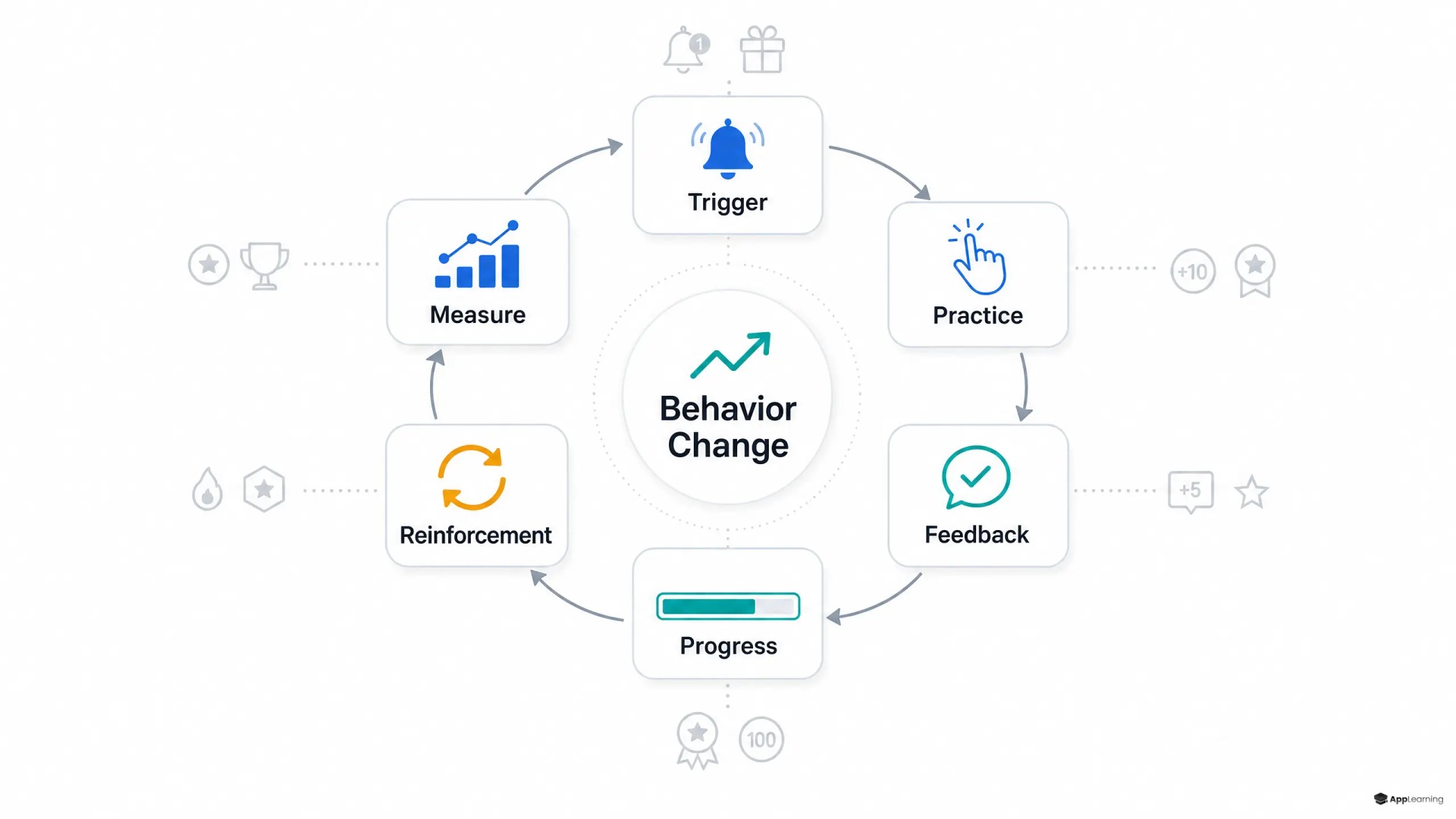
A learning loop turns a one-time content interaction into a repeatable path from uncertainty to competent action. It should be short enough to fit an in-app moment and rigorous enough to reveal whether the learner can apply the concept.
- Trigger: surface help when a user reaches a relevant product decision or friction point.
- Practice: ask the user to choose, calculate, classify or simulate a realistic action.
- Feedback: explain why an answer works and correct the misconception immediately.
- Progression: unlock the next concept only after the learner demonstrates readiness.
- Reinforcement: bring back essential knowledge later through brief retrieval and repeat practice.
- Transfer: connect the completed learning step to a safe, relevant product action.
This structure is grounded in more than game design. A review of effective learning techniques rated practice testing and distributed practice as high-utility approaches. Gamified learning gives product teams a practical interface for delivering both without asking users to enter a separate training environment.
Good to know
Are badges ever useful in gamified learning?
Yes. Badges work best as markers of meaningful progress, not as substitutes for practice, feedback or demonstrated understanding.
Which mechanic should a fintech team build first?
Start with a short practice-and-feedback loop around the product action that has the highest activation or support impact.
How can teams prove learning affects retention?
Track learning exposure, knowledge performance and subsequent feature use in comparable customer cohorts over defined time periods.
Analytics Must Follow the User Into the Product
Completion rate is necessary, but it is not enough. A learner can finish every module while guessing through each quiz and never using the feature. The measurement system must follow the loop from entry to demonstrated understanding to product behavior.
- Activation rate from learning start to the intended product action
- Step-level completion and drop-off within each learning journey
- Quiz accuracy, error patterns and confidence checks
- Return frequency and repeat practice after the first session
- Feature retention in defined customer cohorts after learning exposure
Treat these metrics as a chain, not a dashboard of isolated numbers. If completion rises but quiz accuracy falls, the flow may be too easy or too fast. If accuracy is high but feature use does not move, the lesson may lack a clear transfer step. Feedback needs the same scrutiny: a meta-analysis of 435 studies found that its effects vary, which is why generic “correct” messages are not a serious learning design.
Build learning loops that turn product complexity into confident action.
Talk to usFintech Education Belongs Inside the Journey
For fintech product education, the best loop starts with a real customer job rather than a content catalogue. A user considering a recurring purchase needs a short explanation, a choice, a consequence and a clear next step. Someone setting up security needs guided practice before the setting is saved. Each loop should use product language, reflect the brand and work across web and mobile without forcing the core product team to maintain a parallel education platform.
The App-Learning approach applies this system through embedded, multilingual learning journeys, modular content production and analytics that expose knowledge gaps. The point is not to make finance feel like a game. It is to give customers enough successful, verified practice to use a complex product with confidence—and to prove that education is improving activation and retention.