

Key takeaways
- Regulation increases the need for clear customer education.
- Risk disclosures should become guided product journeys.
- Crypto education can reduce support load and trust friction.
- Product teams should measure whether users understand key risks.
The rulebook moves risk into the journey
The FCA crypto rules are not just another compliance update. In its June 2026 announcement, the FCA said firms that help people buy, trade and hold crypto will need to meet standards for financial resilience, capital, stress testing, market integrity and stablecoins.
The new regime is due to come into force on 25 October 2027, with an authorisation window opening before then. This is not legal advice. The operational point is simpler: regulated crypto products will need to prove that risk is not only disclosed, but made understandable in the moments where customers decide what to do.
Disclosure alone creates a false sense of control
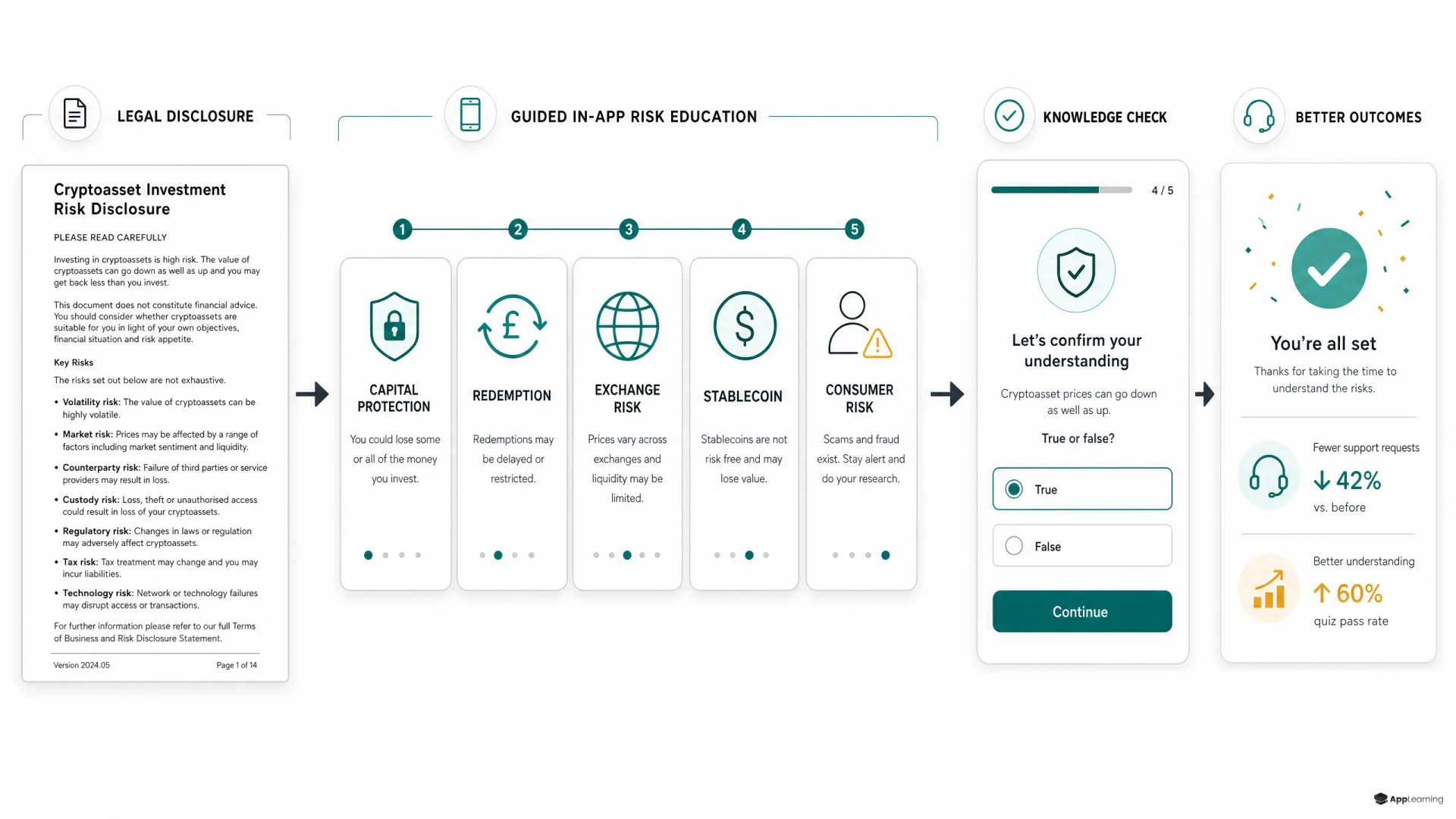
A PDF can prove that information was shown. It does not prove that a customer understood it. The FCA’s crypto Consumer Duty guidance links customer responsibility to communications that help people understand products, features, risks and the implications of their decisions across the lifecycle.
That changes the design brief for crypto risk disclosure. A beginner may see a warning, pass a quiz and still not know whether capital is protected, how exchange execution works, what happens if a wallet address is wrong, or why a stablecoin is not the same product as Bitcoin.
For a Bitcoin company, this is where Bitcoin customer education becomes part of product architecture. The user needs plain explanations before the first buy, before a withdrawal, before a recurring purchase, before a wallet transfer and before a support ticket becomes frustration.
Education belongs at the point of friction
The right model is not an academy hidden in the footer. The right model is contextual crypto product education that appears when the user is about to take an action with risk attached.
- Onboarding explains custody, volatility, capital risk and the role of the firm.
- Asset selection distinguishes Bitcoin, stablecoins, staking, yield and other crypto products.
- First transaction flows explain spread, fees, volatility and execution timing.
- Wallet flows explain custodial balances, withdrawals, self-custody and address mistakes.
- Redemption and exit flows explain selling, withdrawing, stablecoin redemption, delays, fees and suspension cases.
- Support turns repeated beginner questions into short guided lessons inside the app.
Stablecoins show the shift clearly. The FCA’s stablecoin issuance rules deal with claims, redemption, transparency and informed decision-making. Product teams should translate those concepts into screens that users can act on, not dense copy that only lawyers can parse.
Compliance friction can become activation design
Many teams will treat the FCA crypto rules as friction. Legal writes the text. Product places it somewhere in the journey. Growth watches activation fall. Support absorbs the confusion.
A better approach is fintech compliance education. The product explains the concept, checks understanding, gives the user a safe next step and records evidence that the flow worked. This does not remove risk. It makes the risk visible enough for the customer to decide.
At App-Learning, this is the design pattern we see work in complex financial products: short modules, scenario-based checks, progress mechanics, localisation-ready content and analytics tied to product events. The goal is not to make Bitcoin look simple. The goal is to make the next action understandable.
Good to know
Is this legal advice for crypto firms operating in the UK?
No. This is a product and learning systems perspective on regulatory change. Crypto firms should work with qualified legal and compliance advisers on their specific obligations.
What is the main product implication of the FCA crypto rules?
The main implication is that risk communication needs to move from static disclosure into the product journey, especially during onboarding, asset selection, wallet actions, redemptions and support.
Where should Bitcoin customer education sit inside the product?
Bitcoin customer education should sit at the moments where users hesitate or take risk, including first purchase, recurring buy setup, custody selection, withdrawals and self-custody flows.
How can product teams reduce support load with education?
Teams can map repeated support tickets to short in-app lessons, then trigger those lessons before the user contacts support or makes the same avoidable mistake.
The metrics that show understanding
The product question is not whether the user saw the warning. The product question is whether the user can explain the risk well enough to use the product responsibly.
- Completion rate for risk modules by segment and market.
- Accuracy on key concepts after onboarding and before high-risk actions.
- Self-reported confidence before first buy, wallet withdrawal or stablecoin redemption.
- Support deflection on private keys, failed quizzes, redemptions, failed orders and account limits.
- Activation after education, including first transaction and recurring buy setup.
- Retention after first transaction for users who completed learning versus users who skipped it.
- Drop-off at risk gates where friction protects the customer and the firm.
These metrics give product, compliance and support a shared operating language. They also make education maintainable. When a rule changes, a product launches or a new market opens, the learning layer can be updated without rebuilding the whole journey.
Build safer Bitcoin journeys with embedded education.
TalkThe product system around the rulebook
The UK rule shift does not make crypto safe. It forces product teams to be more honest about complexity inside the customer journey. The strongest Bitcoin and crypto companies will not treat education as compliance packaging. They will build a learning layer that explains risk, checks understanding, adapts to knowledge level and leaves evidence. That is how crypto risk disclosure becomes customer trust without pretending regulation removes the risk.